
Memory is the New Oil
AUTHOR
Robert M. Almeida
Portfolio Manager and Global Investment Strategist
In brief
- AI development is currently constrained by high-speed memory (DRAM) shortages and surging prices, leading to increased capital intensity.
- Elevated memory costs impact not only AI and cloud companies, but also a wide range of industries reliant on semiconductors, potentially raising prices or compressing margins for products like smartphones, autos, and consumer appliances.
- This environment favors active management and bottom-up analysis, as companies with structural advantages and pricing power are better positioned to withstand input cost pressures than those whose products are easily substituted.
Historically, major technological shifts eventually encounter bottlenecks. In the 19th century, the expansion of railroads was constrained not by the demand for transport, but by the availability of steel and capital. In the early 20th century, electrification — and later, the automobile — was limited at various points by access to copper and energy. In the 1990s, broadband deployment was gated by the fiber buildout, and in the early cloud era, growth was constrained by data center capacity.
In the current AI cycle, the most visible bottleneck has been the availability of GPUs and compute capacity. More recently, however, memory has also emerged as constraint. Specifically, high-speed memory, or DRAM, which enables the rapid processing of data, has become a critical input in AI systems. This is shown by the remarkable price hikes in various DRAM configurations and specifications over recent months, with increases ranging from 400% to 2,400% (Exhibit 1).
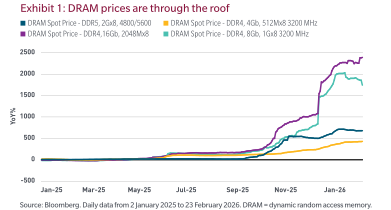
This is not a marginal issue; AI systems rely heavily on massive amounts of high-speed memory. During both training and inference, AI models rely on short-term, high-speed memory (which is embedded in GPUs) to deliver the bandwidth required to process tokens in real time. Put simply, the performance of AI systems has become increasingly memory-bound.
In advanced DRAM, capacity additions are capital intensive, technologically complex, and slow to ramp. Even if demand were to moderate from current levels, it may take years for the supply to fully normalize. In the meantime, elevated pricing is a rational market response and seems unlikely to fall.
The implications of high memory prices extend beyond AI
Semiconductors sit at the core of nearly every modern product, from smartphones and autos to industrial machinery and consumer appliances. When memory prices rise meaningfully and persistently, the cost pressure does not remain isolated to the cloud or the neo-cloud companies building AI clusters — it bleeds into the broader ecosystem. This bottleneck has downstream effects, which we have generalized into two groupings below.
First, it raises the cost of the AI buildout itself, which partially explains the significant acceleration in planned AI capital expenditures. In any industry, when the input cost of a critical component rises, typically either the expected return profile must adjust, or the timeline required to achieve those returns must extend. Elevated memory prices effectively increase the capital intensity of AI investment, which could raise the hurdle rate necessary to justify projects or further delay the point at which free cash flow generation meets investor expectations. If costs remain structurally higher for longer, the return assumptions currently embedded in equity valuations may prove optimistic, not because the opportunity would disappear, but because the path to monetization might prove longer and more difficult.
Second, increased semiconductor input costs will likely gradually pressure the end markets that rely on them: assembly lines, autos, consumer durables, networking equipment. Essentially, anything with embedded chip content (e.g., smartphones, cars, even refrigerators) could see costs move higher. In some cases, pricing power may offset this, but in others, margins may compress, and the difference will matter. When consumers have few alternatives, they are more likely to accept higher prices. Conversely, companies selling products that can be deferred (e.g., durables) or substituted with lower-cost alternatives may deliver profit outcomes below what equity prices have assumed.
The capital cycle at work
As we have written before, what we are observing is a classic capital cycle. The AI buildout is driving a surge in demand for compute, and compute requires memory. Memory supply cannot adjust overnight, however. Prices rise, profits grow, capital follows — and eventually, supply catches up. The question for investors is not whether this cycle exists, but where we are within it, and which businesses are positioned to benefit versus those that will feel a profit squeeze because they cannot pass along higher input costs to customers.
Conclusion
This is precisely the type of environment that rewards fundamental, bottom-up analysis, because index construction does not differentiate between companies that control scarce inputs and those that consume them. It does not distinguish between firms with pricing power and those operating at the margin. Nor does it account for balance sheet resilience in periods of elevating refinancing costs, rising capital intensity, and cost pressures.
Active management, in contrast, can allocate toward businesses with structural advantages in supply access, technological capability, and capital discipline while avoiding those whose earnings are more vulnerable to input cost shocks.
In our view, understanding these links and positioning portfolios accordingly will prove essential as markets begin to reflect on a changed world.
Source: Bloomberg Index Services Limited. BLOOMBERG® is a trademark and service mark of Bloomberg Finance L.P. and its affi liates (collectively “Bloomberg”). Bloomberg or Bloomberg’s licensors own all proprietary rights in the Bloomberg Indices. Bloomberg neither approves or endorses this material or guarantees the accuracy or completeness of any information herein, or makes any warranty, express or implied, as to the results to be obtained therefrom and, to the maximum extent allowed by law, neither shall have any liability or responsibility for injury or damages arising in connection therewith.
Keep in mind that all investments carry a certain amount of risk, including the possible loss of the principal amount invested.
The views expressed are those of the author(s) and are subject to change at any time. These views are for informational purposes only and should not be relied upon as a recommendation to purchase any security or as a solicitation or investment advice. No forecasts can be guaranteed. Past performance is no guarantee of future results.