
Global Market Pulse (EURO)
Leveraging expertise from the MFS Market Insights team to provide timely perspectives on economic and market dynamics that are top of mind for clients.
Market Insights Team
KEY TAKEAWAYS
|
Economy & Markets
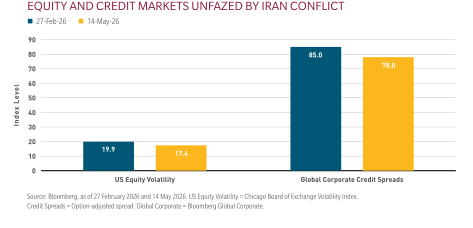
| Measures of volatility lower than pre-war levels |
MFS PERSPECTIVE
|
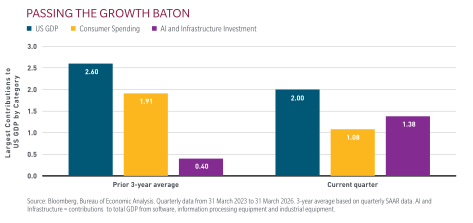
| Consumer-led growth transitioning to corporate growth |
MFS PERSPECTIVE
|
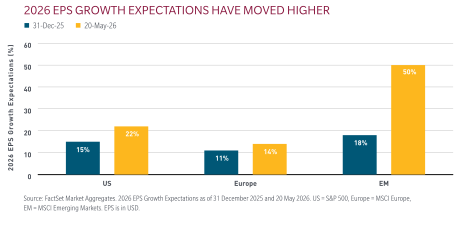
| Stronger earnings outlook supporting equities |
MFS PERSPECTIVE
|
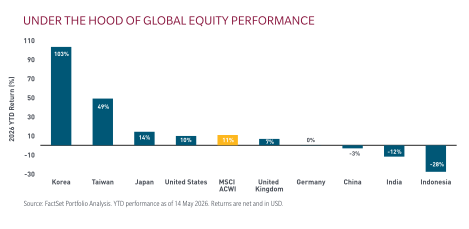
| Broader return divergence reinforces need for selective positioning |
MFS PERSPECTIVE
|
Global Developed Equity - US
Euro based
| US |

• UNDERWEIGHT • NEUTRAL • OVERWEIGHT
|
| MFS CONSIDERATIONS |
| LARGE CAP |
|
| SMALL/MID CAP |
|
| GROWTH |
|
| VALUE |
|
Global Developed Equity - Ex US
Euro based
• UNDERWEIGHT • NEUTRAL • OVERWEIGHT
| EUROPE EX UK |

- Earnings are holding up, but markets continue to slowly de-rate.
- Europe remains hostage to Iran risk, squeezing growth and keeping inflation sticky.
- Limited AI exposure may leave Europe behind if leadership stays narrow.
| MFS CONSIDERATIONS |
- German fiscal support should offer a modest tailwind.
- Energy pressure may create a more challenging backdrop for demand and margins.
- When tensions ease, Europe could be well placed to see sentiment improve.
| UK |

- Faces slower growth and margin pressure.
- Returns are being led by banks, energy and materials.
- Consumer and health care exposure remain less supportive.
- Markets are reacting more to policy than earnings.
| MFS CONSIDERATIONS |
- Sector leadership may help cushion a softer economic backdrop.
- The UK is increasingly trading as a policy and rates story, not just an earnings story.
- If confidence in policy settings improves, sentiment could follow.
| JAPAN |
- Higher rates and reflation support earnings, but returns are uneven.
- Corporate reform and shareholder payouts remain supportive.
- Earnings growth remains intact, led by global demand and domestic capex.
| MFS CONSIDERATIONS |
- As dispersion widens, we favor companies with pricing power and durable earnings.
- Higher rates may continue to underpin financials and other domestic cyclicals.
- Policy support, capital spending and shareholder returns remain key supports.
Emerging Markets
Euro based
• UNDERWEIGHT • NEUTRAL • OVERWEIGHT
| EM EQUITY |
- The opportunity is broad, but less uniform.
- Taiwan and South Korea have overtaken China as AI capex lifts semiconductor leaders.
- Dispersion is widening between markets with energy access and those facing shortages.
| MFS CONSIDERATIONS |
- EM still offers growth but expect more volatility.
- Balance growth with countries that can absorb higher energy costs.
- AI leadership may support returns, but it can also narrow diversification across portfolios.
| EM DEBT - HARD CURRENCY |
- EM’s increasingly developed fiscal and monetary frameworks leave it better able to absorb Iran war shocks.
- Spreads remain tight but valuations are attractive on a total-yield basis.
| MFS CONSIDERATIONS |
- EM debt has shown remarkable resilience amid ongoing geopolitical shocks.
- Fundamentals are sound and fund flows positive, supporting tight valuations.
- However, country selection is key given the idiosyncratic nature of the asset class.
| EM DEBT - LOCAL CURRENCY |
- Iran-driven EM currency weakness is a setback to otherwise strong recent returns.
- The room for EM currencies to appreciate against the EUR is limited, in our view.
| MFS CONSIDERATIONS |
- A more tactical asset class by nature, swings in global risk sentiment can provide periods of challenge and opportunity.
- Watch any longer-term impacts to global inflation expectations, which could alter the duration backdrop.
BLANK
Global Fixed Income
Euro based
• UNDERWEIGHT • NEUTRAL • OVERWEIGHT
| USD DURATION |

- In response to the Iran war, the markets have priced out Fed rate cuts.
- Although the US is more insulated from energy shocks, already sticky inflation is likely to remain elevated and could see more upward pressure.
| MFS CONSIDERATIONS |
- The Fed may initially look through a supply shock but over time must balance inflation risks against demand destruction.
- A finely-balanced labor market will heavily shape future rate decisions.
| US IG CORP |
- Corporate fundamentals remain strong, with elevated margins, rising free cash flow and steady leverage.
- Earnings beats have outpaced misses despite uncertainty.
- Spreads remain tight, but support US IG well versus purely rate-driven asset classes.
| MFS CONSIDERATIONS |
- With spreads tight everywhere, we remain favorable toward US IG, preferring higher-quality asset classes.
- IG corporate yields remain above their 10-year average, which should continue to support investor demand.
| EURO IG CORP |
- The energy shock hurts inflation and growth. The near term is manageable, but higher prolonged oil prices will strain business and consumers.
- Fundamentals remain strong and will cushion some of the impact, but tight spreads do not compensate for the current risk backdrop.
| MFS CONSIDERATIONS |
- A higher-inflation and lower-growth environment could pose challenges for credit returns, favoring managers with strong security selection and risk management.
| EURO DURATION* |
- The ECB has completed its cutting cycle, leaving current valuations uncompelling.
- Europe faces greater energy supply risks, and markets have priced in rate hikes due to the inflationary effects of the closure of the Strait of Hormuz.
| MFS CONSIDERATIONS |
- While the inflation outlook has weakened, the market-implied pricing of future tightening may be excessive.
- A significant growth slowdown could limit future rate hikes.
| US HIGH YIELD |
- Geopolitical uncertainty has hurt sentiment, driving negative fund flows.
- After early widening, spreads are now tighter than pre-conflict levels.
- Fundamentals remain sound, with leverage, margin and free cash flow near historical averages.
| MFS CONSIDERATIONS |
- With valuations rich and technicals weak, we favor IG over HY.
- We prefer sectors such as financials while steering away from secularly challenged industries.
- Dispersion is low, so security selection is key.
| EURO HIGH YIELD |
- Iran-related energy supply concerns have contributed to YTD outflows and marginally wider credit spreads.
- While defaults and distressed ratios remain contained, elevated-for-longer energy and commodity prices could pose challenges for high yield.
| MFS CONSIDERATIONS |
- Fundamentals have softened, but from a strong base.
- We still prefer “up in quality” for credit given the current macro and geopolitical landscape.
- We favor US high yield over Europe given a larger opportunity set.
BLANK
The views expressed herein are those of the MFS Strategy and Insights Group within the MFS distribution unit and may differ from those of MFS portfolio managers and research analysts. These views are subject to change at any time and should not be construed as MFS’ investment advice, as portfolio positioning, as securities recommendations, or as an indication of trading intent on behalf of MFS.
The Global Market Pulse leverages the firm’s intellectual capital to provide perspective on broad market dynamics that are top of mind for asset allocators. We celebrate the rich diversity of opinion within our investment team and are proud to have talented investors who may implement portfolio positions and express different or nuanced views to those contained here, which are aligned to their specific investment philosophy, risk budget and entrusted duty to allocate our client’s capital responsibly.
Index data source: MSCI. MSCI makes no express or implied warranties or representations and shall have no liability whatsoever with respect to any MSCI data contained herein. The MSCI data may not be further redistributed or used as a basis for other indices or any securities or financial products. This report is not approved, reviewed or produced by MSCI.
Frank Russell Company ("Russell") is the source and owner of the Russell Index data contained or reflected in this material and all trademarks, service marks and copyrights related to the Russell Indexes. Russell® is a trademark of Frank Russell Company. Neither Russell nor its licensors accept any liability for any errors or omissions in the Russell Indexes and/or Russell ratings or underlying data and no party may rely on any Russell Indexes and/or Russell ratings and/or underlying data contained in this communication. No further distribution of Russell Data is permitted without Russell's express written consent. Russell does not promote, sponsor or endorse the content of this communication.
“Standard & Poor’s®” and S&P “S&P®” are registered trademarks of Standard & Poor’s Financial Services LLC (“S&P”) and Dow Jones is a registered trademark of Dow Jones Trademark Holdings LLC (“Dow Jones”) and have been licensed for use by S&P Dow Jones Indices LLC and sublicensed for certain purposes by MFS. The S&P 500® is a product of S&P Dow Jones Indices LLC, and has been licensed for use by MFS. MFS’ Products are not sponsored, endorsed, sold or promoted by S&P Dow Jones Indices LLC, Dow Jones, S&P, or their respective affiliates, and neither S&P Dow Jones Indices LLC, Dow Jones, S&P, their respective affiliates make any representation regarding the advisability of investing in such products. BLOOMBERG® is a trademark and service mark of Bloomberg Finance L.P. and its affiliates (collectively “Bloomberg”). Bloomberg or Bloomberg’s licensors own all proprietary rights in the Bloomberg Indices. Bloomberg neither approves or endorses this material, or guarantees the accuracy or completeness of any information herein, or makes any warranty, express or implied, as to the results to be obtained therefrom and, to the maximum extent allowed by law, neither shall have any liability or responsibility for injury or damages arising in connection therewith The views expressed are subject to change at any time.
These views should not be relied upon as investment advice, as portfolio positioning, as securities, recommendations or as an indication of trading intent on behalf of the advisor. No forecasts can be guaranteed.