
Factor Dynamics Through the Cycle
AUTHOR
Jed Stocks, CFA
Portfolio Manager
Jeffrey D. Morrison, CFA
Institutional Portfolio Manager
Evelyn Baranski
Quantitative Research Associate
Sophie Ye
Senior Quantitative Research Associate
In brief
- Our analysis of factor dynamics through the US economic cycle indicates that fluctuations in economic activity and economic cycle phases can be relevant to factor performance.
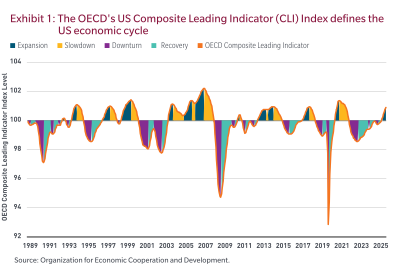
- We use the US OECD Composite Leading Indicator (CLI), a well-established and widely followed index, to define economic cycles.
- For the time horizon analyzed, the OECD identifies four distinct phases – Recovery, Expansion, Slowdown and Downturn — whose magnitude and duration can vary.
- Our analysis illustrates how broad investment factors such as Valuation, Momentum, Size and Low Volatility perform, depending on the economic conditions and where we are in the cycle.
Many well-known investment factors have proved durable in contributing to investment returns. Empirical research indicates that in short and intermediate time horizons different fundamental attributes (factors), styles and sectors work at different points in the US economic cycle. The following analysis on cycle dynamics may provide insight into the interaction between macroeconomic variables and market performance drivers, the degree to which certain factors display persistence through the cycle, and the extent to which they have low correlation to other factors.
We use monthly data from the Organization for Economic Co-Operation and Development's US Composite Leading indicator index from October 1995 through February 2026 to help us as we discuss the four phases of the business cycle.
Phases identified in the analysis
The results are largely intuitive and match typical risk on/risk off conditions evident in other methods for defining US cycles. Each US cycle encompasses four distinct phases:
- Recovery - Index is below 100, but trending up.
- Expansion – Index is trending up and above 100.
- Slowdown – Index is above 100 but trending down.
- Downturn – Index is below 100 and trending down.
Although economic cycles have similarities, each one is unique. The US OECD CLI shows that the phases do not always occur in the same order. The index also captures the smaller cycles that may occur within each full cycle. The impact of US Federal Reserve's rate policies likely played a significant role.
We calculated the performance of nine broad investment factors through these historical cycles defined by the OECD CLI. A full description of each factor can be found at the end of the paper.
- Dividend Yield - the annual dividend paid per share divided by the share price.
- Earnings Revisions - earnings forecast revisions for the next 12 months.
- Leverage - debt to equity, assets to equity, current, quick, and interest coverage ratios. Low Volatility - standard deviation of total returns over various time horizons.
- Market Beta - a stock's return volatility in relation to the market return.
- Price Momentum - the total return of a stock over the last 12 months less the last month's total return.
- Profitability - profits as a % of assets and equity, gross, net and operating margins, return on invested capital.
- Size - market capitalization of the stock.
- Value - price to book, price to earnings, dividends, free cash flow, and earnings yield
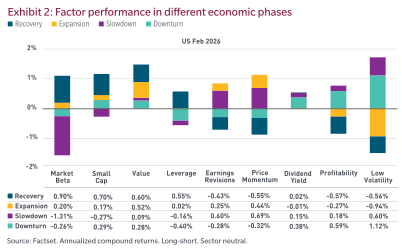
There are a number of metrics that could be helpful in evaluating the historical performance of each factor at the different stages of the economic cycle. Within our analysis the mean return, adjusted t-stat, and hit rates for these factors were used to determine the phases in which those factors were in or out of favor. Exhibit 2 shows the factors that have shown stronger returns in the Recovery and Expansion phases (Market Beta, Small Caps, and Value) on the left and those that have shown stronger returns in the Slowdown and Downturn phases (Low Volatility, Profitability, and Price Momentum) on the right.
An illustration of the US cycle and factor performance is shown in Exhibit 3. It demonstrates how the performance leadership of factors has typically rotated as the US economy shifts from one phase to the next.
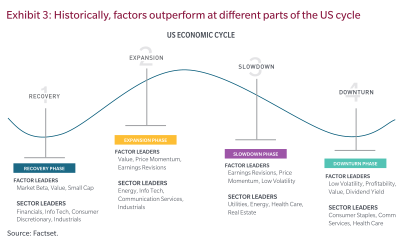
From Exhibit 3 we can infer the following:
- In the average Recovery phase - the Market Beta, Small Cap, and Value factors tended to perform best, while the Profitability, Low Volatility, Price Momentum and Earnings Revisions factors showed the weakest mean returns.
- In the average Expansion phase - the Value, Price Momentum and Earnings Revisions factors showed strong mean returns, while Low Volatility showed the lowest mean returns.
- In the average Slowdown phase – the Earnings Revisions, Price Momentum, and Low Volatility factors performed best, while Market Beta showed the weakest mean return.
- In the average Downturn phase – the Low Volatility, Profitability, and Value showed the highest mean returns, while Market Beta and Leverage factors experienced the lowest mean returns.
Key takeaways from our analysis
- The relationship between US cycles and factor performance is evident.
- Certain factors exhibit more extreme positive or negative mean returns in the downturn phase compared to their mean returns in the other phases.
- An analysis such as this one can help in defining market conditions and explaining factor cycles.
Investors should be aware of the potential disconnects between factors and economic indicators that are bound to arise over time.
These results provide a view on prior US economic cycles and an important context for explaining past factor performance. We will use the framework of our analysis as a foundation for future insights pieces in which we examine individual factor themes in more detail.
Assumptions and Methodologies
The OECD Composite Leading Indicator (CLI) is an aggregate time series displaying a reasonably consistent leading relationship with the reference series for the business cycle in a country (GDP). The CLI is constructed by aggregating together component series selected according to multiple criteria, such as: economic significance, cyclical correspondence and data quality. As a result of the multi-criteria selection process the OECD CLI can be used to give an early indication of turning points in the reference series although it may not be suitable for quantitative forecasts (see OECD System of CLIs). The OECD CLIs are compiled and published on a monthly basis.
The index was first created in the 1970's and since that time has been generally accepted as a way to assess economic movements. The series is designed to reflect the "output gap" which is difference between actual GDP and potential GDP as a percent of potential GDP. This indicator provides signals of turning points in economic activity.
Turning points are identified using a base value of 100 at the start of the period analyzed and the cycle phases were determined by whether readings are above or below this level as well as the general direction of the trend
Factor Definitions
Value: an equal-weighted composite of the following factors
Book to Price per Share The ratio of the company’s book value (the sum of shareholders’ equity plus accumulated retained earnings from the P&L account) to its share price. This factor has been one of the most successful measures of the intrinsic value of company shares.
Earnings Yield Annual earnings (adjusted for amortizations of intangibles, extraordinary charges and credits) per share divided by the share price. This factor measures the worth of a company’s shares according to the company’s ability to support each share with after tax earnings.
Cash Flow Yield Annual cash flow per share divided by the share price. This factor is related to earnings yield but also includes other items, specifically: depreciation, amortizations, and provisions for deferred liabilities. It is intended to capture the cash availability of the company as a multiple of the share price, and offers a value criteria based on the stream of accessible cash earnings.
Sales to Price Net sales per share divided by the share price. This factor measures the worth of a company’s shares according to the annual sales volume supporting the company business. The item is considered by many analysts to be less susceptible to manipulation than other valuation criteria; it is, however, a less comprehensive measure of a company’s range of activities.
EBITDA to Enterprise Value Used to evaluate a company’s return on investment (ROI) by comparing its earnings before interest, taxes, depreciation, and amortization (EBITDA) to its enterprise value (EV).
Forecast Earnings Yield The consensus 1 year forecast annual earnings per share divided by the share price.
Free Cash Flow Yield Annual cash flow per share minus capital expenditure per share divided by the share price. Free Cash Flow is the amount of money available to the company after paying out for the maintenance and renewal of fixed assets.
Price Momentum: Composite of high total return for one year and six months.
Profitability: an equal-weighted composite of the following factors
Return on Equity Net income before preferred dividends divided by the book value of shareholders’ common equity. Return on Equity measures the profitability of the operations of the company as a proportion of the total amount of equity in the company. Since ROE multiplied by the reinvestment rate (the proportion of earnings not paid as dividends but reinvested in the company) gives the warranted growth rate of a company, ROE is a traditional measure of a company’s growth potential.
Return on Invested Capital (Net income + ((interest expense on debt - interest capitalized) * (1-tax rate))) / average of last year’s and current year’s (total capital + short term debt & current portion of long term debt). The Return on Invested Capital (also known as Return on Capital) measures the profitability of a company as measured by its operating income in relation to the total capital invested in the company.
Return on Assets (Net income + ((interest expense on debt - interest capitalized) * (1-tax rate))) / average of last year’s and current year’s total assets. The Return on Assets (ROA) of a company measures its operating efficiency in terms of the profits generated from its total assets. This provides a measure as to how efficient management is at using its assets to generate operating earnings.
Gross Profit Margin Gross profit divided by net sales. Gross profit may be preferred as an alternative over earnings or free cash flow to consider a company’s true economic profitability without subtracting expenses that may in fact be increasing a company’s production advantage or competitive advantage e.g. advertising, R&D, or capital expenditure.
Operating Profit Margin Operating income/revenues. Operating margin measures the profitability of the firm based on earnings before interest and tax.
Dividend Yield: The annual dividend paid per share divided by the share price. This factor measures the value of company shares according to the stream of dividend income resulting from share ownership.
Earnings Revisions: Calculated as the percentage change in the average earnings estimate for the next 12 months based on a weighted average of FY! and FY2 estimate revisions.
Leverage: an equal-weighted composite of the following factors
Debt to Equity Total debt as a percentage of total common equity. The Debt to Equity ratio measures leverage, or gearing, a particular feature of share price risk. The higher the ratio the more changes in a company’s fortune might be reflected in changes in the payment of dividends. The influence of this criterion is, however, especially subject to a number of particular specific considerations (e.g. sector differences, interest rate sensitivity). Consequently it is considered separately from the other “risk” criteria.
Assets to Equity Total assets divided by common equity. The Assets to Equity ratio is an indicator of how much leverage has been used to finance the firm.
Interest Coverage Ratio (ex-financials) Earnings Before Interest and Taxes (EBIT) divided by the company’s interest on outstanding debt over the previous year. Interest Coverage Ratio indicates how easy it is for a company to service its debt. This factor is not available for financial companies.
Low Volatility: an equal-weighted composite of the following factors
Market Beta The “slope coefficient”, (β), from the simple regression: Security monthly return = a + β * market monthly return + random error. The regression is carried out over 36-month periods. Where sufficient information is not available, β=1 is assumed.
Volatility 3 Months The standard deviation of the last 3 Months months of total returns, expressed as an annualized percentage.
Daily Volatility 1 Year The standard deviation of the last year of daily total returns, expressed as an annualized percentage.
Market Cap (low) The market capitalization as of prior close.
The views expressed are those of the author(s) and are subject to change at any time. These views are for informational purposes only and should not be relied upon as a recommendation to purchase any security or as a solicitation or investment advice. No forecasts can be guaranteed. Past performance is no guarantee of future results.
Diversification does not guarantee a profit or protect against a loss. Past performance is no guarantee of future results