
EM Fixed Income: From Tactical to Strategic
Authors
BENOIT ANNE
Senior Managing Director,
Strategy and Insights Group
WARD BROWN
Fixed Income
Portfolio Manager
KATRINA UZUN
Institutional
Portfolio Manager
Emerging market debt (EMD) has evolved into a strategic component of global fixed income portfolios, reflecting a fundamental shift in both the global macro environment and the underlying characteristics of the asset class.
This transformation is being driven by three structural developments:
- Increasing macro risk in some developed markets
- Stronger emerging market fundamentals and institutional credibility
- EMD gaining credentials as a portfolio diversifier
At a time when global risks are broader, more complex and less geographically contained than in prior cycles, EMD is increasingly positioned as a source of long-term diversification, rather than simply a yield-enhancing allocation.
Our investment philosophy reflects this evolution. We believe that emerging market fixed income should be treated as a strategic allocation and that active management, combined with sound risk management, can enhance EMD’s benefits and generate excess returns through multiple market cycles.
A Regime Shift: Developed Markets Are a Growing Source of Volatility
The global macro landscape is undergoing a meaningful shift. While developed markets (DM) have historically been viewed as the anchor of stability of the global financial system, they have increasingly become a source of higher macro volatility. Trade tensions, elevated policy uncertainty, growing fiscal burdens and sticky inflation have driven large moves in rates and credit spreads. As a result, investors are reassessing the concentration of risk embedded in DM heavy fixed income portfolios.
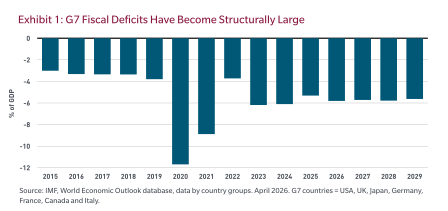
A central theme underpinning this reassessment is the growing concern around debt durability in developed market economies. Rising interest costs, persistent fiscal deficits, and expanding entitlement obligations have intensified scrutiny of sovereign balance sheets across the US, Europe and Japan. Political constraints on fiscal consolidation further complicate the outlook. These dynamics challenge the long held assumption that DM sovereign debt is inherently low risk and raise questions about future volatility, rating trajectories and policy credibility. As illustrated by Exhibit 1, fiscal management has become a major problem in G7 countries, with the US exhibiting one of the most challenged fiscal outlooks in DM.
In Contrast, Emerging Market Fundamentals Have Strengthened Substantially
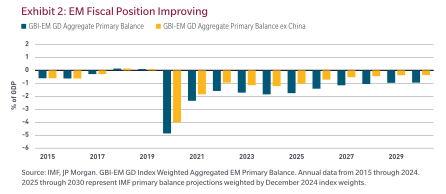
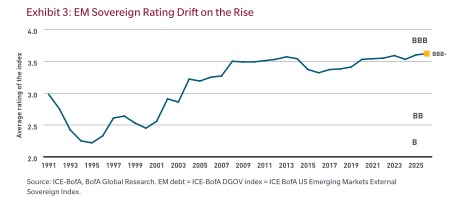
Importantly, emerging markets enter this phase of the cycle from a position of greater strength. Years of more conservative fiscal management, reduced reliance on foreign currency borrowing, and stronger external balances have left several EM sovereigns better positioned to absorb external shocks. We believe EM fiscal adjustment will continue (Exhibit 2). Inflation-targeting frameworks are more established and, in response to post-pandemic inflation, central banks in many EM countries tightened policy earlier than their DM counterparts. This has led to an upside ratings drift, reflecting stronger credit quality as balance sheet metrics and institutional credibility continue to improve across select issuers (Exhibit 3).
The Improved Fundamental Backdrop Has Been Supportive of EM
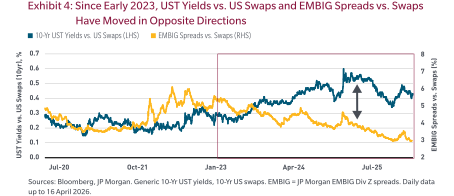
We have observed a number of positive market developments for EM, especially in relation to DM. For instance, EMD spreads over swaps have been on a downward trajectory since early 2023 (Exhibit 4). In contrast, the spread of UST bond yields over swaps has widened during the same period, mainly reflecting the fact that the US fiscal deficit remains very high and the US government debt level continues to climb higher.
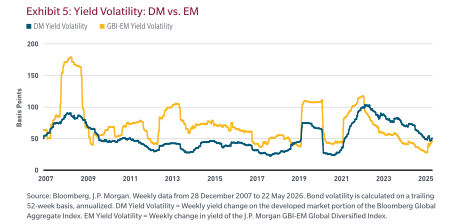
Consistent with these trends, DM yield volatility has increased significantly over the past couple of years. In particular, the safe-haven status of the US treasury market has been challenged in recent months, reflecting some concerns over the credibility of the US policy framework. Against this backdrop, it is worth stressing that EM local debt yield volatility is now markedly lower than that of DM, pointing to a shift of global risks away from EM to DM (Exhibit 5).
The Case for Global Diversification in a Fragmented Risk Environment
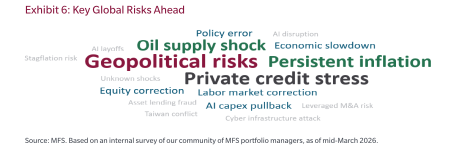
As sources of global risk have multiplied, traditional portfolio diversifiers have become less reliable. Investors are navigating simultaneous challenges and risks, including geopolitical fragmentation, rising fiscal concerns, sticky inflation dynamics, private credit stress, climate related disruptions and demographic pressures (Exhibit 6). This environment has prompted greater appetite for asset classes that can deliver differentiated macro outcomes and sources of risk and return. EMD offers access to a wide range of country specific growth models, policy frameworks and economic cycles, reducing reliance on a narrow set of developed market drivers and introducing macro and market differentiation.
EMD No Longer Simply Amplifies DM Market Risk, It Provides Differentiated Exposure
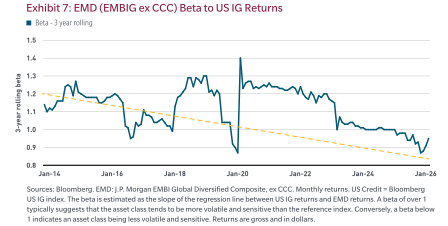
Alongside improving fundamentals, the behavior of emerging market debt within global portfolios has changed. EMD has historically been viewed as a higher-beta asset class. However, it is worth noting that the EMD beta to US IG has been on a declining trend over the past decade and currently stands below 1 (Exhibit 7). The downward shift may reflect a broader and more diverse investor base, deeper local markets and reduced vulnerability to external financing shocks. This change enhances EMD’s role as a portfolio diversifier, allowing investors to express global credit views, rather than simply amplifying US credit risk. We exclude the lowest rated segment of EMD from this analysis, since these credits are primarily driven by idiosyncratic factors, and so have a much lower beta to US IG.
A Strategic Allocation Requires Selective Exposure
As EMD transitions into a strategic role within portfolios, selectivity becomes increasingly important. We believe that the appropriate investment strategy is to favor sovereign credits supported by strong and/or improving fundamentals. Macro stability, the credibility of the policy framework and the strength of fiscal and external positions are key pillars of our fundamental credit selection process. Importantly, our approach avoids EM sovereign markets where macro risks and vulnerabilities do not present an attractive risk-reward profile. The good news is that global EM offers a lot of opportunities to build a diversified portfolio supported by strong fundamentals at this juncture. Our key investment objective is to use country selection based on fundamental analysis to deliver excess returns through a complete investment cycle, with an emphasis on downside risk management.
Risk management is also a critical pillar of our investment process. Given the significance and magnitude of global risks investors are facing, we believe that downside risk management must be a cornerstone of any strategic investment approach to EM fixed income. This is particularly relevant during times of stress or risk aversion shocks, when the EM sovereign credits that are not supported by a robust fundamental position are likely to come under severe market pressure. A focus on fundamental credit quality, combined with active risk management, is essential to navigating these environments effectively.
Conclusion
The global fixed income universe is undergoing a meaningful structural evolution. Developed markets are no longer perceived as a pure anchor of stability, and traditional safe havens are being reassessed. With stronger fundamentals, a more resilient investor base and a structural decline in beta to developed market credit, EMD is increasingly positioned to be a core allocation within global fixed income portfolios. In this evolving global environment, emerging markets debt offers diversified sources of return at a time when diversification is increasingly valuable. For long-term investors, the question is no longer whether to allocate to EMD tactically, but considering how to incorporate it strategically. In our view, a selective, fundamentals-based approach, alongside disciplined risk management, is key to capturing the benefits of this evolution.
Emerging markets can have less market structure, depth, and regulatory, custodial or operational oversight and greater political, social, geopolitical and economic instability than developed markets.
Investments in debt instruments may decline in value as the result of, or perception of, declines in the credit quality of the issuer, borrower, counterparty, or other entity responsible for payment, underlying collateral, or changes in economic, political, issuer-specific, or other conditions. Certain types of debt instruments can be more sensitive to these factors and therefore more volatile. In addition, debt instruments entail interest rate risk (as interest rates rise, prices usually fall). Therefore, the portfolio’s value may decline during rising rates.
The views expressed in this report are those of MFS and are subject to change at any time. These views should not be relied upon as investment advice, as securities, recommendations or as an indication of trading intent on behalf of the advisor. Past performance is no guarantee of future results. No forecasts can be guaranteed.
Diversification does not guarantee a profit or protect against a loss.