
By now it has become clear that the AI capex buildout is no longer only an equity story. It is also turning into a major fixed income theme because it affects issuance, credit quality, sector dispersion, funding costs, and the balance between beta and alpha. For fixed income investors, the key question is not simply who benefits from AI spending, but who can fund it, earn an adequate return on it, and preserve balance-sheet strength through the cycle. Hence, the critical role played by security-selection alpha.
Key takeaways
- AI capex is a durable but more selective credit theme. The buildout should remain supportive for growth, but credit outcomes will depend on company-specific fundamentals, including funding structure, leverage, and cash-flow visibility.
- Watch technicals. AI-linked borrowers may become a larger source of investment-grade issuance, especially in technology, utilities, infrastructure, datacenters, telecom, and select industrials.
- Credit fundamentals are bifurcating. AI is causing greater dispersion of credit fundamentals across sectors, putting strong emphasis on credit analysis.
- Dispersion should rise. Markets are likely to differentiate between companies that can self-fund part of their growth and those that have to rely heavily on debt, private capital, or project finance.
- Security selection is the key alpha lever. Tight spreads and uneven issuer fundamentals mean broad beta exposure is less compelling than bottom-up selection.
The AI umbrella has extended to fixed income
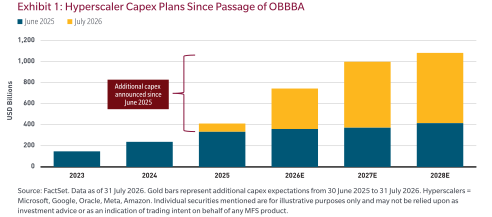
AI has moved from an equity growth story to a fixed income funding story. What began as a narrow theme within technology equities is now driving one of the largest capex cycles in decades, supported by rapid hyperscaler spending and a 2025 tax package that incentivized R&D and capital investment. The macro impact has been meaningful: AI spending has supported growth, while related corporate earnings have remained resilient. But the next stage of the buildout is increasingly being financed through credit markets. That shift matters for bond investors because each incremental dollar of AI capex raises questions about leverage, interest costs, funding access, and return on invested capital. As debt-funded AI investment grows, credit outcomes should become more dispersed, making security selection a larger driver of active fixed income returns.
The AI capex cycle: demystifying the datacenter
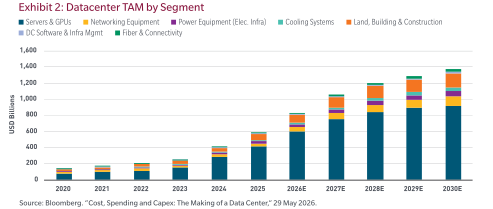
When investors talk about the AI buildout, they are usually talking about the datacenter cycle. Datacenters are industrial-scale computing facilities that require power, cooling, CPUs and GPUs, memory, networking equipment, and fiber connectivity. Much of the early spending has gone into the physical shells: land, construction, power infrastructure, and cooling systems. That has already benefited a broad set of sectors, from construction equipment to modular power providers. As these facilities are completed, the spending mix should shift toward filling them with chips, servers, and networking equipment. That transition helps explain why semiconductor backlogs have extended several quarters ahead, and why the AI capex cycle is now spreading across a wider set of credit issuers and sectors.
The fixed income transmission channels
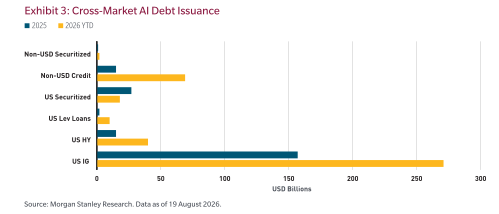
The main fixed income transmission channel is issuance. Datacenter investment has already attracted hundreds of billions of dollars, and annual spending is expected to move toward the trillions by the end of the decade. The hyperscalers — Microsoft, Alphabet, Amazon, Meta, and Oracle — remain the dominant source of demand. Their investment-grade ratings and strong cash flows have allowed them to fund the buildout through public credit markets at historically tight spreads. As Exhibit 3 shows, that has made investment-grade credit the primary market for AI-linked debt issuance so far.
As the AI ecosystem broadens, lower-rated borrowers are also entering public and private credit markets. These issuers often have weaker balance sheets, less proven business models, and greater uncertainty around future demand than the hyperscalers. Some emerging compute-as-a-service companies, for example, have relied on novel financing structures that pledge GPUs as collateral. The yields can be attractive, but the credit risk is less straightforward: demand for excess compute capacity, utilization rates, and collateral values all matter. For fixed income managers, the task is to identify which borrowers can support new debt levels through durable cash flows — and which are more exposed if growth expectations disappoint. As issuance expands, dispersion in AI-linked credit fundamentals should rise.
The technical impact may become just as important as the fundamental one. AI-linked issuance is likely to be concentrated in a handful of sectors, including technology, communication services, utilities, infrastructure, and select industrials. Over time, that could increase their weight in credit benchmarks and reduce the relative dominance of traditional heavyweights, such as banking. So far, demand has absorbed the supply: large AI-related deals have typically been issued across multiple maturities and met with oversubscribed order books, allowing borrowers to price at attractive levels. But that balance is not guaranteed. If investor demand softens while supply remains elevated, spreads may need to widen to clear the market.
Why security selection becomes critical
That is why security selection is becoming the central alpha lever. Technology spreads remain historically tight, and the gap between the highest- and lowest-spread issuers is unusually narrow. In effect, markets are still pricing many AI-linked credits as if their fundamentals are moving together. Exhibit 4 suggests otherwise. When volatility rose in 2025 and 2026, spread dispersion in technology widened more sharply than in the broader investment-grade market. That points to a higher-beta tail within the sector: issuers that can reprice quickly when investors begin to distinguish durable balance sheets from more leveraged or more speculative growth stories.
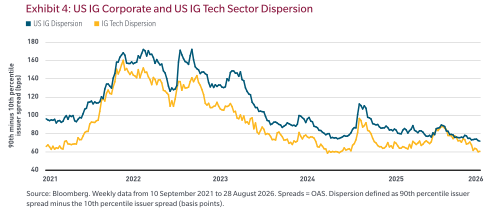
For active managers, that combination — tight valuations, rising issuance, and widening issuer-level dispersion — creates a more fertile environment for bottom-up credit selection. The opportunity is not simply to own the AI theme, but to separate companies with resilient cash flows, credible funding plans, and manageable leverage from those relying on aggressive assumptions or fragile financing structures. In a market where headline spreads offer limited compensation, the ability to identify that difference should be critical to active performance.
Conclusion: From AI beta to fixed income alpha
AI capex is likely to remain a durable market theme, but in fixed income, the next phase should be defined less by broad participation in AI and more by issuer-level differentiation. As the buildout moves from equity enthusiasm to credit market financing, investors will need to assess who can fund growth, sustain returns on invested capital, and preserve balance-sheet strength through the cycle. That is where the opportunity for alpha becomes more compelling. Tight spreads and rising issuance leave less room for passive exposure to the theme, while widening dispersion creates room for bottom-up credit selection. For fixed income investors, the key is not to chase the AI trade, but to distinguish durable credit stories from crowded or fragile financing structures. In our view, the AI buildout should reward investors who can translate issuer-level dispersion into disciplined security selection, moving from AI beta to fixed income alpha.
Source: Bloomberg Index Services Limited. BLOOMBERG® is a trademark and service mark of Bloomberg Finance L.P. and its affiliates (collectively ‘Bloomberg’). BARCLAYS® is a trademark and service mark of Barclays Bank Plc (collectively with its affiliates, 'Barclays'), used under license. Bloomberg or Bloomberg's licensors, including Barclays, own all proprietary rights in the Bloomberg Barclays Indices. Neither Bloomberg nor Barclays approves or endorses this material, or guarantees the accuracy or completeness of any information herein, or makes any warranty, express or implied, as to the results to be obtained therefrom and, to the maximum extent allowed by law, neither shall have any liability or responsibility for injury or damages arising in connection therewith.
The views expressed herein are those of the MFS Strategy and Insights Group within the MFS distribution unit and may differ from those of MFS portfolio managers and research analysts. These views are subject to change at any time and should not be construed as the Advisor’s investment advice, as securities recommendations, or as an indication of trading intent on behalf of MFS. No forecasts can be guaranteed.
No investment style can guarantee a profit or protect against a loss. Past performance is no guarantee of future results.
Keep in mind that all investments, including mutual funds, carry a certain amount of risk, including the possible loss of the principal amount invested.
AUTHORS
Benoit Anne
Senior Managing Director,
Strategy and Insights Group
David Peterson
Lead Analyst,
Strategy and Insights Group