
From Cyclical Lag to Structural Opportunity: Quality’s Path Forward
AUTHOR
Ross Cartwright
Lead Strategist
Strategy and Insights Group
In Brief
- The long-term case for quality remains intact: disciplined capital allocation, resilient earnings power, and balance sheet strength continue to underpin superior compounding.
- Profitability is necessary but not sufficient: profitability can be distorted by leverage and accounting; diversified quality must also reflect balance sheet resilience and earnings durability.
- Conditions that support diversified quality are re-emerging: valuation premia have corrected, earnings breadth looks set to improve, and defensives are stabilizing, even as leadership broadens.
Executive summary
Quality investing is built on a simple but enduring premise: companies with resilient earnings, disciplined capital allocation and strong balance sheets tend to create value more consistently over time. Recent years, however, have been challenging for quality as a style. Market leadership has been dominated by higher-beta, more cyclical and often lower-quality segments, driven by falling rates, compressed credit spreads and elevated risk appetite. These dynamics have weighed on diversified quality exposures even though the underlying fundamentals of high-quality businesses remained intact.
Within the factor, profitability has continued to provide support over longer horizons, but earnings-stability and balance-sheet indicators have been inconsistent, and even profitability — normally a reliable contributor — briefly detracted in 2025, underscoring why a multidimensional definition of quality remains essential. Profitability metrics alone are not a sufficient proxy: leverage, accounting effects and capital-structure choices can distort it, making complementary indicators critical to identifying genuinely durable franchises.
Looking ahead, several conditions that have historically supported quality are re-emerging. Valuation premia have reset to more reasonable levels, earnings participation is expected to broaden, and defensive fundamentals are stabilizing. These shifts point to a more balanced environment, one where the attributes that define quality are better recognized and where durability, resilience and disciplined capital allocation are once again likely to matter for returns.
Recent performance and factor context
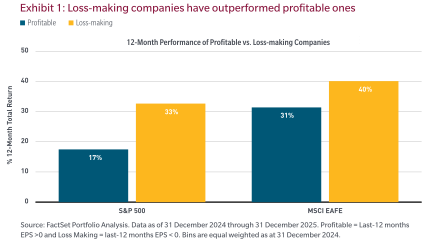
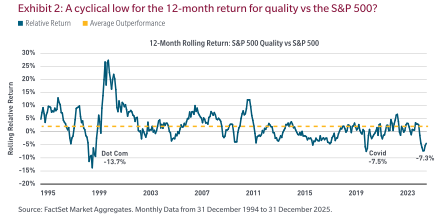
Quality lagged the broader market in 2025; lower-quality cohorts outperformed, and European “quality” exposures experienced their worst year on record.1 A notable feature of the period was the outperformance of loss-making over profitable companies, reflecting a regime in which liquidity and sentiment temporarily dominated fundamentals. The mechanism is straightforward: when policy and credit conditions compress risk premia, the market prices early-cycle earnings potential and volatility more than durability and balance-sheet strength. As those asymmetries fade and earnings breadth normalizes, fundamental dispersion tends to reassert itself (Exhibits 1–2).
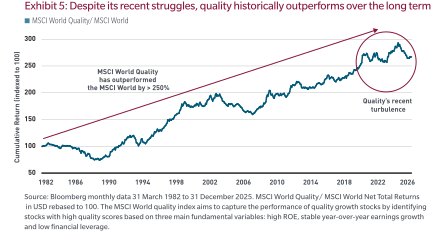
The long-term context remains constructive: in the US, quality has compounded approximately 2.4% per year above the market since 1995. The recent underperformance reflects previous cyclical troughs in which fundamentals took a temporary back seat to liquidity and risk appetite.
Decomposing the quality factor: What actually drove the headwinds
Quality is a multidimensional factor, typically defined across three structural anchors:
- Profitability (e.g., return on equity/ROE, margins, return on capital)
- Low leverage (balance-sheet strength and prudent financing)
- Earnings stability (durability and predictability of earnings and cash flows)
Over time, these characteristics have collectively captured companies with superior competitive positioning, disciplined capital allocation and resilient earnings power. But these pillars do not always move in lockstep, and recent years have underscored this divergence.
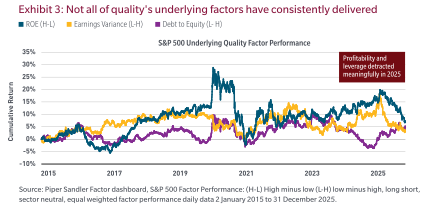
Profitability: Profitability has been the most consistently rewarded quality signal, historically. That has remained true over longer windows, but even profitability experienced reversal in 2025 as lower ROE names briefly outperformed higher ROE peers amid a powerful risk-on environment.
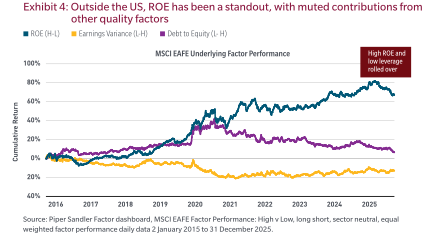
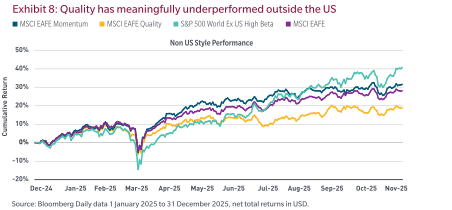
Low leverage: Balance-sheet strength usually supports quality, but benign credit conditions and tight spreads diminished the value investors placed on financial conservatism. Higher-leverage names were rewarded in the US early in the year, while outside the US, lower debt levels ironically acted as a headwind.
Earnings stability: This was the sharpest detractor, especially in the US. Companies with stable earnings lagged their more volatile peers as investors sought exposure to cyclical acceleration and AI-related growth themes. Stability — core to quality’s defensive characteristics in uncertain environments — was discounted in a narrow, momentum-driven market.
Why quality requires more than profitability alone
Profitability (e.g., factors like ROE) has long been a strong contributor to quality outcomes, but it is not a sufficient definition of quality. ROE can be flattered by leverage, buybacks, industry, capital intensity, or the treatment of intangibles. We believe that a composite definition that combines profitability with balance sheet resilience, earnings durability, management discipline and sound governance is therefore essential to isolate genuinely durable franchises and provide necessary checks against structural biases in measures like ROE. The dispersion across subfactors in recent years, particularly the inconsistent signals from stability and leverage, helps explain why the composite quality factor struggled, even as many high-quality businesses continued to compound earnings at attractive rates (Exhibit 4).
While the past five years have tested the quality style, they also highlight an important truth: the value of quality does not arise from any single characteristic, nor does it rely on constant outperformance. Its strength lies in how multiple dimensions reinforce one another across cycles. These attributes compound silently in the background, often without immediate recognition, but they provide a foundation that tends to assert itself. In that sense, to us, the recent stretch of muted returns is not evidence of diminished relevance — it simply reflects the style’s inherent cyclicality and the fact that its payoff comes from durability rather than speed.
The macro regime: Why the quality factor struggled
The recent weakness in quality is best understood as a regime phenomenon, not a breakdown in fundamentals. The following forces combined to challenge the factor:
- Falling rates boosted early-cycle earnings potential.
- Tight credit spreads reduced the premium typically afforded to strong balance sheets.
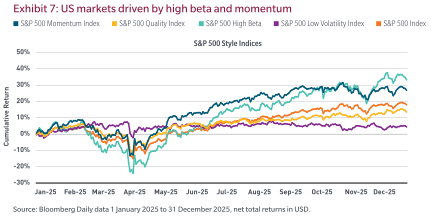
- Elevated risk appetite rewarded high beta and momentum over earnings resilience.
- Narrow leadership, particularly in AI-related and cyclical names, reduced the relevance of diversification and stability.
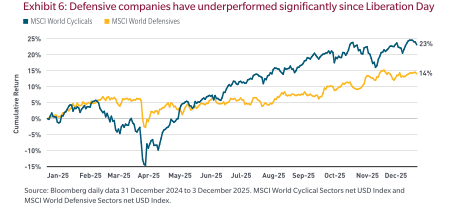
None of these conditions reflect structural impairment in the business models quality seeks to capture. They primarily represent instead a temporary preference for beta, leverage and deeper cyclicality — features that, in our experience, seldom define the long-term winners in global equity markets.
Why quality remains structurally relevant
The case is economic, not just historical:
- Capital discipline: firms with high returns on invested capital typically reinvest more efficiently.
- Financial flexibility: stronger balance sheets provide options through downturns and shocks.
- Earnings durability: predictable earnings support sustained value creation with fewer drawdowns.
These dynamics can be harder to monetize in liquidity-led, narrow regimes, but they do not disappear. Recent years reinforce that while profitability remains essential, it is not a standalone definition of quality; profitability alone is incomplete without the checks provided by balance-sheet and earnings metrics.
Outlook: Conditions that can re-establish a supportive backdrop
The combination of elevated macro risks, compressed risk premia, and persistent market concentration suggests that investors are not being compensated for underlying fragilities in the system. In that context, we believe the attributes that define quality — resilience, prudent balance sheets and dependable earnings — retain, and arguably increase, their relevance.
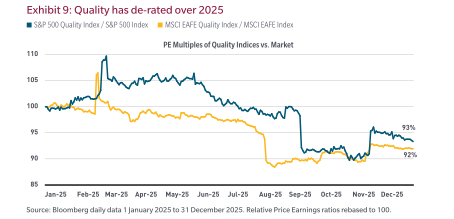
Quality premia compressed meaningfully across regions in 2025, leaving relative valuations more reasonable. This eases a key headwind and restores a stronger foundation for forward excess returns as the market focuses less on momentum and more on fundamentals.
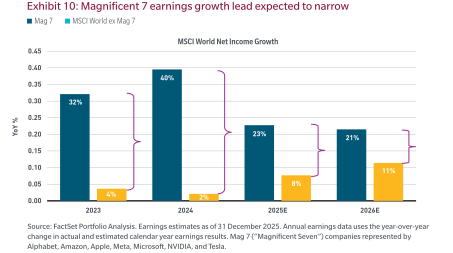
Our expectations are for earnings participation to broaden in 2026, narrowing the extraordinary gaps between mega-cap leaders and the rest of the market. Sector fundamentals in health care and staples seem to be stabilizing, and quality-oriented cyclicals across industrials, select financials and parts of technology appear better positioned as expectations reset (Exhibit 10).
Macro risks create dispersion, and a quality advantage
The broader macro backdrop also warrants careful attention. Fiscal expansion, geopolitical tension, internal political divisions, supply chain realignment and lingering inflation volatility have created a potentially wide distribution of possible outcomes that may not be fully reflected in current valuations or by muted equity volatility. These conditions introduce meaningful asymmetry into markets and reduce the margin for error in business models lacking balance-sheet strength or pricing power.
The behavior of gold over the past year illustrates this tension clearly: its strength alongside buoyant risk assets signals a persistent demand for protection against systemic or geopolitical shocks, even as equity markets appear to price a smoother path ahead. This disconnect highlights why investors should not assume that a recent calm implies reduced risk.
What this means for positioning
The path ahead is unlikely to be linear, and pro-cyclical fiscal and monetary policy may extend the current phase of cyclical leadership; these effects typically fade as earnings breadth improves and valuations normalize. As market drivers broaden, the environment becomes more balanced. With valuation differentials compressed and expectations resetting, this creates conditions in which leadership can expand beyond a narrow set of companies.
As policy support moderates, we think that differentiation should be shaped more by fundamentals than liquidity-driven regimes. As cyclical impulses fade, a wider range of business models can contribute to returns.
Quality: Temporary headwinds, lasting strength
Quality investing remains anchored in durable economic drivers. In our view, the underperformance of 2025 reflected a market regime of falling rates, accelerating earnings, tight credit spreads, elevated risk appetite and narrow leadership, not a weakening in the underlying fundamentals of high-quality companies. Although profitability has been one of the most reliable contributors to quality over the long term, even this signal temporarily reversed in 2025, amplifying the pressure created by inconsistent earnings stability and leverage indicators. These dynamics point to a cyclical regime rather than any structural break in the quality premium.
With valuations now more reasonable, earnings breadth improving and defensives stabilizing, the environment is becoming more balanced. Despite recent challenges, we feel the long-term relevance of quality is unchanged. As market drivers broaden and dispersion increases, we think today’s dislocation offers a timely opportunity to re-engage with the enduring strengths of quality as a style and the long-term value it seeks to capture.
Endnote
1 Bloomberg: European Quality Trade Suffered Historic Defeat: Equity Insight, By Jan-Patrick Barnert and Michael Msika
The views expressed herein are those of the MFS Strategy and Insights Group within the MFS distribution unit and may differ from those of MFS portfolio managers and research analysts. These views are subject to change at any time and should not be construed as the Advisor’s investment advice, as securities recommendations, or as an indication of trading intent on behalf of MFS.
No forecasts can be guaranteed.
Diversification does not guarantee a profit or protect against a loss. Past performance is no guarantee of future results.