
When Capital Regimes Change, Benchmarks Break
AUTHOR
Robert M. Almeida
Portfolio Manager and Global Investment Strategist
In brief
- Shifts in capital regimes can disrupt market leadership.
- We’re currently transitioning from a capital-light to capital-intense environment.
- With fundamentals regaining importance, investors may face considerable risks if they depend too much on historical trends in today’s shifting economic environment.
Some things about the future are predictable. For example, we know that the sun will rise in the east and set in the west — there’s no debate about that. However, in many other aspects of life, especially when it comes to economic and financial markets, the future is far less certain. In these cases, outcomes can only be understood in terms of probabilities.
Securities, in essence, represent these probabilities. Every trade investors make reflects assumptions about factors such as revenue growth, profit margins, reinvestment needs, and the cost of capital. In simpler terms, stock prices represent capitalized probabilities. They are the market’s collective “best guesses” about the returns that businesses are likely to deliver. When actual returns exceed or fall short of these expectations, stock prices adjust accordingly.
Benchmarks, such as stock indices, are not neutral reference points. Instead, they are weighted baskets of stocks that reflect the market’s assumptions about business returns. Over time, these indices tend to become concentrated in the companies that are best suited to the prevailing economic and capital conditions. However, when these conditions shift, market leadership often changes as well. Businesses that once thrived under a specific regime may struggle due to factors such as new technologies, regulations, or changes in capital availability. In such cases, new leaders emerge, and stock prices adjust to reflect these transformations.
2009–2021: The Era of Capital Harvesting
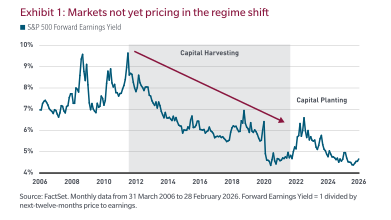
An unusual economic and capital regime began in the aftermath of the Global Financial Crisis and lasted from 2009 to 2021. This period was defined by falling capital intensity, excess savings, and a steadily declining cost of capital. During this time, households focused on repairing their balance sheets, banks reduced lending, and corporations cut back on tangible investments. Companies outsourced production, optimized supply chains for efficiency, and directed capital toward dividends, stock buybacks, and acquisitions rather than building new capacity. In essence, capital was harvested rather than planted.
This approach led to historic profitability as returns on invested capital were amplified. Combined with steadily falling interest rates, this environment supported higher equity valuations. Investors became comfortable with the idea of low inflation, low interest rates, and structurally high returns on capital. Benchmark-driven investing thrived during this time as the value of individual security selection diminished. Indices became increasingly concentrated in businesses that excelled under capital-light, scalable models. However, even as the economic forces that underpinned these valuations have begun evolving in recent years, many of the assumptions that supported them remain embedded in today’s market.
2022 and Beyond: The Era of Capital Planting
A new economic and capital regime began to emerge around 2022. This second cycle, which can be described as “capital planting,” has been shaped by significant global changes. Events such as the COVID-19 pandemic, rising geopolitical tensions, and trade fragmentation have forced companies to prioritize resilience over efficiency. Businesses have started to build redundancy into supply chains, expand capacity, and invest in infrastructure. The focus has shifted away from financial engineering, such as stock buybacks and dividends, and toward tangible investments.
The rise of artificial intelligence has further accelerated this transition. The AI revolution requires significant investments in data centers, power generation, semiconductors, memory, and construction capacity — all of which are highly capital-intensive. In addition, this infrastructure buildout is subject to real-world constraints, which further drive up costs and increase the marginal cost of capital. Energy costs are another critical factor; economic activity, at its core, is a transformation of energy, and rising energy costs have ripple effects across a number of industries. For example, sustained increases in oil prices can raise input costs, reinforcing the broader trend toward higher capital intensity and operating expenses.
As the cost of capital rises, businesses face greater challenges in generating returns that exceed this higher threshold. It becomes increasingly difficult to earn returns above rising marginal costs, especially compared to the environment of steadily declining costs that characterized the 2010s. This shift also impacts the valuation multiples that investors are willing to pay, as higher risk-free rates alter the investment landscape.
In addition to capital expenditures related to AI, the technology, though it promises significant productivity gains, introduces its own challenges. Technological advancements often lower barriers to entry, fostering competition and enabling new entrants into markets. This process of “creative destruction” can erode the competitive advantages of established businesses, forcing them to reinvest heavily to maintain their market positions. As a result, early cost savings driven by AI may be offset by the need for reinvestment, making it more challenging to sustain high returns in an increasingly capital-intensive environment.
Conclusion
Today’s unusually low equity earnings yield suggests that the market is still pricing in an economic and interest rate environment similar to the post-GFC era. This presents both risks and opportunities for investors. If the investment landscape is indeed transitioning to one defined by rising capital intensity, greater real-world constraints, a structurally higher cost of capital, and AI-driven competition, the assumptions embedded in benchmarks may become increasingly fragile. Valuations that were once supported by falling discount rates may now depend on disciplined execution in a more demanding environment.
Businesses that thrived in an era of capital-light scalability may find themselves needing to focus more on tangible investments, energy requirements, supply chain resilience, and reinvestment intensity. Fundamentals are making a comeback, and relying too heavily on past trends could pose significant risks for investors in this new economic regime.
Keep in mind that all investments carry a certain amount of risk, including the possible loss of the principal amount invested.
The views expressed are those of the author(s) and are subject to change at any time. These views are for informational purposes only and should not be relied upon as a recommendation to purchase any security or as a solicitation or investment advice. No forecasts can be guaranteed. Past performance is no guarantee of future results.