
Executive Summary
The active versus passive debate is often framed around fees, efficiency, and recent performance. Those issues matter, especially after a period in which benchmark exposure has been hard to beat. But they can obscure the more fundamental point: a stock is a claim on a company’s future cash flows, and its price reflects today’s expectations for those cash flows. Future investment returns depend on the gap between what is priced today and what ultimately happens.
Why? Because capital cycles change outcomes. High returns attract investment; investment changes supply, competition and pricing power; and those shifts eventually test the assumptions embedded in valuations.
The case for active management is not that markets ignore change. Prices are forward looking and efficiently incorporate collective expectations about the future. However, market-cap-weighted benchmarks allocate the most capital to the companies that have already become large, reflecting past earnings growth, share-price appreciation, and investor conviction. Passive investors therefore remain anchored to today’s market leadership through benchmark weights earned by prior success. Concentration itself is not the problem; it is the outcome of strong fundamentals, supportive valuations, and favorable macroeconomic conditions. The key question is whether the conditions that produced today’s market leaders can persist, and, if they cannot, where the next generation of market leadership will emerge.
Start with the Stock
A stock is not just a ticker, factor exposure, or index weight. It is an ownership claim on a business, and its value depends on the cash that business can generate for owners over time.
This is the starting point for active management. The challenge is not simply finding good companies, it is judging whether today’s price properly reflects tomorrow’s economics. Good businesses can be poor investments if expectations are too high — and less-favored companies can be attractive if expectations are too low.
Valuation Is the Language of Expectation
Valuation is not just a timing tool; it is an articulation of expectations. While measures such as price-to-earnings (P/E) ratios are useful reference points, they do not determine intrinsic value. A high valuation is not always expensive; low is not always cheap. What matters is whether future growth potential, margin durability, reinvestment, and risk-taking can support the current valuation.
This becomes even more important when capital cycles turn. The largest benchmark weights may still be excellent businesses, but future returns depend on whether they can keep exceeding expectations that are already high.
The key risk may not be valuation multiples alone. Many of today’s market leaders are not overly expensive by conventional measures. The bigger question is whether future earnings can justify current prices as competition intensifies and capital needs rise. The next cycle may be shaped less by multiple contraction than by earnings assumptions that prove too optimistic.
Why Capital Cycles Matter
Capital cycles are simple but powerful: high returns attract capital; capital creates capacity; capacity changes competition; and competition affects pricing power, margins, and future returns.
Successful companies do not inevitably fail, but exceptional returns should also not be assumed to persist. As the capital cycle unfolds, some companies will deepen their advantages, while others discover that growth is not necessarily value creation. Active management seeks to distinguish between those outcomes — before they are priced in.
A market-cap-weighted index owns future winners and future losers in proportion to their current market value. It does not judge which companies, sectors, or assumptions will be rewarded or hindered in the next phase of the cycle.
Why the Last Decade Favoured Ownership
The decade after the Global Financial Crisis created unusually supportive conditions for passive investing: falling rates, abundant liquidity, globalization, and the rise of asset-light business models. Earnings growth was rewarded, multiples expanded, and the largest companies became larger.
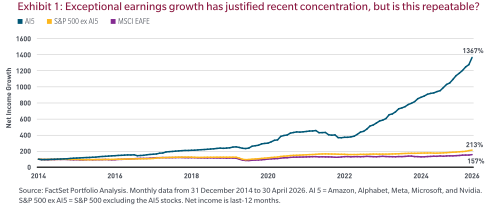
This produced a powerful feedback loop: strong fundamentals lifted prices, prices raised benchmark weights, and higher weights increased passive exposure. As shown in Exhibit 1, much of today’s concentration has been justified by genuine earnings delivery. Concentration is not a judgement; it is an outcome. The question is whether those profit pools will remain durable, and what might cause leadership to broaden or rotate.
The implication is that as the largest stocks became bigger, they did not just dominate benchmark weight; they also increasingly dominated benchmark risk.
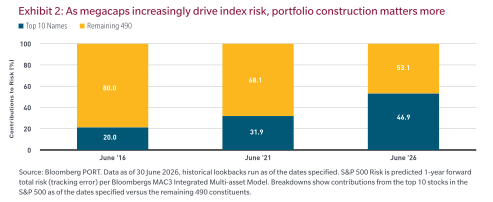
For active managers, this has portfolio construction consequences: underweighting the largest stocks became not only a valuation or conviction decision, but a portfolio-construction challenge. Not owning or underweighting these companies materially reduced portfolio beta, and investors often found it difficult to replace that exposure through other growth investments. As market returns became increasingly concentrated in a small group of stocks, lower-beta portfolios faced a meaningful relative performance headwind.
The Next Cycle Looks More Capital Intensive
The next cycle will be more capital intensive for the companies that now dominate market-cap-weighted indices. AI is the clearest example: a software revolution dependent on semiconductors, datacenters, energy, land, permitting, and supply chains. AI may live in the cloud, but the cloud depends on the infrastructure built on the ground beneath it. AI capex illustrates the investment challenge. Companies are raising aggressively to finance the AI buildout, and though demand and earnings remain favourable, valuations and free cash flow are being strained.
That does not mean the opportunity for robust future returns has disappeared; however, the margin for error has narrowed. When expectations are high, even a modest shift in assumptions can meaningfully impact returns.
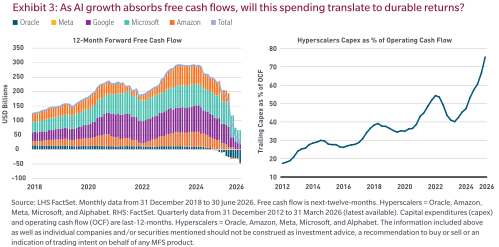
Beyond capex, AI will reshape industries, redirect profit pools, and challenge business models. Some companies will use AI to improve productivity, deepen customer relationships, and protect margins. Others may be disintermediated as software automates labor, distribution, or expertise. The question is not only who is exposed to AI, but who can implement it effectively and keep the margin improvement.
Capital intensity changes returns. Growth now requires more investment, which brings execution, financing, regulatory, and overcapacity risk. The question shifts from who can grow to who can grow profitably.
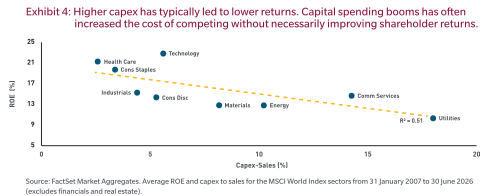
The same logic applies beyond AI. Strategic autonomy, reshoring, defense, electrification, grid investment, and supply-chain resilience are not just growth themes — they are capital demands. These initiatives will also attract capital and expose weaker models, which can create durable opportunities for active managers.
Passive Is Not Backward-Looking, but It Is Anchored
Passive investing is not simply backward-looking. Prices look forward, but benchmark weights carry history. A company’s index weight reflects both current expectations as well as the past earnings delivery, share-price performance, and investor enthusiasm that got it there.
Passive generally works well when the consensus is broadly right and the future resembles the recent past. It is less suited to environments where the opportunity set shifts, the cost of capital changes, and tomorrow’s winners differ from yesterday’s. Passive captures the consensus efficiently, but it does not challenge it.
Passive investors do not need to believe today’s leaders are overvalued to recognise that benchmark ownership embeds an assumption: that today’s profit concentration will remain sufficiently durable.
The Role of Active Management
Any credible argument for active management must acknowledge recent history: many active managers have not delivered consistent excess returns, and investors have been well served by low-cost benchmark exposure. In some cases, active managers were too cautious toward high-growth companies, too reliant on mean reversion, or insufficiently differentiated after fees. The lesson is to raise the standard for active management. It must be selective, differentiated, and disciplined and offer real value for the fees charged.
The case for active management must therefore rest not on dismissing passive, but on asking where expectations may be wrong and future cash flows might be mispriced. A stronger case for active management is that expectations are assumptions, not facts, shaped by fundamentals, extrapolation, herding, and recent experience.
Alpha requires both a differentiated view and an opportunity set in which that view can be rewarded. For much of the past decade, the opportunity side of that equation was constrained by low dispersion, dominant benchmark leaders, and macro conditions that lifted many businesses together. If dispersion rises as capital cycles turn, the scope for active decision-making may increase.
For MFS, active management is less about predicting macro outcomes and more about evaluating business economics: reinvestment opportunity, pricing power, capital discipline, and cash-flow durability. Those factors will matter more as the new capital cycle unfolds, and companies must invest heavily as the cost of capital rises and policy grows more uncertain. We feel as weak capital allocation becomes harder to hide, companies that confuse growth with value creation may disappoint, while those with durable advantages, disciplined reinvestment, and resilient cash generation can stand out.
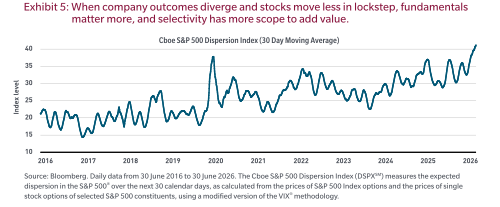
In our view, passive exposure to the market still has a place, but it is important to recognize that passive does not mean neutral. A benchmark has biases toward size, past success, current consensus, and sectors that have already attracted capital. Those biases may be justified, but they are still assumptions about profit leadership, not facts. Active management offers a way to examine those biases and decide where they are justified, excessive, or blind to change.
Conclusion: From Ownership to Selectivity
The past decade has rewarded ownership. Falling rates, abundant liquidity, asset-light business models, and dominant platforms lifted returns across a broad set of companies and made benchmark exposure difficult to beat. The next capital cycle may be less forgiving, however. Rising costs, greater competition, higher capital requirements, and changing industry structures are likely to create wider gaps between winners and losers.
That does not make passive investing wrong, nor does it make active management easy. Both investing styles have different features and risks, but if the next cycle rewards different business models, capital structures, and sources of cash-flow growth, broad ownership alone may be less rewarding and more risky. The opportunity is to identify where expectations are too high, capital is misallocated, and durable value creation is underestimated. The shift is not simply from passive to active; it is from ownership to selectivity. In a cycle where outcomes diverge, we feel the winners will be the businesses whose future cash flows can still exceed what the market has priced in.
"Standard & Poor's®" and S&P "S&P®" are registered trademarks of Standard & Poor's Financial Services LLC ("S&P") and Dow Jones is a registered trademark of Dow Jones Trademark Holdings LLC ("Dow Jones") and have been licensed for use by S&P Dow Jones Indices LLC and sublicensed for certain purposes by MFS. The S&P 500® is a product of S&P Dow Jones Indices LLC, and has been licensed for use by MFS. MFS's Products are not sponsored, endorsed, sold or promoted by S&P Dow Jones Indices LLC, Dow Jones, S&P, or their respective affiliates, and neither S&P Dow Jones Indices LLC, Dow Jones, S&P, their respective affiliates make any representation regarding the advisability of investing in such products.
Index data source: MSCI. MSCI makes no express or implied warranties or representations and shall have no liability whatsoever with respect to any MSCI data contained herein. The MSCI data may not be further redistributed or used as a basis for other indices or any securities or financial products. This report is not approved, reviewed or produced by MSCI.
Source: Bloomberg Index Services Limited. BLOOMBERG® is a trademark and service mark of Bloomberg Finance L.P. and its affiliates (collectively 'Bloomberg'). BARCLAYS® is a trademark and service mark of Barclays Bank Plc (collectively with its affiliates, 'Barclays'), used under license. Bloomberg or Bloomberg's licensors, including Barclays, own all proprietary rights in the Bloomberg Barclays Indices. Neither Bloomberg nor Barclays approves or endorses this material, or guarantees the accuracy or completeness of any information herein, or makes any warranty, express or implied, as to the results to be obtained therefrom and, to the maximum extent allowed by law, neither shall have any liability or responsibility for injury or damages arising in connection therewith.
The views expressed herein are those of the MFS Strategy and Insights Group within the MFS distribution unit and may differ from those of MFS portfolio managers and research analysts. These views are subject to change at any time and should not be construed as the Advisor’s investment advice, as securities recommendations, or as an indication of trading intent on behalf of MFS. No forecasts can be guaranteed. .
No investment style can guarantee a profit or protect against a loss. Past performance is no guarantee of future results.
Keep in mind that all investments, including mutual funds, carry a certain amount of risk, including the possible loss of the principal amount invested.
AUTHORS
Rob Almeida
Portfolio Manager and
Global Investment Strategist
Ross Cartwright
Lead Strategist, Strategy and Insights Group