
In brief
- As part of our long-term, active approach, we model these risks with the help of our emerging markets ESG dashboard and other tools, and we engage with issuers to better understand how these factors affect them.
- The energy transition in emerging markets has its own unique dynamic and risks that need to be taken into account in the investment process.
From diversification benefits to attractive return potential, we believe there are several reasons to consider a strategic asset allocation to emerging markets (EM). According to the world bank’s short-term forecasts, investment growth in emerging markets and developing economies (EMDEs), excluding China, is expected to average 3.7% and 4.0% in 2026 and 2027, respectively, compared to 2.6% and 2.7% for advanced economies.1
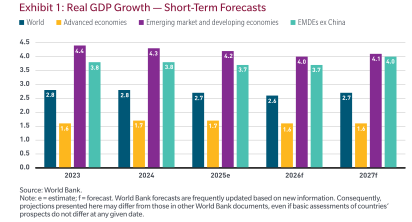
Our research shows that factors including physical climate risk, natural resource management, social stability, the quality of education, income inequality, rule of law, labor rights, voice and accountability are leading indicators of the creditworthiness of emerging market issuers. Understanding the impact of these factors is critical to our ability to assess issuers’ probability of default and potential changes in credit spreads through time — and materiality is also key to this risk assessment.
This paper explores how we assess ESG factors, including climate change, in our investment approach to emerging market debt (EMD), as well as some of the related questions regarding the energy transition in emerging markets.
Our Approach
1. Assess and Model Material Risk Factors Using Our ESG Dashboard
Using an array of metrics, we have constructed an ESG dashboard for our analysts and portfolio managers to use in the investment decision-making process. This tool allows our portfolio managers to understand the range of material risks and opportunities beyond financial reports, helping them track and compare ESG performance across issuers over time on a consistent, standardized basis and relative to a country’s level of development. When using the dashboard, we typically focus on two key questions:
a. Relative performance: Which issuers fare better (or worse) on ESG factors relative to their peers or, in the case of sovereigns, relative to what their level of development would suggest?
b. Directionality: Which direction are the ESG metrics trending?
The data in our ESG dashboard is compiled from a variety of respected sources chosen for their broad availability across emerging markets as well as their depth and spread across time.
Traditional ESG data sets tend to use arbitrary weightings for environmental, social, and governance factors — for example, using weightings of ⅓, ⅓ and ⅓. Our dashboard, however, weights these factors based on quantitatively back-tested correlations over time. As materiality is not a static phenomenon, we consistently run these regressions to determine if spread materiality is changing and subsequently reflect these changes in our weightings.
While there is broad consensus in emerging market investing that governance is the most crucial factor, we have seen the increased relevance of environmental and social factors such as education and health care. In some cases, we may use base weightings of 15%, 35% and 50%, respectively, for environmental, social and governance factors in our dashboard that our analysts can adjust further to accurately reflect their level of relevance to each issuer.
Our ESG dashboard allows our analysts and portfolio managers understand the range of material risks and opportunities beyond financial reports. ESG data is compiled from respected sources with breadth and depth across EMs.
It offers our investors a clear snapshot of some nontraditional macroeconomic data from a single country in a way that is comparable across time and within the context of a given region.
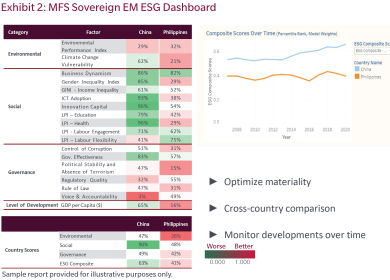
It is important to note that this dashboard does not provide a forward-looking assessment of material ESG risk factors. However, it does indicate potential trends and changes in underlying fundamentals, which allows our investors to have an informed view of future changes to these risk factors.
2. Engagement and Accountability
We believe that an integrated approach must consider both short- and long-term risks when assessing issuers, and that open communication with issuers is a crucial aspect of bond ownership. Our belief is that as long-term asset managers, we can positively influence governance and business practices by encouraging executive teams to recognize that these issues are relevant to an increasingly broad investor base and require further consideration. Our EMD portfolio managers and credit analysts typically conduct hundreds of meetings per year with government officials, company executives, opposition politicians, economists, academics, journalists and consultants. These meetings include interactions designed to deepen their understanding of issuers as well as engagement meetings to deep dive on material topics affecting the issuers.
In our engagements with two EM issuers (Chile and Uruguay), we noted both countries’ strong fundamentals, ambitious sustainable development goals and progress toward internal reforms aimed at strengthening macro policy frameworks — all of which factored into our decision to participate in both countries’ Sovereign Sustainability–Linked Bond and Sustainability-Linked Bond issuances. Both countries have pioneered bond issuances that feature specific coupon step-ups (and step-downs, in the case of Uruguay) tied to performance on key indicators, including meeting their greenhouse gas emission targets and improving board gender diversity by 2030 and 2031, respectively.
As part of our continuous risk assessment process, we conduct annual risk reviews on our portfolios. These reviews allow us to refine our understanding of portfolio ESG risks and make our own independent assessment of material risks.
Lastly, in our engagements with issuers, we are careful to be respectful of local norms and do not apply a one-size-fits-all approach to our expectations.
Navigating the energy transition in emerging markets
Emerging markets face the challenge of balancing economic growth with access to affordable energy and energy security while avoiding carbon-intensive development pathways. That challenge is evolving. Over the past five years, China has invested heavily in renewable energy and green technologies domestically, helping lower production costs and expand the global availability of these technologies through Chinese-led investment and exports. For many emerging markets, this has sharpened the transition story from a purely climate-focused narrative to one also linked to affordability, resilience and energy security. Recent geopolitical tensions, including concerns around the Strait of Hormuz, have reinforced that point: countries with greater renewable capacity and more diversified energy systems may be better positioned to absorb fossil fuel supply shocks. At the same time, the role of Chinese green technology remains politically contested in some developed markets, particularly in Europe, where concerns around industrial policy, competitiveness and supply-chain dependence continue to shape the debate.
For investors in emerging market debt, this means the transition should be assessed through a wider lens than climate policy alone. Transition and stranded asset risks remain relevant, but they are increasingly concentrated in specific sectors and policy contexts, particularly coal and other assets exposed to changing economics, regulation and geopolitics. Understanding where these risks are material, and where transition dynamics may instead support resilience or competitiveness, is essential.
- Transition and Stranded Asset Risks: Transition risk remains highly relevant in emerging markets, but it is not uniform. Coal exposure, in particular, remains a key area of focus given the potential for policy shifts, changing power-sector economics and pressure from international financing partners. Investors need to assess how credible and economically viable a country’s transition pathway is, including the implications for existing and planned fossil fuel assets, fiscal revenues, employment and energy security.
- Sovereign Financing and Use of Proceeds: Sovereign green, social, sustainability and sustainability-linked bonds remain relevant tools for financing the transition, but issuance momentum has moderated in some markets. This has raised questions around project selection, the credibility of use-of-proceeds frameworks, issuer incentives and whether investors are being appropriately compensated for the risks they are taking. As a result, assessing the quality and materiality of labelled bond frameworks remains as important as assessing the label itself.
- AI, Power Demand and Comparative Advantage: The artificial intelligence-related investment story in emerging markets remains nascent and highly dependent on geopolitics, infrastructure readiness and resource availability. Countries may compete to attract data-center and digital infrastructure investment, but the ability to provide reliable energy, water and grid capacity will be critical. The opportunity set therefore needs to be considered alongside competing domestic demands, including household electricity access, industrial development and climate adaptation needs.
- Climate Resilience, Adaptation and Energy Security: Climate risks continue to pose significant challenges for emerging market countries, including extreme weather events, water scarcity and disruptions to agriculture. However, energy security is becoming a more prominent part of the investment case. Falling renewable technology costs may help some countries reduce import dependence and improve resilience to commodity price shocks. Investors should assess not only mitigation plans but also adaptation strategies, grid investment, storage capacity and the extent to which transition spending strengthens broader macroeconomic resilience.
- Regulatory Divergence and Policy Nuance: The policy environment is becoming more fragmented. While some jurisdictions are tightening climate-related rules, others are slowing implementation, prioritizing affordability or taking a more pragmatic approach to energy security. This divergence creates both risks and opportunities for emerging market issuers. Investors need to understand the direction of local policy and the credibility of implementation, as well as how global trade, industrial policy and supply-chain dynamics may influence transition outcomes.
Case Study: Morocco
The case study below illustrates how we incorporate ESG factors in our assessment of Morocco’s sovereign debt.
- Morocco faces considerable risks linked to climate change, including drought risk and a high level of dependence on imported energy and food products.
- However, the country is making inroads on addressing key structural challenges, including health care, education and labor participation. This is on top of investments in renewable energy and water security. In addition to its steady progress on these issues, Morocco’s relative political stability and healthy institutions allow for a favorable environment for tackling future challenges.
- In our view, the aforementioned factors are important parts of a larger mosaic that makes a compelling case for investing in this market. Ultimately, we want to be able to capture the improvement in valuations as issuers benefit from improving ESG performance, and close engagement with issuers is an important mechanism to achieve this objective.
Exhibit 3: Morocco Sovereign Debt — ESG Assessment

ENVIRONMENTAL
Drought Risk and Energy Dependency
- High concentration of economic activity within rain-fed agriculture creates disproportionate risks from drought
- Drought increases dependency on imported food and disproportionately impacts poor rural communities
- Imported oil also drives up the external deficit
Government Mitigation
- Effective implementation of economic diversification agenda
- Heavy investing in renewable energy production (large solar potential) and water security

SOCIAL
Improving Health
within poor rural communities:
- Lower mortality rates; eradication of communicable diseases; increasing life expectancy
Education Challenges
implementation of the 2019 Education Act may address these issues:
- Elevated high school drop-out rates; low international test scores, limited STEM schooling
Uneven Labor Participation
development of a robust manufacturing sector challenged by:
- High youth unemployment rate; low (<20%) female participation rate

GOVERNANCE
High Relative Stability
- Monarchy is stable and well-respected
- Healthy institutions skilled in upholding the rule of law, government effectiveness, and institutional quality
Navigating COVID-19
- COVID and earthquake-related funds were raised and disbursed effeciently
- On track to effect broader social assistance programs without significant backlash
For illustrative purposes only and not to be construed as a recommendation or advice of any nature.
The country has made slow but significant inroads on its sizable structural challenges.
Conclusion
Successful investors in emerging market debt must contend with complexity and uncertainty on several levels. MFS’ integrated approach, our ability to identify and model material risk factors, and our engagement-focused model favorably position us to effectively manage risk while successfully capitalizing on investment opportunities.
End Notes
1 Global Economic Prospects. June 2026. World Bank. https://openknowledge.worldbank.org/server/api/core/bitstreams/2106db86-a217-4f8f-81f2-7397feb83c1f/content
MFS may incorporate environmental, social, or governance (ESG) factors into its investment decision making, fundamental investment analysis and engagement activities when communicating with issuers. The statements or examples provided above illustrate certain ways that MFS has historically incorporated ESG factors when analyzing or engaging with certain issuers but they are not intended to imply that favorable investment, ESG outcomes or engagement outcomes are guaranteed in all situations or in any individual situation. When engaging with companies, including engagements on ESG topics, MFS’ focus is discussing, gathering information about, and seeking appropriate transparency on matters that could be material to the long-term economic valuation of the company so that MFS may make an informed investment decision that advances MFS clients’ long-term economic interests. MFS does not engage for the purpose of trying to change or influence control of a company. Engagements often consist of ongoing communications with an issuer. Engagement with an issuer may not result in any direct changes to any issuer’s ESG-related practices. Favorable investment or engagement outcomes, including those described above, may be unrelated to MFS analysis or activities. The degree to which MFS incorporates ESG factors into its investment decision making, investment analysis and/or engagement activities will vary by strategy, product, and asset class, and may also vary over time, and will generally be determined based on MFS’ opinion of the relevance and materiality of the specific ESG factors (which may differ from judgements or opinions of third-parties, including investors). Any examples above may not be representative of ESG factors used in the management of any investor’s portfolio. Any ESG assessments or incorporation of ESG factors by MFS may be reliant on data received from third-parties (including investee companies and ESG data vendors), which may be inaccurate, incomplete, inconsistent, out-of-date or estimated, or only consider certain ESG aspects (rather than looking at the entire sustainability profile and actions of an investment or its value chain), and as such, may adversely impact MFS’ analysis of the ESG factors relevant to an investment. The information included above, as well as individual companies and/or securities mentioned, should not be construed as investment advice, a recommendation to buy or sell or an indication of trading intent.
The views expressed are subject to change at any time. These views are for informational purposes only and should not be relied upon as a recommendation to purchase any security or as a solicitation or investment advice. No forecast can be guaranteed.
Important Risk Considerations: Investments in debt instruments may decline in value as the result of, or perception of, declines in the credit quality of the issuer, borrower, counterparty, or other entity responsible for payment, underlying collateral, or changes in economic, political, issuer-specific, or other conditions. Certain types of debt instruments can be more sensitive to these factors and therefore more volatile. In addition, debt instruments entail interest rate risk (as interest rates rise, prices usually fall). Therefore, the portfolio's value may decline during rising rates.
Emerging markets can have less market structure, depth, and regulatory, custodial or operational oversight and greater political, social, geopolitical and economic instability than developed markets.
This material is directed at investment professionals for general information use only with no consideration given to the specific investment objective, financial situation and particular needs of any specific person. Any securities and/or sectors mentioned herein are for illustration purposes and should not be construed as a recommendation for investment. Investment involves risk. Past performance is not indicative of future performance. The information contained herein may not be copied, reproduced or redistributed without the express consent of MFS Investment Management (“MFS”). While the information is believed to be accurate, it may be subject to change without notice. MFS does not warrant or represent that it is free from errors or omissions or that the information is suitable for any particular person’s intended use. Except in so far as any liability under any law cannot be excluded, MFS does not accept liability for any inaccuracy or for the investment decisions or any other actions taken by any person on the basis of the material included. MFS does not authorise distribution to retail investors.
Distributed by: U.S. – MFS Institutional Advisors, Inc. (“MFSI”), MFS Investment Management and MFS Fund Distributors, Inc.; Latin America – MFS International Ltd.; Canada – MFS Investment Management Canada Limited. Note to UK and Switzerland readers: Issued in the UK and Switzerland by MFS International (U.K.) Limited (“MIL UK”), a private limited company registered in England and Wales with the company number 03062718, and authorised and regulated in the conduct of investment business by the UK Financial Conduct Authority. MIL UK, an indirect subsidiary of MFS®, has its registered office at One Carter Lane, London, EC4V 5ER. Note to Europe (ex UK and Switzerland) readers: Issued in Europe by MFS Investment Management (Lux) S.à r.l. (MFS Lux) – authorized under Luxembourg law as a management company for Funds domiciled in Luxembourg and which both provide products and investment services to institutional investors and is registered office is at S.a r.l. 4 Rue Albert Borschette, Luxembourg L-1246. Tel: 352 2826 12800. This material shall not be circulated or distributed to any person other than to professional investors (as permitted by local regulations) and should not be relied upon or distributed to persons where such reliance or distribution would be contrary to local regulation; Singapore – MFS International Singapore Pte. Ltd. (CRN 201228809M); Australia/New Zealand - MFS International Australia Pty Ltd (“MFS Australia”) (ABN 68 607 579 537) holds an Australian financial services licence number 485343. MFS Australia is regulated by the Australian Securities and Investments Commission.; Hong Kong - MFS International (Hong Kong) Limited (“MIL HK”), a private limited company licensed and regulated by the Hong Kong Securities and Futures Commission (the “SFC”). MIL HK is approved to engage in dealing in securities and asset management regulated activities and may provide certain investment services to “professional investors” as defined in the Securities and Futures Ordinance (“SFO”).; For Professional Investors in China – MFS Financial Management Consulting (Shanghai) Co., Ltd. 2801-12, 28th Floor, 100 Century Avenue, Shanghai World Financial Center, Shanghai Pilot Free Trade Zone, 200120, China, a Chinese limited liability company registered to provide financial management consulting services.; Japan - MFS Investment Management K.K., is registered as a Financial Instruments Business Operator, Kanto Local Finance Bureau (FIBO) No.312, a member of the Investment Trust Association, Japan and the Japan Investment Advisers Association. As fees to be borne by investors vary depending upon circumstances such as products, services, investment period and market conditions, the total amount nor the calculation methods cannot be disclosed in advance. All investments involve risks, including market fluctuation and investors may lose the principal amount invested. Investors should obtain and read the prospectus and/or document set forth in Article 37-3 of Financial Instruments and Exchange Act carefully before making the investments.
AUTHORS
Pelumi Olawale, CFA
Strategist, Strategy & Insights Group
Katrina Uzun
Institutional Portfolio Manager
Aimee Kaye
Emerging Markets Sovereign Research Analyst