
Changing Capital Intensity and the Case for Non-US Equities
AUTHOR
Robert M. Almeida
Portfolio Manager and Global Investment Strategist
In brief
- Rising DM capital intensity marks a structural shift.
- This may close the capital intensity gap between EM and DM.
- With the potential for aggregate returns to compress and dispersion widen, in our view, capital-efficient firms — and active management — should matter more.
Equity markets have a habit of mistaking outcomes for causes. When stocks perform well, investors reach for explanations like economic growth or favorable policies. Yet throughout time, equity returns have traced back to businesses’ returns on capital, not GDP.
Over the past several decades, developed market equities — particularly in the United States — outperformed emerging markets, not because their economies grew faster, but because their companies learned how to grow using less capital as balance sheets shrank relative to income statements. Software replaced hardware, intellectual property replaced factories, and global supply chains outsourced asset intensity.
US companies led the way in these respects, and the result was a powerful and sustained rise in returns on invested capital. Valuations followed.
Emerging markets have experienced a very different trajectory. Growth was real and often impressive, but many companies in these markets were capital heavy. Infrastructure, housing, manufacturing capacity, etc. require large upfront investment with long payback periods. While it was accretive to economic growth, returns on capital remained modest relative to developed market companies. Investors who favored emerging market equities over developed learned that economic growth alone is not what compounds wealth.
This distinction matters because stock prices do not respond to growth in isolation. As shown in Exhibit 1, stock prices respond to the efficiency with which capital is deployed.
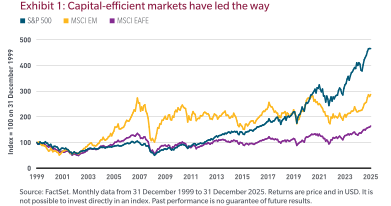
For much of the last 30 years, developed markets have enjoyed a structural advantage in this respect. But that may have changed.
A change in capital intensity
In the last few years, capital intensity in the US has begun to rise. After decades of becoming more capital-light, US companies are once again committing large sums of capital aimed at sustaining growth. Artificial intelligence infrastructure — datacenters, semiconductor fabrication, energy generation and supply-chain redundancy — all require both substantial upfront investment and ongoing reinvestment.
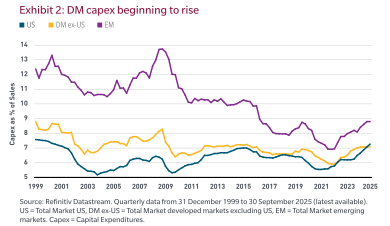
These investments may be strategically necessary and economically valuable, but from a capital-cycle perspective, rising capital intensity has almost always lowered marginal returns. As capital floods into attractive opportunities, competition increases, depreciation rises and the return on the next dollar invested falls — even if returns on existing assets remain high for a time.
Importantly, this shift is occurring from a starting point of historically-elevated profitability and valuation. High returns and abundant capital are precisely the conditions that encourage overinvestment, the consequences of which tend to first appear gradually, then all at once.
We have seen this before
In the late 1990s and early 2000s, telecommunications was viewed as a transformational technology. Fiber networks promised exponential growth in data usage and revolutionary business models. That narrative was largely correct, but what proved disastrous for investors was not the technology itself, but rather that the amount of capital — and the supply it created — was more than society could bear. The lesson was how the capital cycle can oversupply and dilute returns.
Today’s AI-driven investment cycle is different in its specifics but familiar in its structure. When a theme is compelling enough to attract vast amounts of capital, history suggests that future returns are more likely to disappoint than to surprise.
Emerging market companies are entering this phase from a very different starting point
As shown above, capital intensity in emerging markets has long been higher than in developed markets. Many emerging market companies already operate in environments where capital is scarce, financing costs are high, and efficiency is suboptimal. While capital intensity has risen some in DM, what is important is the secularly shrinking gap between emerging and developed market businesses.
This matters because returns on capital are determined at the margin. If developed market firms are moving from a capital-light to a more capital-intensive growth model, while emerging market firms are no longer becoming incrementally more capital-heavy, the gap in returns on capital may narrow — but from the developed market side.
What matters too is what has been discounted by investors. The valuation gap between US equities and the rest the world implies to us that investors are not thinking about the impact of rising capacity intensity in the US.
This is not a call to abandon US stocks, nor is it a claim that emerging markets will suddenly become capital-light. The argument is that the marginal shift in capital intensity determines the direction of change, thereby influencing the varying risk premia investors are willing to pay.
We believe this is why non-US equities outpaced US equities in 2025 and may continue to do so as the discounting process may have begun.
Which brings us to the role of active management
Periods of rising capital intensity have tended to compress aggregate returns and widen dispersion. When capital is cheap and business models are asset-light, many companies can look good simultaneously. When capital becomes expensive and growth requires heavier investment, the difference between firms that allocate capital well and those that do not becomes critical.
Benchmarks do not distinguish between efficient and inefficient capital deployment. They reward size, not discipline. In contrast, active investors can assess where capital is being invested, at what expected return, and under what competitive conditions.
In our view, in a world where returns on capital are no longer uniformly rising, understanding capital allocation becomes more important — not less. The next phase of equity returns is unlikely to be driven by broad multiple expansion. It will be driven by selectivity.
Conclusion
Capital intensity is rising. Returns on capital will adjust. And markets will eventually reflect that reality. The opportunity — for those willing to look beyond narratives and focus on the mechanics of value creation — lies in identifying who adapts and who does not. Against that backdrop, we think non-US companies, particularly in emerging markets, will have an edge.
“Standard & Poor’s®” and S&P “S&P®” are registered trademarks of Standard & Poor’s Financial Services LLC (“S&P”) and Dow Jones is a registered trademark of Dow Jones Trademark Holdings LLC (“Dow Jones”) and have been licensed for use by S&P Dow Jones Indices LLC and sublicensed for certain purposes by MFS. The S&P 500® is a product of S&P Dow Jones Indices LLC, and has been licensed for use by MFS. MFS’ Products are not sponsored, endorsed, sold or promoted by S&P Dow Jones Indices LLC, Dow Jones, S&P, or their respective affi liates, and neither S&P Dow Jones Indices LLC, Dow Jones, S&P, their respective affi liates make any representation regarding the advisability of investing in such products.
The Index data sourS&P 500 Index measurce: MSCI. MSCI makes the bres no exproad US stock markess or implied warranties or ret. It is not possible to invest direpr ectly in an index.esentations and shall have no liability whatsoever with respect to any MSCI data contained herein. The MSCI data may not be further redistributed or used as a basis for other indices or any securities or fi nancial products. This report is not approved, reviewed or produced by MSCI. It is not possible to invest directly in an index.
Keep in mind that all investments carry a certain amount of risk, including the possible loss of the principal amount invested.
The views expressed are those of the author(s) and are subject to change at any time. These views are for informational purposes only and should not be relied upon as a recommendation to purchase any security or as a solicitation or investment advice. No forecasts can be guaranteed. Past performance is no guarantee of future results.