
Provided by: Market Insights Team
Diversification as a Defense – and an Opportunity
The case for diversification has strengthened as investors navigate a market shaped by elevated concentration, AI-driven enthusiasm, and shifting macroeconomic risks. In recent years, US large-cap returns have been heavily driven by a small group of mega-cap technology companies, increasing single sector and single-company exposure in capitalization weighted portfolios. With several large IPOs expected over the next year, market concentration could worsen even further. In this environment, broad diversification across asset classes and regions may help mitigate risks by spreading exposure across sectors, geographies, and return drivers that perform differently across economic cycles.
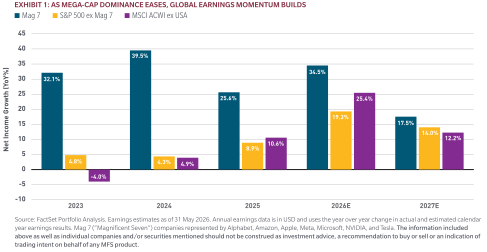
Growing signs of equity market broadening strengthen the argument for global exposure. While the “Magnificent Seven” powered much of the early 2020s’ earnings growth, expectations are now shifting toward wider participation, with the rest of the S&P 500 projected to gain momentum. US SMID-cap stocks have rallied year to date as investors rotate away from mega-caps, supported by a narrowing valuation gap and improving earnings outlook. Although US companies continue to exceed earnings expectations, growth prospects have improved meaningfully outside the US – particularly in Europe and emerging markets. Europe and Japan are likely to benefit from ongoing structural and corporate reforms, while emerging markets are making notable advances in AI, manufacturing, and renewable energy.
Investors are placing greater emphasis on risk management amid heightened geopolitical uncertainty. US equities continue to benefit from AI spending and strong profitability, but elevated valuations and market concentration remain risks. In contrast, non-US equities offer relatively attractive valuations and exposure to different economic drivers, policy dynamics, and currencies. At the same time, broader earnings leadership points to a healthier global economy, which is a constructive backdrop for fixed income, particularly global credit and EM sovereign debt. Despite geopolitical uncertainty, strong corporate fundamentals and improving free cash flows continue to support investment grade bonds, especially higher-quality issuers. While yields have moderated since their 2022 highs, they remain attractive across global credit markets. Moreover, non US assets are well positioned to gain from the potential continued weakening of the US dollar. Taken together, today’s complex environment reinforces the strategic importance of diversifying across asset classes, sectors, and regions to enhance long-term, risk-adjusted returns.
ACTIONS TO CONSIDER |
The Umbrella of Security
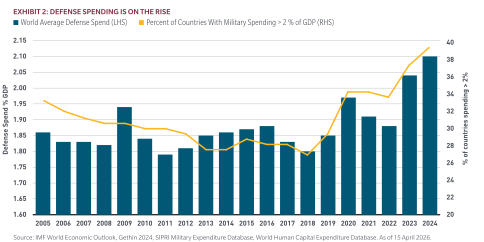
Defense spending is no longer rising gradually — it is accelerating globally. For the first time in decades, every NATO member met its 2% of GDP target for defense spending in 2025. Europe is leading the shift amid the Ukraine conflict, with real defense spending up nearly 20% in both 2024 and 2025. The trend extends beyond Europe: Japan has increased defense spending at a pace of about 10% annually over the past two years despite a pacifist constitution, while the US remains central to the global defense architecture as both a NATO anchor and a major exporter of advanced weapons systems.
History suggests defense spending is cyclical — and we are entering a new upswing. Following decades of relatively muted conflict after the Cold War, a new defense cycle is underway. These periods are rarely funded through growth alone; instead, they typically lead to higher deficits, increased debt issuance, and greater pressure on social spending.
The macro impact is usually mixed: supportive for growth, but inflationary. Higher defense spending can stimulate economic activity, but it also tends to push inflation modestly higher. Today’s geopolitical backdrop reinforces this dynamic. The US is relatively insulated from major energy shocks due to its status as a net exporter of oil and gas, but Europe, which is structurally dependent on oil imports, remains more exposed.
Security now extends beyond military capability. Access to critical resources — especially rare earth minerals used in defense, AI, and advanced technologies — has become strategically important. China’s 2025 export restrictions highlighted this vulnerability, prompting countries to seek alternative sources of strategic minerals. Supply chains themselves are now geopolitical assets, and countries without domestic resources must secure them externally, often at a higher cost.
The “umbrella of security” is expanding — to energy, minerals, and supply chains. Maintaining it will require sustained spending, which will in turn require governments to make difficult choices about what projects to prioritize in budgetary spending. Geopolitics and fiscal policy are increasingly intertwined, and bond markets are responding.
ACTIONS TO CONSIDER |
Navigating AI Disruption
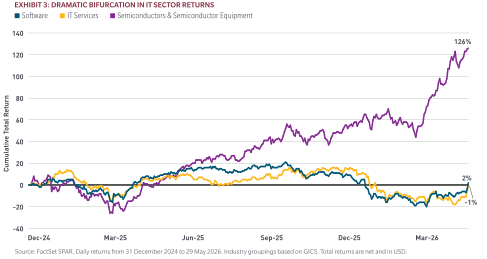
Artificial intelligence is reshaping competitive advantages across industries, creating both powerful opportunities and meaningful risks for investors. Navigating this disruption requires a rigorous analytical process to separate durable winners from vulnerable incumbents. The key question is not simply which companies use AI, but which companies can convert AI into stronger economics. Potential winners may include firms with proprietary datasets, mission critical software, strong customer relationships, pricing power, or the ability to successfully embed AI into existing products to improve productivity and retention. Potential losers may include businesses exposed to automation, commoditization, margin pressure, or customer disintermediation. Investors should evaluate how AI changes revenue growth, cost structures, barriers to entry, capital intensity, and long-term returns on invested capital.
As AI lowers the cost of prediction, automation, and content generation, the market is likely to reward businesses that own scarce, high-quality data assets, control proprietary workflows, or provide critical AI infrastructure. Data-rich businesses can become increasingly strategic because their datasets may improve model performance, deepen customer insight, or reinforce competitive moats. In a world where algorithms are becoming more widely available, differentiated data, distribution, trust, and domain expertise may matter more than the technology itself.
Valuation discipline is equally important. AI enthusiasm can lead to overvaluation for some more obvious beneficiaries while overlooking companies where AI upside is underappreciated or where disruption fears may be excessive. Attractive investment opportunities may emerge where the market misprices the timing, magnitude, or distribution of AI-related benefits. Conversely, high expectations can create risk if valuations already assume flawless execution and rapid monetization.
AI disruption also introduces broader risks and opportunities. Regulatory scrutiny, data privacy worries, intellectual property concerns, cybersecurity threats, model reliability, and implementation costs could all affect adoption and profitability. At the same time, AI can also expand addressable markets, improve productivity, enhance decision-making, and create new business models. The investment challenge is to avoid thematic speculation and instead apply fundamental analysis to identify where AI strengthens — or erodes — competitive advantages and where valuation provides a margin of safety. The opportunity lies not in owning AI broadly, but in understanding how disruption can redistribute value.
ACTIONS TO CONSIDER |
AI Capex is Reshaping Markets
The AI capex buildout is one of the largest corporate investment cycles in modern US history, with implications reaching far beyond technology. As hyperscalers, semiconductor companies, utility companies, industrials, and infrastructure providers invest to support AI workloads, the opportunity set is widening. The growth case remains constructive for compute, connectivity, power, cooling, and the data center buildout. Semiconductor and semiconductor equipment manufacturers are the clearest beneficiaries, but as AI capacity continues to scale, the opportunity spillover is broadening to encompass electrical equipment, power infrastructure, grid modernization, and select industrials.
Hyperscaler spending looks durable because these companies combine strategic urgency with the financial capacity to keep investing. They benefit from strong cash flow, dominant cloud platforms and deep customer relationships. Their scale also creates advantages in procurement, infrastructure efficiency, data access, and model deployment. AI spending is capital intensive, but few companies are better positioned to fund it through the cycle. If AI lifts cloud demand, software adoption and new platform revenues, today’s capex could translate into durable growth.
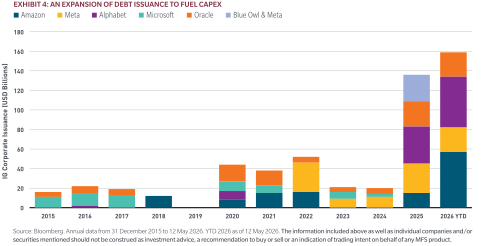
The funding side of the AI buildout, however, matters just as much. The required investment is enormous, and not every participant has the same flexibility as the largest platform companies. Data center developers, utilities, telecom providers, and other infrastructure-linked borrowers may need to lean more on debt, project finance, private capital, or equity issuance. That raises the risk of wider dispersion between companies that can self-fund growth and those facing higher leverage, higher funding costs, or execution risk.
Within fixed income, AI capex is viewed primarily through the lens of funding and technicals rather than growth. Heavier issuance from infrastructure related borrowers could pressure spreads if supply outpaces demand, especially where leverage is rising. So far, demand for AI-linked deals has remained strong enough to keep the market in balance and support valuations. Selectivity is critical, however. Investors need to separate the borrowers funding durable, cash flow-backed infrastructure from those pursuing more speculative expansion. While AI capex is a bullish theme for equities, in credit, the story is more selective, with funding structure, balance sheet capacity, and supply technicals likely to drive outcomes.
ACTIONS TO CONSIDER |
When Supply Meets Scarcity: The Risk of a Production Cost Crisis
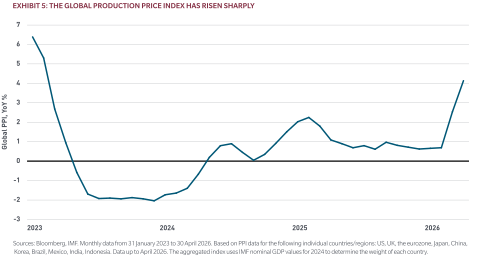
Supply bottlenecks have re-emerged as a defining feature of the current macro environment. This has challenged the post-Global Financial Crisis playbook, which relied on stable costs and expanding margins. As MFS Global Investment Strategist Rob Almeida notes, profits ultimately reflect revenues minus costs — and today, the cost side of that equation is becoming increasingly uncertain.
Labor scarcity is a key risk. Years of underinvestment in physical capacity, combined with rising demand for skilled workers tied to infrastructure and technology deployment, has tightened labor markets. This is pushing wages higher and contributing to structurally elevated cost bases for companies, particularly in sectors reliant on specialized talent.
At the same time, energy and infrastructure constraints are amplifying production costs. The shift toward a more capital-intensive economy — requiring investment in power generation, transmission, and industrial capacity — means companies are increasingly exposed to higher input costs across energy, materials, and logistics. These pressures are not temporary; they reflect a system that entered this cycle underbuilt and is now playing catch-up.
Together, these forces may create upside risk to inflation. Even as demand moderates, supply-side frictions keep cost pressures elevated, limiting the pace at which inflation can normalize. Historically, though inflationary bursts may support pricing power in the short term, they also often embed higher costs that tend to persist, ultimately weighing on margins.
This backdrop calls the resilience of corporate earnings into question. As growth slows and revenues moderate, rising fixed costs — labor, energy, and cost of goods sold — become harder to absorb. Negative supply shocks may simultaneously pressure revenues and raise costs, a combination that accelerates margin compression and can lead to faster-than-expected earnings deceleration.
The implications for investors are uneven. Companies that control scarce resources, own critical infrastructure, or have strong pricing power may be better positioned to protect margins. In contrast, firms operating in commoditized or highly competitive markets may struggle to pass through higher costs. The result is a widening dispersion between winners and losers — making stock selection, rather than broad market exposure, increasingly important in a supply constrained world.
ACTIONS TO CONSIDER |
GARP: Finding Resilient Growth in a Changing Market
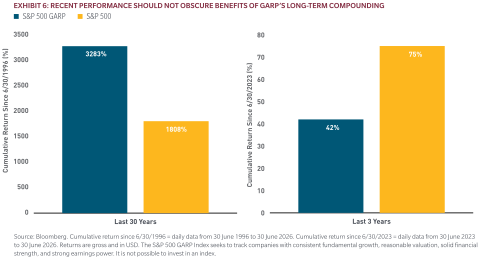
Growth at a reasonable price, or GARP, is an approach to investing in growth businesses where durability of earnings, capital allocation, and valuation all matter. That means focusing on quality compounders at a reasonable price. This approach is especially relevant in a market where investor attention has gravitated toward the most visible growth narratives, leaving other high-quality businesses underappreciated.
The market is entering a more capital-intensive phase, but not every company linked to AI, reshoring, energy security, or supply-chain resilience will benefit. These themes may drive large investment needs, but rising capital intensity can also pressure free cash flow, margins, and returns. The more important question is which businesses have the staying power to absorb investment, protect profitability, and convert spending into durable earnings growth. Some will strengthen competitive positions; others may discover that growth requires more capital than expected and therefore delivers weaker incremental returns.
As disruption spreads across sectors, attractive opportunities may also come from steadier compounders with resilient demand, pricing power, balance-sheet strength, and disciplined reinvestment. These businesses may not look like the most exciting growth stories today, but they can compound through change if they defend returns and reinvest without destroying value. In that environment, adaptability and valuation discipline may matter more than simply having exposure to the most visible structural themes.
The accompanying chart helps frame the long term case. GARP has not been rewarded recently relative to the broader market, particularly during a period when investors have favored momentum, risk appetite, and the most visible growth themes. But over the longer term, compounding returns depend less on chasing the strongest current narrative and more on owning businesses that can sustain earnings growth at reasonable valuations. That valuation discipline is central to GARP: the aim is not simply to own growth, but to avoid paying too much for growth that may prove less durable than expected.
For investors, GARP offers a way to stay anchored in quality, adaptability, and valuation as the market changes. Cycles still matter, and a key risk is mistaking cyclical strength for durable growth and paying too much for earnings when margins are near a high point. But the stronger case for GARP is structural: it can help investors build more resilient portfolios as competition, capital intensity, and sources of growth evolve.
ACTIONS TO CONSIDER |
The Erosion of Dollar Dominance
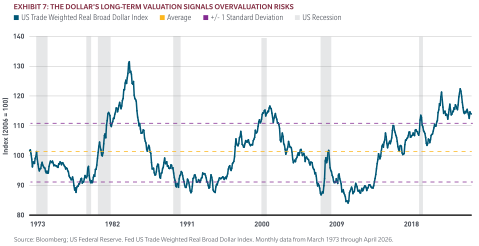
Dollar dominance is eroding at the margin. It is happening slowly and unevenly, but meaningfully. However, the greenback remains at the center of the global financial system, dominating trade invoicing, cross-border lending, international debt issuance, SWIFT payments and FX turnover. Across most major measures of international usage, its share has remained close to 50% over the past 15 years.1
But reserve-currency leadership is not the same as currency strength. A currency can remain systemically important even as investors grow less willing to hold it at stretched valuations — a key distinction. The clearest sign of gradual de-dollarization is in official reserves, where the dollar’s share has fallen by roughly eight percentage points since 2015, while gold and smaller reserve currencies have steadily gained ground.2 This is particularly true for emerging markets, though less so for developed economies.3
The greater risk to the dollar is not its role in global payments, but its role as a store of value. That is where credibility matters most — and where the US backdrop has become more challenging. Tariffs, sanctions, geopolitical fragmentation, renewed nationalism, rising defense spending, and fiscal concerns have combined to weaken the narrative of US exceptionalism. The result is a stronger incentive for global investors and central banks to diversify away from dollar assets, testing the dollar’s traditional safe haven status.
This makes the strategic case for a weaker dollar. Not because the dollar is about to be displaced — it is not. No credible alternative is ready to take its place: Europe still lacks the fiscal union to support a true rival reserve currency, while China would need to open its capital account. But the absence of a successor does not prevent a gradual reallocation away from the dollar.
This backdrop strengthens the case for non-dollar assets in a diversified portfolio. Gold remains a key beneficiary of reserve diversification, while non-US assets should benefit from any shift away from crowded dollar exposure. Emerging markets look especially well placed. A weaker dollar tends to support EM currencies and local debt, and sustained dollar weakness could become a meaningful tailwind for EM returns. In that context, EM should be seen not just as a cyclical trade, but as a strategic portfolio allocation.
ACTIONS TO CONSIDER |
Private Credit: Repricing the Risk
Private credit is facing its first real stress test after years of rapid growth. Signs of strain are emerging across multiple fronts: BDC spreads have widened, non-accruals have risen, and redemption pressures have intensified, with some managers offloading troubled assets via secondary markets. At the same time, structural pressures are building, with AI disrupting software borrowers, who account for around 21% of direct lending, and triggering restructuring processes.4 The opacity inherent to private markets — infrequent marks, limited disclosure, and fragmented reporting — means the full extent of credit deterioration may not yet be visible. Highlighting growing systemic risks, the ECB has warned of potential contagion risks to European insurers.
That said, current stress in private credit is unlikely to pose a material risk to the broader economy. The sector remains relatively small, accounting for around 10% of lending to non-financial corporates, compared with 21% for high yield and leveraged loans.5 As a result, while a slowdown in new lending could place modest upward pressure on credit spreads, the likelihood of a broader credit crunch remains limited, and several factors further mitigate this risk. Committed dry powder provides a near-term buffer to lending activity, while banks retain the capacity to step in as credit providers to such middle-market companies if needed. In addition, excess bank capital is expected to rise following the finalization of Basel III Endgame rules, further supporting credit availability.
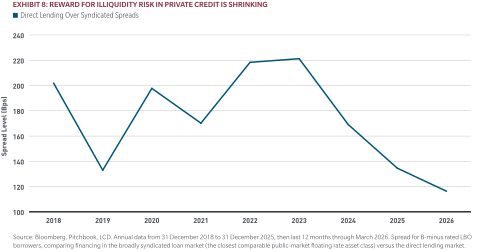
Private credit’s repricing is bringing liquidity back into focus. As the illiquidity premium has narrowed, the case for sacrificing liquidity has weakened. In this environment of rising geopolitical uncertainty, liquidity has become increasingly important. The ability to adjust exposures and respond to shifting conditions has become a risk management imperative rather than an afterthought. Private credit still has a role in diversified portfolios, but allocations should be carefully calibrated to reflect a risk profile that has materially repriced.
This reinforces the relative appeal of public fixed income as a portfolio anchor. Liquid credit markets have remained relatively resilient through recent stress, with yields still attractive despite tight spreads, inflows holding up in the face of heavy hyperscaler-led issuance, and corporate fundamentals showing exceptional strength. In this environment, active management is critical — not only to identify relative value, but to preserve liquidity, maintain flexibility, and adjust exposures as conditions evolve.
ACTIONS TO CONSIDER |
The views expressed herein are those of the MFS Strategy & Insights Group (SAIG) within the MFS distribution unit and may differ from those of MFS portfolio managers and research analysts. These views are subject to change at any time and should not be construed as the Advisor’s investment advice, as securities recommendations, or as an indication of trading intent on behalf of MFS.
1Goldman Sachs. “Dollar Dominance and Dollar Depreciation – Moving on Different Tracks,” September 2025.
2Goldman Sachs. “Dollar Dominance and Dollar Depreciation – Moving on Different Tracks.” September 2025.
3 Deutsche Bank Research. “The Return of History: Gold, the Dollar, and the Monetary Future,” April 2026.
4Sources: JP Morgan. North America Economic Research, “US: Private Credit isn’t a Public Problem.” Abiel Reinhart, Michael Feroli, Nelson Jantzen, Kabir Caprihan, 01 May 2026.
5Sources: JP Morgan. North America Economic Research, “US: Private Credit isn’t a Public Problem.” Abiel Reinhart, Michael Feroli, Nelson Jantzen, Kabir Caprihan, 01 May 2026.
BLOOMBERG® is a trademark and service mark of Bloomberg Finance L.P. and its affiliates (collectively “Bloomberg”). Bloomberg or Bloomberg’s licensors own all proprietary rights in the Bloomberg Indices. Bloomberg neither approves or endorses this material, or guarantees the accuracy or completeness of any information herein, or makes any warranty, express or implied, as to the results to be obtained therefrom and, to the maximum extent allowed by law, neither shall have any liability or responsibility for injury or damages arising in connection therewith.
“Standard & Poor’s®” and S&P “S&P®” are registered trademarks of Standard & Poor’s Financial Services LLC (“S&P”) and Dow Jones is a registered trademark of Dow Jones Trademark Holdings LLC (“Dow Jones”) and have been licensed for use by S&P Dow Jones Indices LLC and sublicensed for certain purposes by MFS. The S&P 500® is a product of S&P Dow Jones Indices LLC, and has been licensed for use by MFS. MFS’ Products are not sponsored, endorsed, sold or promoted by S&P Dow Jones Indices LLC, Dow Jones, S&P, or their respective affiliates, and neither S&P Dow Jones Indices LLC, Dow Jones, S&P, their respective affiliates make any representation regarding the advisability of investing in such products.
Index data source: MSCI. MSCI makes no express or implied warranties or representations and shall have no liability whatsoever with respect to any MSCI data contained herein. The MSCI data may not be further redistributed or used as a basis for other indices or any securities or financial products. This report is not approved, reviewed or produced by MSCI.
This material is for institutional, investment professional and qualified professional investor use only. This material should not be shared with retail investors.
This material is for general information purposes only, with no consideration given to the specific investment objective, financial situation and particular needs of any specific person. This material does not constitute any promotion of or advice on MFS investment products or services. The views expressed are those of the author(s) and are subject to change at any time. These views are for informational purposes only and should not be relied upon as a recommendation to purchase any security or as a solicitation or investment advice. Past performance or any prediction, projection or forecast is not indicative of future performance. The information contained herein may not be copied, reproduced or redistributed without the express consent of MFS. While reasonable care has been taken to ensure the accuracy of the information as at the date of publication, MFS does not give any warranty or representation, expressed or implied, and expressly disclaims liability for any errors or omissions. Information may be subject to change without notice. MFS accepts no liability for any loss, indirect or consequential damages, arising from the use of or reliance on this material.
Unless otherwise indicated, logos and product and service names are trademarks of MFS® and its affiliates and may be registered in certain countries.
Distributed by: U.S. – MFS Institutional Advisors, Inc. (“MFSI”), MFS Investment Management and MFS Fund Distributors, Inc., Member SIPC; Latin America – MFS International Ltd.; Canada – MFS Investment Management Canada Limited. Note to UK and Switzerland readers: Issued in the UK and Switzerland by MFS International (U.K.) Limited (“MIL UK”), a private limited company registered in England and Wales with the company number 03062718, and authorised and regulated in the conduct of investment business by the UK Financial Conduct Authority. MIL UK, an indirect subsidiary of MFS®, has its registered office at One Carter Lane, London, EC4V 5ER. Note to Europe (ex UK and Switzerland) readers: Issued in Europe by MFS Investment Management (Lux) S.à r.l. (MFS Lux) – authorized under Luxembourg law as a management company for Funds domiciled in Luxembourg and which both provide products and investment services to institutional investors and its registered office is at S.a r.l. 4 Rue Albert Borschette, Luxembourg L-1246. Tel: 352 2826 12800. This material shall not be circulated or distributed to any person other than to professional investors (as permitted by local regulations) and should not be relied upon or distributed to persons where such reliance or distribution would be contrary to local regulation; Singapore – MFS International Singapore Pte. Ltd. (CRN 201228809M); Australia/New Zealand - MFS International Australia Pty Ltd (“MFS Australia”) (ABN 68 607 579 537) holds an Australian financial services licence number 485343. MFS Australia is regulated by the Australian Securities and Investments Commission.; Hong Kong - MFS International (Hong Kong) Limited (“MIL HK”), a private limited company licensed and regulated by the Hong Kong Securities and Futures Commission (the “SFC”). MIL HK is approved to engage in dealing in securities and asset management regulated activities and may provide certain investment services to “professional investors” as defined in the Securities and Futures Ordinance (“SFO”).; For Professional Investors in China – MFS Financial Management Consulting (Shanghai) Co., Ltd. 2801-12, 28th Floor, 100 Century Avenue, Shanghai World Financial Center, Shanghai Pilot Free Trade Zone, 200120, China, a Chinese limited liability company registered to provide financial management consulting services.; Japan - MFS Investment Management K.K., is registered as a Financial Instruments Business Operator, Kanto Local Finance Bureau (FIBO) No.312, a member of the Investment Trust Association, Japan and the Japan Investment Advisers Association. As fees to be borne by investors vary depending upon circumstances such as products, services, investment period and market conditions, the total amount nor the calculation methods cannot be disclosed in advance. All investments involve risks, including market fluctuation and investors may lose the principal amount invested. Investors should obtain and read the prospectus and/or document set forth in Article 37-3 of Financial Instruments and Exchange Act carefully before making the investments.