
AI, Inflation, and Stock Selection
AUTHOR
Robert M. Almeida
Portfolio Manager and Global Investment Strategist
Key Takeaways
- The market is shifting from a low-inflation, low-rate world to one defined by higher costs and constrained supply.
- AI is driving growth, but deploying it requires massive investment in real-world infrastructure, which exacerbates current price pressures.
- As costs increase, the difference between companies that set prices and those that accept them grows wider, making stock selection increasingly important.
A New Investment Regime
We’ve written a great deal recently about what we believe is an ongoing paradigm shift, even if it doesn’t always feel that way. Today’s investors often anchor to recent experience, and for good reason: the conditions of the 2010s handsomely rewarded broad market exposure. That decade was defined by low inflation, low interest rates, benign growth and steadily rising valuations. Companies boosted profits through outsourcing, cost-cutting, and financial engineering rather than reinvesting in physical assets. Passive investment strategies thrived due to broad market growth, resulting in generally positive outcomes and limited repercussions for investors.
That backdrop is changing. Since 2022, spending across households, businesses, and governments has accelerated. Inflation has proven more persistent than many expected, and interest rates have moved higher in response. The economy is becoming more capital intensive, and the cost of labor, energy, materials, and equipment is once again a critical factor in determining which companies succeed and which fall behind.
The Physical Reality of AI
Artificial intelligence sits at the center of this transition, but its near-term impact may surprise investors who see it primarily as a cost-saving tool. While AI has the potential to boost productivity over time and will likely be deflationary in the long run as it lowers the barriers-to-entry across many industries and opens the door to new competition, the immediate reality is different. Building AI at scale requires enormous physical investment: data centers, semiconductors, memory, power generation, transmission infrastructure, cooling systems, rare earth materials, skilled labor, and more. The technology itself is digital, but the foundation it runs on is decidedly physical.
This matters because the economy entered this cycle underbuilt. Years of underinvestment left the capital stock depleted, and the infrastructure needed to support AI onshoring and economic resilience simply does not exist at the required scale. Demand for these inputs is rising faster than the physical world can accommodate, and that imbalance is pushing costs higher. This is also one of the key reasons interest rates have remained elevated.
Rising Costs Create Winners and Losers
Higher input costs are now a reality for both consumers and businesses. Households see it in food, electricity, rent, insurance, and transportation. Companies feel it through wages, logistics, materials, energy, and technology spending. These pressures are not temporary; they reflect structural shifts in how the economy operates.
Not every company can absorb or pass through these costs indefinitely. If they could, inflation would be far worse than it is today. Instead, sustained higher costs are likely to redistribute profits across industries and individual businesses. Companies that control scarce resources, supply critical inputs like semiconductors or power equipment, or possess strong pricing power are already demonstrating their advantage. Conversely, companies offering easily replaceable products or services in competitive markets will find it harder to protect margins. Over time, this divergence will produce clear financial performance gaps, and with them, meaningful opportunities for active managers.
Why Stock Selection Matters Now
Two dynamics make careful security selection especially important in this environment. First, when the future no longer resembles the recent past, broad market exposure becomes a less reliable strategy. Passive investing works best when yesterday’s winners continue to win. Active management adds the most value when investors need to distinguish between businesses with durable competitive advantages and those facing structural headwinds that are not yet priced in.
The second key dynamic in today’s market is that equity risk premiums are tight (Exhibit 1). When investors are compensated less for owning broad market risk, the cost of owning an asset with underwhelming financial results is magnified. There is simply less cushion to absorb mistakes, raising the stakes for portfolio construction.
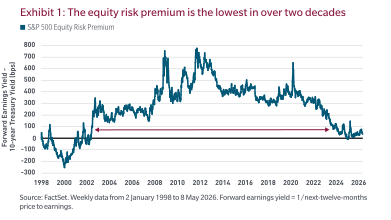
The central question for investors is no longer whether AI will boost productivity. We assume it will. Instead, we should ask: who absorbs the costs in margins, market share, or lost customers? The old regime rewarded financial engineering, duration, and multiple expansion. The new regime is likely to reward scarcity, reinvestment, resilience, and pricing power, and we believe that paradigm shift is already underway.
The S&P 500 Index measures the broad US stock market. Index performance does not include any investment-related fees or expenses. It is not possible to invest directly in an index.
“Standard & Poor’s®” and S&P “S&P®” are registered trademarks of Standard & Poor’s Financial Services LLC (“S&P”) and Dow Jones is a registered trademark of Dow Jones Trademark Holdings LLC (“Dow Jones”) and have been licensed for use by S&P Dow Jones Indices LLC and sublicensed for certain purposes by MFS. The S&P 500® is a product of S&P Dow Jones Indices LLC, and has been licensed for use by MFS. MFS’ Products are not sponsored, endorsed, sold or promoted by S&P Dow Jones Indices LLC, Dow Jones, S&P, or their respective affiliates, and neither S&P Dow Jones Indices LLC, Dow Jones, S&P, their respective affi liates make any representation regarding the advisability of investing in such products.
Companies mentioned are for illustrative purposes only and may not be relied upon as investment advice or as an indication of trading intent on behalf of any MFS product.
Keep in mind that all investments carry a certain amount of risk, including the possible loss of the principal amount invested.
The views expressed are those of the author(s) and are subject to change at any time. These views are for informational purposes only and should not be relied upon as a recommendation to purchase any security or as a solicitation or investment advice. No forecasts can be guaranteed. Past performance is no guarantee of future results.