
In brief
- AI can take over the screen and much of the workflow, but that does not mean it captures the underlying economics.
- A system of record is not an automatic moat. What matters is whether an application, after integrating AI, still produces an exact, authorized, and auditable outcome.
- Because AI affects workflows differently, even within the same company, AI is turning software into a security-selection problem.
For most of us, software is what we see on our screen. We log in, click through menus, enter information, and press submit. If an AI agent can do all of that for us, it is tempting to conclude that the software underneath will become less valuable. Broadly, that is what financial markets have discounted.
Sometimes it will. But that conclusion is not universal.
For much of the past three years, the AI trade appeared straightforward: own companies supplying scarce infrastructure and discount businesses exposed to disruption. This first phase has rewarded thematic exposure, scale, and scarcity. The next stage may be harder.
Earlier this year, we argued that simple data repositories and repetitive workflows were at greater risk, while software built around trust, compliance, and accountability appeared more durable. We still think that is correct. But continued work by the MFS technology sector team suggests that “systems of record” may be too broad a dividing line. The better question is what the system provides after AI takes over the screen. As always, it comes back to who will own the economics.
The Screen Is Not Always the Product
At the risk of oversimplifying, enterprise software does three jobs: 1) remember what happened, 2) move work through an organization, and 3) enforce the rules that make an outcome official.AI is especially capable of much of the second job: taking over the screen, and, increasingly, applying some judgment. An AI agent can gather information, route a task, and initiate an action without a person opening the application, making the software “headless.” But headless does not necessarily mean worthless.
Payroll is a useful example. An AI agent may be able to explain a paycheck or initiate an employee’s requested change. But the payroll system still has to do the work that makes the outcome reliable: calculate the amount owed, apply the relevant rules, verify permissions, create an audit trail, and make the payment official. The customer is not just paying for an answer. It is paying for a reliable, consistent outcome.
By contrast, when AI owns the workflow and the wider context, a system of record may become a filing cabinet. That is to say, still necessary, but no longer a moat. Yet a ledger or procure-to-pay system could lose the screen and retain attractive economics because exact logic, permissions, and authority remain inseparable from the product.
What Matters is the Job, Not the Label
This is why generalizations like “software is vulnerable” or “systems of record are protected” are too crude. A single application can contain both exposed and defensible workflows.
The better unit of analysis is the job being performed. Does the customer need a plausible answer or an exact one? Who must rely on it? How easily can the logic and context be recreated? Does the software merely advise, or can it also approve and execute the transaction?
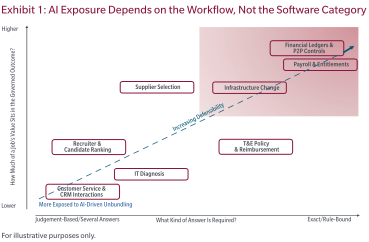
While an equity benchmark includes a company’s stock as a constituent, a fundamental investor can analyze the mix of exposed and defensible workflows within the business and weigh the balance of risks.
An AI Agent Will Still Need the Keys
Imagine the following: a customer disputes an invoice. An AI agent must retrieve the customer history, inspect the contract and invoice, determine whether a correction is allowed, and identify who can approve it. Then, a system with the proper authority must make the relevant change.
Reasoning alone is not enough. An AI agent needs context, permission, and the ability to make the action real.
Model providers bring reasoning. Application vendors bring meaning, rules, and transaction authority. Data platforms provide context. Broader platforms bring identity and distribution. No one owns all of the above today, which is why we doubt a single company will own the entire stack anytime soon. That is unlike parts of Internet 2.0, where customer ownership and network effects produced a handful of concentrated profit pools that heavily influenced equity benchmarks.
Some incumbents may be able to monetize the authority they already own. Others may end up back-end record keepers while someone else owns the workflows and customer relationships — and more of the economics. Either way, “software” is too broad to be the investment conclusion.
For investors, we feel AI’s impact on software is increasingly both a security-selection problem and an opportunity.
Conclusion
The first phase of AI rewarded thematic exposure, scale, and scarcity. The next may demand something harder: connecting product architecture to economic value, pricing power, margins, and returns on capital.
This does not make active management easy; recent performance makes that clear. But an index cannot distinguish between software that is becoming a filing cabinet and software that still sits behind an outcome the customer must trust. A benchmark owns both. Our job is to identify which revenues AI might commoditize, which it might reinforce, and which new profit pools a company can actually keep.
As AI makes answers abundant, the scarce asset may end up being the authority to turn an answer into an action the enterprise can trust.
AI may take the screen. The question for investors is who still owns the outcome.
The information included above as well as individual companies and/or securities mentioned should not be construed as investment advice, a recommendation to buy or sell or an indication of trading intent on behalf of any MFS product.
Keep in mind that all investments carry a certain amount of risk, including the possible loss of the principal amount invested.
The views expressed are those of the author(s) and are subject to change at any time. These views are for informational purposes only and should not be relied upon as a recommendation to purchase any security or as a solicitation or investment advice. No forecasts can be guaranteed. Past performance is no guarantee of future results.
AUTHOR
Robert M. Almeida
Portfolio Manager and Global Investment Strategist