
The central investment question is not where security demand will grow. It is who can capture the security premium, and who will fund it.
This distinction is becoming more important as security reshapes the competitive advantage across an expanding range of industries. In a world increasingly defined by trust, resilience, and control, companies are being rewarded not only for efficiency, but also for reliability and access. The key test is whether security-related demand translates into pricing power, durable cash flow, and returns that justify the capital deployed.
Security is therefore better understood as a stock-selection framework than as a broad sector allocation. The opportunity lies in identifying companies that can invest in security to convert trust, access, and scarcity into economic value without cost muting the return on investment.
Key Takeaways
Security is broadening from a policy concern into an economic force affecting supply chains, infrastructure, technology, energy, raw materials, and strategic capacity.
Policy support can improve demand visibility, but it cannot guarantee attractive returns. As capital demand rises, shareholder outcomes will still depend on capital intensity, execution, competition, and funding costs.
The winners will be companies able to earn a security premium from trust, access, or control while preserving free cash flow and maintaining capital discipline. The cost will fall on those who are required to build resilience without sufficiently charging for it.
Yesterday’s investment framework is becoming less reliable
For much of the past 30 to 40 years, companies were rewarded for efficiency: lowest-cost sourcing, just-in-time logistics, outsourced production, lean inventories, and inexpensive financing. Demand could often be served through existing networks with limited incremental capital.
That model is changing. Customers and governments are asking if supply will be available when needed, whether networks can be trusted, where production is located, and how systems will perform under cyber, geopolitical, or operational stress. These questions are rewiring supply chains around resilience and strategic control.
The economic consequences differ sharply by company. Some businesses can charge for trusted access, scarce capabilities, or mission-critical reliability. Others must carry more inventory, duplicate capacity, or relocate production without gaining pricing power. Security strengthens the competitive advantage for some companies and raises the cost of competing for others.
Efficiency still matters. But in a more fragmented world, reliability, control, and access increasingly influence margins, capital intensity, and cash conversion.
Governments are becoming allocators of strategic capital
Governments are increasingly shaping where capital is deployed through procurement, fiscal incentives, export controls, strategic stakes, and public-private partnerships. These tools shape demand, capacity, market access, and financing conditions across defense, energy, semiconductors, critical materials, and infrastructure.
Policy support improves revenue visibility and reduces some forms of uncertainty. It does not eliminate return risk. Procurement contracts may limit upside or transfer execution risk to suppliers. Incentives may encourage investment without changing industry cyclicality. Protected demand can attract new capital, intensify competition, and leave minority shareholders exposed to policy objectives that differ from their own.
The distinction is whether that support improves project economics or simply funds more of the same. If incentives merely encourage more investment into structurally lower-return assets, strategic importance can coexist with disappointing shareholder outcomes.
When demand gets physical
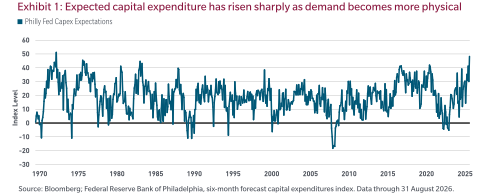
The emerging security agenda is increasingly tied to physical systems. Datacenters need power, grid connections, cooling, land, semiconductors, and other supporting infrastructure. Resilient supply chains require materials, manufacturing capacity, inventories, logistics, and trusted production. Defense, energy security, grid reliability, AI infrastructure, and reshoring all compete for overlapping pools of capital, labor, power, engineering capability, and permitting.
Competing for the same inputs raises costs, delays projects, and makes execution a central part of the investment case. Some capacity will be built because it is strategically necessary, not because it is naturally high return. Governments and customers may accept the cost of redundancy or domestic production, but equity investors still need to determine who pays for it and whether shareholders are adequately compensated.
A broader capital cycle raises the investment bar
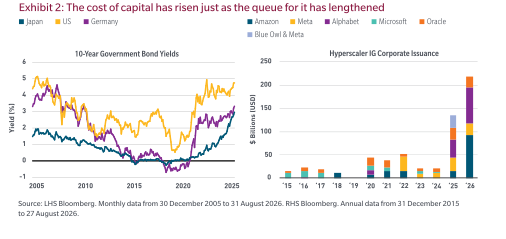
As the security agenda broadens capital spending beyond hyperscalers and AI infrastructure into grids, defense, energy security, raw materials, and strategic manufacturing, it will not occur in a vacuum. It arrives alongside already heavy public borrowing, as governments fund new security priorities, refinance existing debt at higher rates, and meet aging-related commitments. Savings are finite, and when public and private borrowers draw on the same pool, capital is rationed by price. That sensitivity is visible in debt management itself. The US Treasury has shown an appetite for shaping the maturity profile of issuance to relieve pressure on the long end of the curve. Such measures do not resolve the underlying fiscal position, but they do show that debt supply and term premia are now live constraints rather than background conditions.
That changes the equity question. A broader capex cycle may support nominal growth and selected corporate revenues, but it can also raise the hurdle rate for value creation. If the same forces that lift demand also increase financing costs, discount rates, and pressure on free cash flow, shareholders may not capture the full benefit.
Security may lift demand, but capital still has a price.
Who earns the security premium, and who funds it?
Strategic importance is not the same as investment attractiveness. A company may be essential to national or economic security and still fail to earn attractive returns if it lacks pricing power, over invests well ahead of demand, operates under regulated economics, or competes in a market where policy support attracts too much capital.
Exhibit 3: Exposure does not equal advantage
| Category | What it captures | Key investor question |
| Beneficiaries | Companies that can earn a security premium | Does strategic relevance improve pricing, cash flow, and returns? |
| Beneficiaries | Companies that can earn a security premium | Are margins, valuation, execution risk, and cyclicality manageable? |
| Cost-bearers | Companies that absorb the higher cost of resilience | Can they pass through those costs without weakening demand or returns? |
The strongest candidates provide mission-critical goods or services, offer trusted access to scarce products or networks, or occupy a control point in the value chain that is difficult to replicate. They also need the balance sheet strength and capital discipline to invest without destroying returns, as well as policy support that is durable rather than temporary or politically fragile.
These categories are not fixed. A beneficiary can become a cost-bearer if competition increases, capital intensity rises, or policy changes. An enabler can create significant value if it retains a bottleneck position and pricing power or disappoint if supply expands too quickly.
What investors need to underwrite
Across sectors and regions, the analytical framework is consistent. Investors should assess:
- Pricing power: Can the company charge for trust, reliability, scarcity, or access?
- Capital intensity: How much investment is required, and when will cash flow follow?
- Return spread: Will incremental returns on invested capital exceed the cost of capital?
- Control points: Does the company occupy a defensible position that is difficult to replicate or displace?
- Policy durability: Is support likely to survive political change, and how are the benefits shared?
- Capital-cycle risk: Could policy attention and subsidies attract enough new supply to undermine long-term returns?
- Valuation: Is the expected security premium already reflected in the share price?
The sector implications are broad. Energy and grid infrastructure may benefit from investment in reliability and transmission. Technology companies may benefit from the demand for trusted networks, critical semiconductors, and bottleneck infrastructure. Selected materials and industrial businesses may gain from strategic demand and supply-chain localization. But sector exposure should not be the starting point. Within each area, companies will differ materially in pricing power, funding needs, execution risk, and capital discipline.
Conclusion: Security creates dispersion, not automatic winners
Security is becoming increasingly valuable across the global economy, but value creation will not accrue evenly. As governments, businesses, and consumers place a greater premium on reliability, continuity, and secure supply, demand for security umbrellas is likely to rise across a broad set of industries. Yet security umbrellas will have to be built, duplicated, or held in reserve, and the capital to do so is neither free nor unlimited.
The task, therefore, is to identify where security improves the economics rather than simply adding cost. The most attractive opportunities lie not in the companies most exposed to security, but in those able to convert trust, access, and scarcity into returns that remain durable even as capital flows toward them.
That is bottom-up work, and the answer changes as prices move. Exposure to the theme is easy to obtain. Being paid for it, rather than paying for it, is not.
Source: Bloomberg Index Services Limited. BLOOMBERG® is a trademark and service mark of Bloomberg Finance L.P. and its affiliates (collectively 'Bloomberg'). BARCLAYS® is a trademark and service mark of Barclays Bank Plc (collectively with its affiliates, 'Barclays'), used under license. Bloomberg or Bloomberg's licensors, including Barclays, own all proprietary rights in the Bloomberg Barclays Indices. Neither Bloomberg nor Barclays approves or endorses this material, or guarantees the accuracy or completeness of any information herein, or makes any warranty, express or implied, as to the results to be obtained therefrom and, to the maximum extent allowed by law, neither shall have any liability or responsibility for injury or damages arising in connection therewith.
The information included above as well as individual companies and/or securities mentioned should not be construed as investment advice, a recommendation to buy or sell or an indication of trading intent on behalf of any MFS product.
The views expressed herein are those of the MFS Strategy and Insights Group within the MFS distribution unit and may differ from those of MFS portfolio managers and research analysts. These views are subject to change at any time and should not be construed as the Advisor’s investment advice, as securities recommendations, or as an indication of trading intent on behalf of MFS. No forecasts can be guaranteed.
No investment style can guarantee a profit or protect against a loss. Past performance is no guarantee of future results.
Keep in mind that all investments, including mutual funds, carry a certain amount of risk, including the possible loss of the principal amount invested.
Diversification does not guarantee a profit or protect against a loss. Past performance is no guarantee of future results.
AUTHOR
ROSS CARTWRIGHT
Lead Strategist,
Strategy and Insights Group