
AI Driving Stress in Software Stocks
AUTHOR
Robert M. Almeida
Portfolio Manager and Global Investment Strategist
In brief
- Technology, especially AI, is deflationary and disrupts business models built on existing frictions.
- Financial markets are concerned that AI could lead to excess software supply and weaken pricing power.
- Periods of uneven disruption can create opportunities for active managers.
Technology is inherently deflationary: it reduces friction by creating cheaper, more efficient solutions, which leads to economic surplus. For businesses whose revenue models are tied to the very frictions being removed, however, the impact on profits is rarely benign.
As large as the hopes and promises surrounding artificial intelligence may be, so too are the unknowns. Financial markets are confronting this tension in software, where AI threats loom large, as shown in the exhibit below.
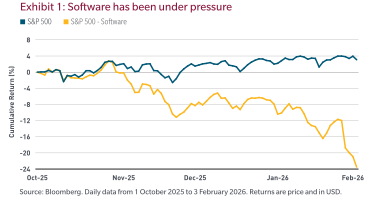
Importantly, this is not a judgement from the market about near-term growth. It instead represents a deeper concern that AI may breed excess software supply, erode pricing power, and ultimately challenge the durability of returns and the duration of growth.
The Devil is in the Details: Four Ways AI Impacts Software
Software is not a monolithic industry; AI’s impact will vary meaningfully by business model and use case. While some areas face real displacement risk, others are more resilient, and in some cases, AI may even strengthen their value proposition. As MFS software analyst and technology sector leader Matt Doherty describes, the impacts of AI can be grouped into four broad categories. We share below where the team believes the risks are real and where they may be overstated.
AI Makes It Easier to Build Software In-House
In theory, AI-powered code generation, also known as “vibe coding,” will allow enterprises to build software internally, reducing reliance on third-party vendors.
In practice, however, this risk appears low. While AI lowers the technical barriers to code development, enterprise software buying decisions are typically dictated by non-technical factors such as security, compliance, governance, reliability, and others. Recent commentaries from CIOs reinforce this. Simply put, writing code is only a small part of owning and operating mission-critical software.
AI Lowers Barriers-to-Entry for New Software Vendors
Technology consistently bends cost curves, enabling new businesses and even entire industries to emerge where prohibitive cost structures once existed. This is certainly true in software, which has led to investor concerns about increased competition and weaker moats.
However, software’s attractive margins and high returns on capital have always invited venture investment and competition. Verticals like CRM (customer relationship management), ERP (enterprise resource planning), accounting, and customer support have seen thousands of entrants over the last few decades, yet incumbents such as HubSpot, Intuit, and others have still grown their market share. Increased competition does not automatically imply the destruction of durable advantages like distribution, switching costs, ecosystems, and brand trust.
AI-Native Architectures and the Future of Pricing Models
The prospect of agentic AI is driving fears of high obsolescence risk in software businesses with traditional, seat-based pricing models. The reality, we think, will be a hybrid. Many leading AI-native applications utilize seat-based pricing. This reflects customers’ preference for cost certainty. While this kind of consumption-based pricing works well in infrastructure, applying it to business workflows introduces budgeting uncertainty due to the absence of clear labor replacement or tangible ROI for the customer.
Over time, pricing models will likely evolve toward a blend of seats and value-based outcomes. Importantly, established software companies have successfully navigated major business model transitions before, creating significant opportunities for active investors.
Value Migration Toward Large Language Models and Vertically Integrated Platforms
This is where the most structural risk lies, and it is probably the most complicated scenario, so an analogy might be helpful. We can think of software applications as restaurants and AI as a delivery super-application.
Restaurants owned the customer relationship. Then delivery apps emerged, controlled demand, and took a share of the economics. While the restaurant still prepares the food, the interface and customer loyalty have shifted. In this metaphor, software is the restaurant, data is the food, and the AI model is the delivery platform.
This risk is real, but we don’t believe it is universal. Software that is a mere data repository, or workflows that are repetitive and where switching costs are low, has the potential to be disintermediated. But code that is embedded within deep, complex workflows that require trust, compliance and accountability will be much more difficult to displace. The application is the workflow, not just the data and certainly not just the code.
The emergence of LLMs isn’t necessarily a death sentence for software but instead represents a shift where value might accrue over time and offer immense opportunity for investors with fundamental insights.
Conclusion
Outside of software, investors are generally thinking about AI as a catalyst for another productivity cycle for businesses. While that may prove true, productivity gains have historically been competed away. As AI drives down costs and barriers-to-entry in other industries, new competition emerges, reshaping profit pools and upending the stock prices of businesses dependent on outdated bottlenecks. AI may increase the probability of both outsized winners and permanent losers within the same industry.
Such circumstances highlight the significance of active management. During periods of uneven disruption, core fundamentals — including business models, incentive structures, customer dynamics, and adaptability — become critical determinants of success.
“Standard & Poor’s®” and S&P “S&P®” are registered trademarks of Standard & Poor’s Financial Services LLC (“S&P”) and Dow Jones is a registered trademark of Dow Jones Trademark Holdings LLC (“Dow Jones”) and have been licensed for use by S&P Dow Jones Indices LLC and sublicensed for certain purposes by MFS. The S&P 500® is a product of S&P Dow Jones Indices LLC, and has been licensed for use by MFS. MFS’ Products are not sponsored, endorsed, sold or promoted by S&P Dow Jones Indices LLC, Dow Jones, S&P, or their respective affiliates, and neither S&P Dow Jones Indices LLC, Dow Jones, S&P, their respective affiliates make any representation regarding the advisability of investing in such products.
Index data source: MSCI. MSCI makes no express or implied warranties or representations and shall have no liability whatsoever with respect to any MSCI data contained herein. The MSCI data may not be further redistributed or used as a basis for other indices or any securities or financial products. This report is not approved, reviewed or produced by MSCI. It is not possible to invest directly in an index.
Keep in mind that all investments carry a certain amount of risk, including the possible loss of the principal amount invested.
The views expressed are those of the author(s) and are subject to change at any time. These views are for informational purposes only and should not be relied upon as a recommendation to purchase any security or as a solicitation or investment advice. No forecasts can be guaranteed. Past performance is no guarantee of future results.