
In brief
- Risks from AI disruption are widening beyond software.
- AI can both erode and widen economic moats.
- Disruption brings opportunity, but seizing it requires deep analysis and collaboration.
In our last Strategist’s Corner, “AI Driving Stress in Software Stocks,” we highlighted the disruptive risks facing the software industry. We argued that AI is not simply a productivity enhancement tool layered onto existing products; it is a force that may reduce switching costs and accelerate competition in software. But while the risks are real, they aren’t equally distributed.
While the simple workflows or data repositories of today are likely to be replaced by AI, the deeply-embedded code powering complex workflows that rely on trust and accountability may instead be bolstered by AI. And since the release of the aforementioned piece, market fears have extended beyond software.
The Discount Lens Widens
What initially appeared to be a software-specific repricing now looks increasingly like a broadening of disruption risk across multiple industries, as shown below.
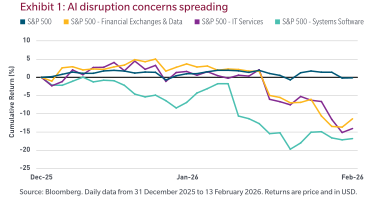
The common thread is not technology exposure per se, but rather business models whose economics are a function of information asymmetry or manual processes.
More specifically, we thought it would be helpful to categorize these businesses by type.
- Information asymmetry – These are businesses built on proprietary knowledge or research advantages such as ratings agencies or index providers.
- Human expertise – Firms where people are the product — specifically, advice, design, coding, analysis or other cognitive services. Customers are paying for judgement and expertise.
- Process friction – Many workflows require scale, coordination or manual effort, such as payroll processing or credit/background checks. These are their barriers to entry.
- High marginal cost structures – Businesses where labor is the primary input cost and services are repeatable or process driven.
AI challenges each of these: it may lower the cost of cognition, accelerate iteration, or reduce the time required to replicate capabilities. This introduces uncertainty around the durability of margins and long-term competitive positioning, which of course is ultimately what the market cares about and why volatility is rising and spreading among these stocks.
However, disruption is not synonymous with destruction. As we’ve noted previously, AI can be both a moat destroyer and a moat amplifier. While commoditization is a real risk for some application-layer providers, infrastructure and data-layer businesses could in fact experience the opposite dynamic. Databases, data management platforms and mission-critical systems of record may see increased strategic value in an AI-enabled world. As AI models proliferate, the importance of clean, proprietary, well-governed data should rise.
Volatility reflects the market’s effort to reprice a shifting distribution of future outcomes. Much is changing quickly, whether through new unknowns or challenges to prior profit assumptions.
Periods like this bring risk — but also opportunity. It is up to us to underwrite where competitive advantages are eroding and where they may strengthen.
Jevons’ Paradox: Framing AI Risks and Opportunities
In the 19th century, economist William Stanley Jevons observed that improved efficiency increases consumption. He saw that as coal became cheaper, it powered more applications, expanded industrial output, and drove greater total demand.
We’ve recently seen similar dynamics in technology. As computing power has become cheaper, we don’t use fewer chips. Rather, we have embedded computing into nearly every device and workflow. Similarly, as cloud storage costs declined, data volumes exploded.
AI may produce a comparable effect, as reductions in the costs associated with generating analysis, code, content, advice and the like could lead to increased demand for these value-added outputs rather than a decline. For example, if AI reduces the cost of analyzing financial data, investors may demand more analytics, scenarios, and real-time insights, increasing total data consumption and enhancing the strategic value of some of the businesses being discounted by investors today.
For businesses with proprietary data, embedded workflows, or distribution scale, lower marginal costs may translate into higher usage and stronger network effects. If AI boosts returns to scale by leveraging data, fine-tuning models, or handling integration challenges, established companies with existing strengths may further extend their lead.
In that sense, what we’re witnessing may be less a wholesale erosion of profitability and more a reallocation of profit power within industries.
Conclusion
Our task as investors is not to broadly categorize industries as “AI winners” or “AI losers,” but to assess where competitive advantages are reinforced and where they’re undermined. The durability of moats and not the mere presence of any given technology, we think, is the critical question for investors.
Periods of structural change rarely reward prior assumptions. Benchmarks reflect the past, not the future. In such environments, the ability to form differentiated views becomes increasingly valuable, requiring deep analysis and collaboration rather than extrapolation.
When the market applies a broad “guilty until proven innocent” framework, careful underwriting can distinguish between structural erosion and strengthening. The opportunity lies not in predicting the pace of AI adoption, but in identifying where economic power is likely to concentrate and where it may fade.
“Standard & Poor’s®” and S&P “S&P®” are registered trademarks of Standard & Poor’s Financial Services LLC (“S&P”) and Dow Jones is a registered trademark of Dow Jones Trademark Holdings LLC (“Dow Jones”) and have been licensed for use by S&P Dow Jones Indices LLC and sublicensed for certain purposes by MFS. The S&P 500® is a product of S&P Dow Jones Indices LLC, and has been licensed for use by MFS. MFS’ Products are not sponsored, endorsed, sold or promoted by S&P Dow Jones Indices LLC, Dow Jones, S&P, or their respective affi liates, and neither S&P Dow Jones Indices LLC, Dow Jones, S&P, their respective affiliates make any representation regarding the advisability of investing in such products.
The Index data source: MSCI. MSCI makes no express or implied warranties or representations and shall have no liability whatsoever with respect to any MSCI data contained herein. The MSCI data may not be further redistributed or used as a basis for other indices or any securities or financial products. This report is not approved, reviewed or produced by MSCI. It is not possible to invest directly in an index.
Keep in mind that all investments carry a certain amount of risk, including the possible loss of the principal amount invested.
The views expressed are those of the author(s) and are subject to change at any time. These views are for informational purposes only and should not be relied upon as a recommendation to purchase any security or as a solicitation or investment advice. No forecasts can be guaranteed. Past performance is no guarantee of future results.
AUTHOR
Robert M. Almeida
Portfolio Manager and Global Investment Strategist