
Key Takeaways
- Price is what the market offers; value is what the business can justify. Valuation is the discipline that connects the two.
- High valuations raise the burden of proof. The higher the price paid, the more confidence investors need in the durability of future cash flows.
- Valuation keeps investors anchored to business ownership. The goal is not to avoid growth or innovation, but to test which fundamentals can justify the price and which narratives assume too much.
Valuation is the discipline of underwriting future cash flows, assessing business durability, and determining whether the price paid offers adequate compensation for risk. In markets shaped by powerful themes like AI, we believe that valuation discipline becomes more important, not less, because elevated expectations leave little margin for error. The risk is often not believing in the wrong theme, but paying a price that assumes the theme will unfold perfectly.
The Enduring Role of Valuation
Every cycle seems to produce a reason valuation should matter less. In the late 1990s, it was the internet. In the mid-2000s, it was financial innovation and housing. Today, it is artificial intelligence, abundant liquidity, policy support, capital-light business models, and the scale advantages of dominant platforms. The details differ, but the question is the same: when investors pay a high price for an attractive future, what needs to go right?
Price reflects what investors are currently willing to pay, influenced by sentiment, liquidity, positioning, and the expectations embedded in market prices. Value, on the other hand, reflects the long-term economic reality of a business: its ability to generate durable cash flows, reinvest capital at relatively attractive rates, and withstand competitive and cyclical pressures.
Over short periods, price and value can diverge materially. Stock prices can move much faster, and sometimes much further, than the underlying economics of the business. That does not make the market irrational. It simply means price action may reflect liquidity, positioning, risk appetite, and a shifting narrative as much as changes in long-term business performance. The gap between price and value is therefore both the opportunity and the risk that disciplined valuation work is designed to assess.
Valuation Reveals What the Market Already Expects
Effective valuation requires identifying the market implied assumptions. The relevant question is not simply whether an asset appears expensive or cheap on a conventional multiple. Multiples can be useful shorthand, but they are outputs, not conclusions. They only become meaningful when tested against the durability, growth, and risk of the future cash flows they imply. The better question is: what must occur to justify today’s price? The objective is not to call the top of a cycle. It is to understand what today’s prices require from tomorrow’s earnings power. The higher the price relative to fundamentals, the less tolerance there is for disappointment. In this sense, valuation converts a story about the future into a required level of earnings, cash flow, and return on capital.
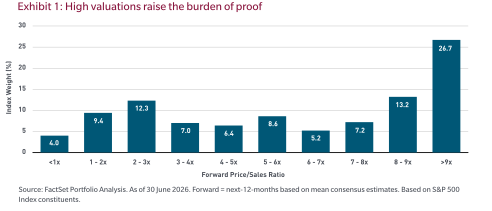
The arithmetic of high sales multiples is typically unforgiving. Investors are underwriting sustained revenue growth, meaningful margin expansion, and durable competitive advantages well into the future. The higher the valuation, the less room there is if those assumptions fall short.
Because the future is uncertain, valuation should test a range of plausible outcomes rather than rely on a single precise forecast. We believe that this is where the margin of safety becomes essential: it exists when the price paid is meaningfully below a conservative estimate of value, helping protect investors from forecasting errors, business setbacks, and shifts in the market environment. The objective is not precision but discipline: assessing whether prospective returns adequately compensate for the risks being underwritten.
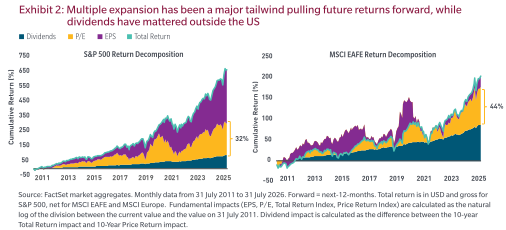
A valuation framework is not the same as owning statistically cheap stocks. A company can trade at a high multiple and still be considered attractive if its cash generation, reinvestment opportunities, and competitive advantages justify the price. Equally, a low multiple can be seen as a value trap if the business lacks staying power, faces deteriorating returns on capital, or cannot defend its cash flows through a cycle. In this sense, valuation analysis can support high conviction in growth companies; it does not rule out high-multiple stocks: it rules out prices that assume more than the business can reasonably deliver. A meaningful portion of recent equity market returns has come not from earnings growth or cash-flow improvement alone, but from investors being willing to pay higher multiples for those fundamentals.
Valuation and the Ownership Mindset
One of valuation’s most important roles is to help cultivate an ownership mindset: treating stocks as fractional interests in real businesses, not just symbols moving across a screen. That means focusing on business fundamentals, competitive advantages, balance sheet strength, reinvestment opportunities, and management’s capital allocation.
By contrast, a market participation mindset prioritizes price action and what others may do next, turning a stock into a vehicle for sentiment rather than a claim on long-term cash generation.
When a stock is treated only as a price, the investor has shifted from evaluating a business to trading a symbol. Price can be observed instantly, but value must be analyzed. It requires diligence: examining whether a company can sustain returns on capital, defend its competitive position, reinvest profitably, and manage the risks to future cash flows.
Momentum or sentiment shifts may reward traders for a time, but long-term investors ultimately depend on business performance and the price paid for it. Even an excellent company can disappoint if its price assumes perfection, while an unpopular business with durable cash flows can reward investors when expectations are too low.
By anchoring investors to business economics, valuation can help investors distinguish between a great story and a great investment.
Discipline in Optimistic Markets
High valuations are not, by themselves, a reason to avoid an investment. They are a reason to apply a higher standard of evidence. The more optimistic the expectations embedded in the price, the less room there is for disappointment. A disciplined investor can admire a company, respect its management, believe in its products, and still conclude that the stock price reflects too much optimism. The quality of a business and the attractiveness of its investment return are related, but they are not the same thing.
Take the Nifty Fifty stocks of the 1970s as an example. These dominant US growth companies were widely treated as “one-decision” stocks to buy and hold indefinitely, regardless of price. As enthusiasm intensified, many traded at valuations upwards of 50–60 times earnings. When the 1973 Oil Embargo triggered rising inflation, higher rates, and a broader market downturn, their stock prices fell sharply. Many businesses remained operationally strong and kept growing; the problem was that valuations and expectations had become detached from realistic future returns.
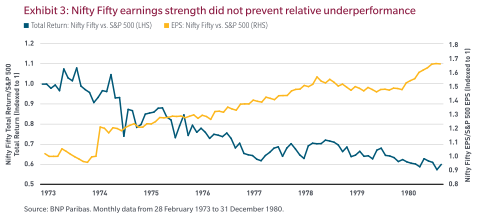
Valuation matters most when confidence is highest because in our experience that is when uncertainty is most likely to be underpriced. Rising prices can create the impression that risk has declined even as expectations become increasingly demanding.
This is why valuation can feel least useful when it is most needed. Markets adapt to what is working: successful strategies attract capital, become crowded, and eventually embed expectations that become harder to satisfy. Exhibit 4 illustrates this adaptive process. As investors crowd into perceived winners, the valuation premium over perceived losers widens, raising the bar for future returns.
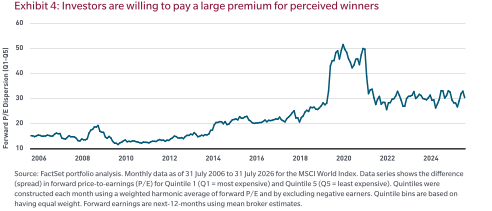
The wider the valuation gap between perceived winners and the rest of the market, the greater the future return becomes dependent on continued execution and sustained investor enthusiasm.
Applying Valuation Discipline: An Underwriting Framework
Viewed through an ownership lens, valuation becomes a practical underwriting framework for testing the assumptions implied by a price.
- What outcomes does today’s price already assume?.
- Can the company sustain cash flows and returns on capital through different market conditions?.
- Are investors being adequately compensated for the risks being underwritten?.
- Is performance being driven by business fundamentals or multiple expansion?.
A disciplined valuation process helps separate companies whose fundamentals support their valuations from those priced for near-perfect execution.
Conclusion
Valuation is not a rejection of growth, innovation, or change. It is the discipline of recognizing that even exceptional businesses can be poor investments when the price already discounts too much of the future. In markets driven by compelling narratives, valuation keeps investors anchored to what they actually own: a claim on future cash flows, not simply exposure to a story. Ultimately, we believe that it separates admiration for a business from a sound investment in it.
The views expressed herein are those of the MFS Strategy and Insights Group within the MFS distribution unit and may differ from those of MFS portfolio managers and research analysts.
These views are subject to change at any time and should not be construed as the Advisor’s investment advice, as securities recommendations, or as an indication of trading intent on
behalf of MFS. No forecasts can be guaranteed.
No investment style can guarantee a profit or protect against a loss. Past performance is no guarantee of future results.
Keep in mind that all investments, including mutual funds, carry a certain amount of risk, including the possible loss of the principal amount invested.
AUTHORS
ROSS CARTWRIGHT
Lead Strategist, Strategy and Insights Group
KELLY GARRETT
Sr. Analyst, Strategy and Insights Group