
In summary
- Internet 2.0 served the last customer at almost no cost.
- AI can make it more costly to win, serve, and keep the next customer.
- As a result, selectivity matters more now.
In my 27 years at MFS, one axiom has stood out in the Investment Department: “the last customer is the most profitable.” Once a platform, factory, or network is created, the associated fixed costs are absorbed. The first customers help pay for that infrastructure buildout, and the last ones get to ride on it.
Internet 2.0 amplified that logic. An established platform could serve a new user at little cost, while more users strengthened data, distribution, and switching costs. The cost of serving the next customer fell as barriers facing competitors rose, allowing incremental margins to expand.
Investors treated those economics as normal, a belief reinforced by passive investing. In reality, they belonged to a unique capital cycle in which capital intensity was falling and competition was muted.
The Next Customer
Now, AI is throwing down an economic UNO reverse card.
Companies are directing more capital into datacenters, power systems, and semiconductors, as well as factories and supply chains. Meanwhile, AI is lowering the cost of trying new things, drawing more challengers into profit pools.
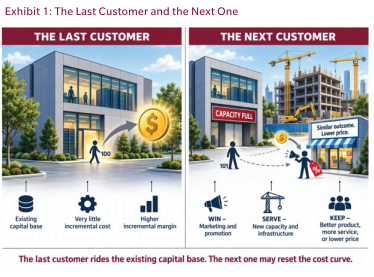
The last customer served by an existing platform may remain extraordinarily profitable because the investment has already been made. But the next platform may require a larger capital base. Once capacity fills, more demand may require another datacenter, power commitment, or production line. Keeping that customer may also require a better product, more advertising, better service, or a lower price.
As Exhibit 1 illustrates, the next dollar of revenue may arrive with a much larger bill attached.
Win, Serve, and Keep
The next customer can bring three additional costs.
First is the cost to win: digital distribution and AI create more competitors, but not more hours in the day. Winning attention may require more content and marketing.
Second is the cost to serve. The cloud feels weightless, but it runs on expensive power, memory, and compute. Internet 2.0 companies often added users at almost no incremental cost. Conversely, many AI services need more infrastructure as usage rises.
Third is the cost to keep. Digital channels and flexible supply chains let specialists reach customers without recreating an incumbent’s organization. The leader may spend more while enjoying less pricing power.
The incumbent need not disappear for its economics to weaken — it need only earn a lower return on the next dollar. This is where active management becomes critical, separating businesses that can compound the next dollar from those spending more merely to defend the last one.
Growth Is Not Return
Suppose a company earns $10 on $100 of capital: a 10% return. If earning the same $10 required $200, the return would fall to 5%. The accounting profit is unchanged, but the economics are not. That distinction matters to stock prices.
This is where compounders and cyclicals separate. These are not sector labels, but descriptions of how returns behave as capital and competition respond.
A true compounder reinvests at attractive returns across a full cycle. A cyclical, on the other hand, can resemble a compounder during periods of scarcity, when revenue, margins, and returns rise together. But high returns attract capital and competition, and if the next customer requires more capacity just as pricing power weakens, the business may end up extending a cycle rather than compounding value.
Investors use the word “quality” too loosely. Quality does not simply mean high margins today. Quality is the ability to reinvest profitably through a full cycle and avoid the math of the bust. The market may reward the fastest grower during the boom, but long-term investors earn the full-cycle return.
The Investment Question
The question is no longer simply how quickly a company can add customers. It is whether the profit from the next customer exceeds the capital required to win, serve, and keep it.
That leads to three tests: Does the business earn above its cost of capital today? Can it reinvest the next dollar at an attractive return? And, most importantly, after customers and competitors respond, can that business keep its gains?
The prior cycle rewarded exposure to established profit pools. The emerging cycle should reward selectivity. A benchmark owns companies at today’s weights. Fundamental investors can assess whether the next dollar of growth creates value before the index adjusts.
The last customer may still be the most profitable, but in the next capital cycle, investors can no longer take that as a given. Investors abandoning active management today may be jumping out the basement window, giving up on selectivity just as it begins to matter more.
Individual securities mentioned are for illustrative purposes only and may not be relied upon as investment advice or as an indication of trading intent on behalf of any MFS product.
Keep in mind that all investments carry a certain amount of risk, including the possible loss of the principal amount invested.
The views expressed are those of the author(s) and are subject to change at any time. These views are for informational purposes only and should not be relied upon as a recommendation to purchase any security or as a solicitation or investment advice. No forecasts can be guaranteed. Past performance is no guarantee of future results.
AUTHOR
Robert M. Almeida
Portfolio Manager and Global Investment Strategist