
Key Insights
The time might be right for the broader use of global credit in fixed income portfolios. In our view, the asset class combines meaningful diversification across countries, sectors and issuers with supportive macro and corporate fundamentals, attractive starting yields and the flexibility to help investors either de-risk from equities or selectively re-risk from sovereign duration. In a more fragmented macro environment, global credit can provide a resilient source of income and a more balanced return potential, with active management helping investors capture the breadth of the opportunity set while avoiding weaker areas of the market. This paper explores the five key reasons that we believe make the case for including global credit in fixed income portfolios as part of an active management approach:
- Broader diversification across regions, sectors and issuers can improve portfolio resilience
- Supportive global growth and resilient corporate fundamentals underpin the asset class
- Starting yields remain attractive by historical standards, supporting income and return potential
- Global credit can serve de-risking objectives
- It is also an attractive re-risking asset class
1. Global credit offers compelling diversification benefits
More than ever, the need for global diversification appears critical. The sources of global risk have multiplied. Investors are simultaneously navigating challenges and risks, including geopolitical fragmentation, rising fiscal concerns, global trade tensions, sticky inflation dynamics, private credit stress, climate-related disruptions and demographic pressures, among others. A high degree of country or regional concentration could therefore be misguided against this backdrop.
In an environment defined by uncertainty, macro and policy divergence and a less-reliable US-only playbook, global credit stands out as a compelling asset class for investors seeking broader diversification within fixed income. By investing across regions, sectors and issuers, global credit can help reduce concentration risk, expand the opportunity set and create a more balanced source of income and return potential. Rather than relying on one economy, one policy cycle or one credit market, investors gain access to a wider range of drivers that can strengthen portfolio resilience.
By construction, global credit offers significant country diversification. While the US remains the largest country of risk, its weight in the index is well below 50%, considerably lower than US exposure in global equity indices (Exhibit 1). The eurozone accounts for 15%, followed by supranationals and emerging markets (11%).
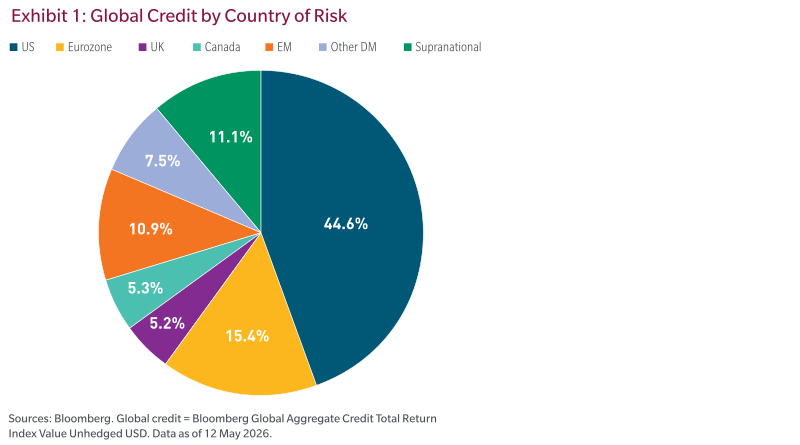
Global credit broadens the investable universe in a meaningful way. Different regions offer different sector compositions, capital structures and issuer profiles. The US market may provide depth in sectors such as communications, health care and large-cap industrials, while Europe can offer attractive opportunities in financials, utilities and select investment-grade issuers. Canada and other developed markets can add further variety. This breadth matters because diversification in credit is not only about geography; it is also about avoiding excessive exposure to any one sector, business model or refinancing risk. Within an active global credit mandate, a global remit gives investors more ways to express conviction and more flexibility to rotate toward areas where compensation for risk is more attractive. At the sector level, banking accounts for 15.9% of the global credit index, followed by supranationals (10.1%), utilities (7.6%) and financial services (6.8%). It is interesting to note that technology represents only 3.8% of the index.
Importantly, we believe the diversification benefits of global credit are best captured through active management. A passive global allocation may broaden exposure, but an active approach may be better equipped to assess regional fundamentals, currency-hedged opportunities, liquidity conditions and issuer-specific risks. In a world of elevated macro divergence and wider dispersion across sectors and companies, active security selection and dynamic asset allocation can help investors turn global breadth into genuine diversification rather than simply a larger set of risks.
2. Macro fundamentals are supportive of global credit
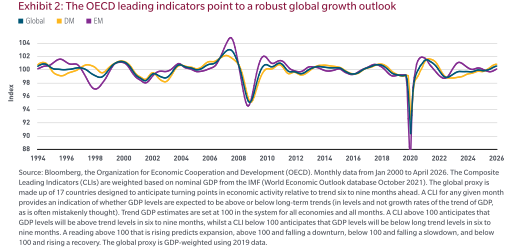
The global economy continues to display a clean bill of health, which, we believe, produces a positive signal for risky assets, including credit. For now, there are no signs that the ongoing geopolitical crisis has seriously dented the global growth outlook, as illustrated by Exhibit 2. In a number of markets, economic activity is supported by a resilient consumer, strong corporate profitability and robust private investment. The US, Germany and Canada appear to be among the key contributors to developed market (DM) growth while solid emerging market (EM) growth is mainly the result of strong activity in Brazil, India, Korea and Mexico.
Nevertheless, global macro risks are skewed to the downside. Looking ahead, the key risks to watch are, first, whether global supply chains become severely disrupted, a development that could potentially harm global growth prospects, especially if the conflict in the Middle East extends into the summer months. In addition, other major risks are the impact of firmer inflation expectations and tighter financial conditions, renewed trade tensions as well as potential disappointment over AI-driven productivity and AI capex investment.
IG credit fundamentals are strengthening. This is the case for both the US and Europe, the two largest allocations of the global credit index. In particular, credit fundamentals have been supported by a sharp improvement in profit margins and cash flow positions. Away from the US and Europe, EM credit fundamentals have displayed resilience, although dispersion has increased somewhat across countries and sectors and there are signs that leverage may be rising. Looking at sectors more closely, energy and commodities as well as IT benefit from global macro tailwinds whereas EM real estate continues to face serious challenges, particularly in China.
3. Global credit yields are attractive by historical standards
At over 4.50%, global credit yields screen as historically attractive. This is an important consideration given that starting yields tend to exert significant influence on subsequent returns. The global credit yield stands at 4.62%. In historical periods where the starting yield was between 4.3% and 4.9%, the subsequent five-year period produced a median return of 6.15%, with a range of 4.10% to 8.18% (Exhibit 3).
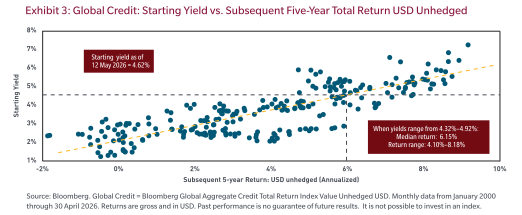
Break-even yields point to a considerable valuation cushion. Indeed, a sharp rise in total yields — exceeding 80 basis points (bps) — would have to occur for global credit–expected total returns over the next year to turn negative. There is no denying that at roughly 70 bps, global credit spreads are tight, but we currently do not see a catalyst that would trigger a substantial spread correction in the period ahead.
4. Global credit is an attractive de-risking asset class
In today’s market environment, the case for de-risking is compelling. In particular, global equities have performed strongly over the past few weeks but valuations may represent a headwind in the period ahead. Meanwhile, there are signs of mounting stress in private credit. However, de-risking does not have to mean giving up income or moving entirely into cash-like assets. We believe global credit can play that role more effectively. It offers investors a combination of attractive yields, generally resilient corporate fundamentals and a broader opportunity set than domestic-only credit markets. In that sense, global credit can serve as a practical middle ground: defensive enough to help navigate elevated uncertainty, yet still positioned to generate income and selective total return opportunities.
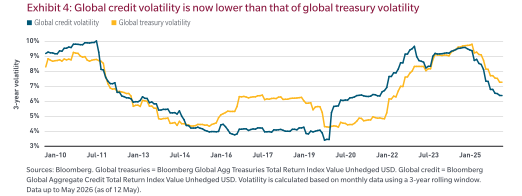
One reason global credit stands out as a de-risking asset class is its resilience in the face of macro volatility. Indeed, credit markets have held up relatively well even as the global backdrop has become more complicated, with spread moves modest by historical standards in both the US and Europe. Specifically, global credit total return volatility stands at 6.3% over the past three years1, or about half that of the MSCI World Index. This resilience matters for investors looking to reduce risk because it suggests that credit — particularly higher-quality segments — can remain more stable than equities or more cyclical risk assets when uncertainty rises. At the same time, monetary easing in parts of the world and moderate risks of an economic slowdown may provide an underlying cushion for the asset class.
Global credit remains attractive from an income standpoint. In a higher-yield world, investors can earn meaningful carry without moving far down the credit quality spectrum. That is particularly relevant in a de-risking context, where the objective is not simply to avoid volatility, but to be compensated for the risks that remain in the portfolio. For many investors, this makes global credit appealing relative to other asset classes that may offer less income, more valuation risk or weaker downside characteristics. Put differently, global credit can help investors stay invested defensively rather than retreating entirely from markets.
Importantly, the de-risking case for global credit is strongest when paired with a quality bias and careful security selection. If de-risking is a strategic objective, it may be appropriate to favor prudent portfolio risk, a focus on avoiding issuers exposed to idiosyncratic or secular pressures and a preference for lower-beta sectors where fundamentals remain sound. This reinforces the idea that global credit is not a risk-on allocation; it can be constructed in a way that is deliberately defensive, emphasizing balance-sheet resilience, stable cash flows and sectors less vulnerable to macro shocks.
Finally, global credit is especially well suited to active management, which is critical in a de-risking framework. In periods of elevated uncertainty, passive exposure can leave investors tied to tight spreads, concentrated index risk or the weakest parts of the market. An active global strategy has the ability to shift across regions, sectors and issuers, manage liquidity carefully and respond to dislocations as they emerge. That flexibility can help investors manage downside risk more effectively, but also identify selective opportunities created by volatility.
5. Meanwhile, global credit is also an attractive re-risking asset class from treasuries
Global sovereigns are facing significant headwinds. In many markets, including the US and some European countries, investors have grown increasingly concerned over poor fiscal dynamics and the worsening of public debt profiles. With that in mind, the appetite for exposure to the long end of the yield curve in some markets has been challenged. In the US for instance, the long-end of the yield curve has been steepening for the wrong reasons, mainly reflecting the pricing of a higher risk premium.
Global credit offers more compelling risk-adjusted returns than global treasuries. Whether one looks at the 1-year, 3-year or 5-year timeframes, the historical returns per unit of volatility for global credit have been considerably higher than for its treasury counterpart. For instance, over the past three years, the global credit index has produced an annualized return of 5.15% for a volatility of 6.4%. In contrast, the annualized return of the global treasury index over the same period has been only 1.26%, combined with a higher volatility of 7.3%. The main driver of treasury underperformance has been a challenging rate volatility environment. It is important to note that rate volatility has been considerably higher than spread volatility, thereby hurting duration risk more than credit risk. As illustrated by Exhibit 4, global credit volatility is now lower than that of global treasury volatility.
Global credit is supported by stronger fundamentals and technicals. To some extent, one can argue that in a number of markets, corporate balance sheets appear stronger than those of their sovereigns. On one side, corporate sectors are supported by strong profitability and solid cash flow positions while on the other side, fiscal deficits, policy credibility and concerning dynamics are all contributing to higher sovereign risk premiums. On the technical front, we will need to keep an eye on the possible impact of the surge in AI-related issuance, but for now, the new supply has been met by particularly robust demand. Looking ahead, we do not believe that the expected supply pipeline will cause a spread correction.
The Case for Global Credit
For investors looking to strengthen fixed income allocations, global credit stands out for five simple reasons: broader diversification, supportive fundamentals, attractive yields and the flexibility to both de-risk and selectively re-risk portfolios. In a world where macro risks are more fragmented and concentration matters more, a global approach can help investors stay diversified, stay invested and stay selective. With yields still compelling, corporate fundamentals broadly resilient and risk-adjusted returns comparing well with other major asset classes, global credit offers a strong case for a bigger role in portfolios. In our view, the opportunity is best captured through active management, where investors can navigate regional differences, avoid weaker areas of the market and focus on the best sources of value.
Endnote
1 Sources: Bloomberg. Global credit = Bloomberg Global Aggregate Credit Total Return Index Value Unhedged USD. Volatility is calculated based on monthly data using a 3-year rolling window. Data up to May 2026 (as of 12 May).
Investments in debt instruments may decline in value as the result of, or perception of, declines in the credit quality of the issuer, borrower, counterparty, or other entity responsible for payment, underlying collateral, or changes in economic, political, issuer-specific, or other conditions. Certain types of debt instruments can be more sensitive to these factors and therefore more volatile. In addition, debt instruments entail interest rate risk (as interest rates rise, prices usually fall). Therefore, the portfolio’s value may decline during rising rates.
The views expressed herein are those of the MFS Strategy and Insights Group within the MFS distribution unit and may differ from those of MFS portfolio managers and research analysts. These views are subject to change at any time and should not be construed as the Advisor’s investment advice, as securities recommendations, or as an indication of trading intent on behalf of MFS. No forecasts can be guaranteed.
Diversification does not guarantee a profit or protect against a loss. Past performance is no guarantee of future results.
AUTHOR
Benoit Anne
Senior Managing Director,
Strategy and Insights Group