
Navigating the Structural and Policy-Driven Headwinds Facing the Municipal Higher Education Sector
AUTHORS
Kristy Bykowski, CFA
Fixed Income Research Analyst
Kristen Richardon
Fixed Income Research Analyst
Lauren Sepolen, CFA
Fixed Income Research Analyst
Matthew Whoriskey, CFA
Fixed Income Research Analyst
Michael Adams, CFA
Fixed Income Institutional Portfolio Manager
Key Takeaways
- The municipal higher education sector faces a confluence of structural and federal policy-driven headwinds that are increasing the dispersion of fundamentals among issuers within the sector.
- Wider fundamental differentiation will be reflected in investment performance, increasing the importance of research and security selection.
- MFS’ municipal team applies a research process incorporating multiple perspectives, including fundamental, quantitative, legal, and valuation, to identify attractive opportunities and manage risk.
Challenges Facing the Sector
The municipal higher education sector, which comprises US colleges and universities, is grappling with a confluence of structural and federal policy-driven headwinds.
The most prominent structural headwind is the “demographic cliff,” a long-anticipated decline in the population of traditional college-aged students. Driven by falling birth rates, which have been declining since 2007, the pool of US high school graduates seems to have peaked in 2025. The enrollment pipeline of prospective college students is therefore projected to shrink by 13% between 2026 and 2041 (Figure 1).
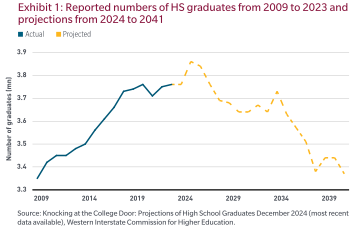
With private colleges deriving nearly 70% of their operating budgets from tuition and auxiliary revenues, a more constrained enrollment environment will create competitive and financial challenges for college leadership to navigate.1 Smaller, less selective private schools will likely be the most severely affected.
Recent federal policy changes also present challenges for the higher education sector.
1) International Enrollment – Stricter requirements for educational and work visas, visa processing delays, travel bans, and heightened immigration scrutiny will temper the demand for US higher education from prospective international students. As of fall 2025, negative impacts are already being seen, including a 1% year-over-year decline in the total number of international students arriving in the US and a 17% year-over-year decline in new (first-time) international student arrivals to the US.2 Because international students are often one of the few cohorts that pay full tuition, colleges and universities may feel the impact of these policy changes even more keenly via lower net tuition dollars per enrolled student.
2) Student Loan Caps – Federal regulatory changes to student loan programs — including new caps that will limit federal loans through the Parent PLUS, Grad PLUS, and Professional PLUS programs — could also constrain demand and force students to borrow via more expensive private lenders. This would add to heightened concerns around affordability and could lead to further declines in enrollment, increasing the financial strain on colleges and universities.
3) Federal Grant Funding – Proposed cuts to federal research grant funding, including caps on indirect overhead cost recovery and changes to several discretionary federal grant programs, could further reduce revenues for colleges and universities at a time when other revenue sources are already facing constraints.
4) Endowment Tax – Early federal proposals for more aggressive taxation on university endowments initially appeared to be a broader risk for the sector, but the final legislation enacted via the One Big Beautiful Bill Act was more favorable than anticipated and narrowed impacts only to 12 of the strongest and most financially sound institutions.
While these headwinds can lead to a challenging operating environment for US colleges and universities, their specific impacts will vary widely across individual institutions. To prudently navigate this landscape, we believe that investors must pair a top-down understanding of these challenges with a bottom-up analysis of the risks and opportunities a specific investment may offer.
How We Identify Investment Opportunities
A focus on fundamental differentiation. MFS applies a disciplined, research-intensive approach that starts with a detailed understanding of the risks facing the sector, as described above. We take a team-based approach, leveraging insights from several higher education experts. With a focus on bottom-up analysis of individual borrowers and a detailed understanding of the macro environment, the team collaborates to develop a sector-wide view and to fundamentally differentiate credits along a risk spectrum.
As part of our due diligence, our analysts review each borrower to assess an institution’s durability. Particularly during periods of operating stress, the more sources of resilience a school possesses, the more likely it will be able to adapt to challenges and take advantage of opportunities. Analysts look for credit levers, or attributes, such as:
√ Growing enrollment
√ Niche academic programs
√ Diversified revenue sources
√ Trend of balanced financial operations
√ Sound financial management practices
√ Healthy balance sheet
√ Manageable tuition discount rate or growing-per-student net tuition
√ Demonstrated fundraising capabilities
A quantitative complement. Complementing the fundamental analysis outlined above, the team has also developed a proprietary quantitative ranking dashboard to assess a school’s credit risk versus peers. The tool ranks colleges and universities based on key financial ratios, long-term performance, and qualitative factors (including niche and governance). This structured analysis provides a systematic, consistent framework against which our fundamental assessments can be tested and revisited.
An emphasis on legal protection. Partnering with our in-house legal counsel, we review investments for their bondholder protections. We favor investments that offer a sound security package, including operating or financial covenants and collateral provided by essential assets. Security packages and collateral vary but can include a pledge of tuition and receipts, a lien on a specific campus revenue stream, or a mortgage on campus real estate. These protections are especially important when considering investments that are lower on the credit quality spectrum.
A valuation lens. The final layer of our analysis is valuation. When considering an investment, our analysts seek to ensure that yields compensate for risks. Although a school may possess favorable fundamentals, the yields may be insufficient to warrant investment. The result is a blend of valuations and fundamentals. The typical investment has a number of characteristics that indicate both fundamental durability and a yield that compensates for the risks the institution faces. Ultimately, our security selection process in the higher education sector leads us to favor resilient institutions that offer relatively attractive yields.
Case Studies: Differentiating Within the Sector
Below are examples of how MFS differentiated between colleges with very different outcomes.
Avoiding failing institutions: This Northeast-based school embodied few of the positive characteristics MFS looks for, and we therefore avoided the borrower when it sought access to the capital markets in 2019 and 2022. The college suffered from a multi-year enrollment decline, offered no discernable academic niche, and lacked diversified revenue sources. Forecasted enrollment gains appeared overly optimistic, and prior expense cuts left little room for further efficiency gains. Debt levels increased in the late 2010s, and the institution resorted to short-term borrowing to fund deficits; subsequent attempts to refinance the school’s loans were not successful. Student retention rates weakened, the rate of decline of applications accelerated, and the board approved an extraordinary draw on the endowment to assist with unrestricted cash balances. Ultimately, the college closed its doors and ceased operations in mid-2023.
Selecting resilient or thriving institutions: We invested in the inaugural municipal transaction for this small, high-yield university based on its unique niche, demonstrated demand, sound financial management, and strong bondholder protections, including a legal pledge to the school’s gross revenues, restrictive covenants, and a cash-funded debt service reserve. Several years later, declining enrollment, driven by a strong local job market and rising competition, led to financial stress and exacerbated the school’s operating volatility given their already-small revenue base. This resulted in a one-notch downgrade by a ratings agency. Supported by an ongoing fundamental analysis that reaffirmed our thesis, however, we maintained our investment. We determined that the university’s brand and niche remained intact, and it continued to exhibit operating flexibility due to its modest tuition discounting and low leverage. Although operating margins compressed, swift actions to cut expenses preserved positive cash flow and solid coverage of debt service, reaffirming our assessment of their sound financial management. The board brought in new leadership, who refocused the university on its core strengths within its niche and introduced new affordability initiatives to better support its target population. This strategy delivered relatively meaningful results: since implementation, freshman applications have risen more than 80%, total enrollment is up 15%, operations have remained consistently positive, and liquidity has more than doubled. The university now exhibits a strong fundamental credit profile characterized by good liquidity, healthy margins, and low leverage. These improvements recently led a ratings agency to upgrade their rating.
Conclusion
The municipal higher education sector faces a confluence of structural and federal policy-driven headwinds that are increasing fundamental differentiation within the sector. These challenges increase the differing outlooks between stronger and weaker schools, magnifying the importance of security selection in the investment process. Our disciplined investment approach — grounded in fundamental credit analysis and complemented by a quantitative framework, legal expertise, and valuation discipline — enables effective navigation through these differentiated outlooks, with the goal of building long-term value for clients.
Endnotes
1 Source: Moody’s Private College Medians FY24.
2 Source: Fall 2025 Snapshot on International Student Enrollment, Institute of International Education.
The views expressed are those of the author(s) and are subject to change at any time. These views are for informational purposes only and should not be relied upon as a recommendation to purchase any security or as a solicitation or investment advice. No forecasts can be guaranteed. Past performance is no guarantee of future results.
Diversifi cation does not guarantee a profi t or protect against a loss. Past performance is no guarantee of future results.