
The Paradox of the Intangible Edge
Picture this: a company riding high on quarterly earnings, its stock chart climbing like a rocket. Investors cheer; analysts nod approvingly. Yet beneath the surface lies something far more enduring than numbers — a force that doesn’t appear on balance sheets but quietly determines who thrives and who falters: Culture.
When we at MFS commissioned Oxford’s research on Financial Returns to Corporate Culture, our goal was clear: to move beyond anecdotes and measure culture as a priced, material driver of financial outcomes. The findings are striking. Culture is not a slogan; it is intangible capital. Rare, hard to imitate, and capable of generating sustainable advantages. And like any form of capital, it can pay dividends — sometimes in ways that defy short-term expectations.
Why Culture Matters Now
Markets reward what they can measure. For decades, that meant hard metrics: cash flows, margins, multiples. But as cycles turn and volatility rises, investors are rediscovering what academics have long suspected: the “soft” stuff is also hard stuff. Culture compounds quietly, shaping adaptability, resilience, and trust.
In collaboration with Oxford, we analyzed 627,000 earnings calls across 5,900 firms over 20 years, applying Natural Language Processing (NLP) to decode and reveal five cultural signals: innovation, integrity, quality, respect, and teamwork. What emerged is a story of asymmetry: some traits, like innovation, are systematically rewarded, while others, like integrity and teamwork, carry nuanced, context-dependent payoffs.
Three Stories That Matter
1. Innovation: A Signal of Adaptability
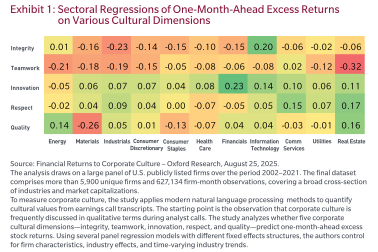
Innovation isn’t just a buzzword; it’s a survival instinct. In knowledge-intensive sectors like communication services, technology and financials, innovation predicted higher returns with coefficients as high as 0.23 (a one-unit increase in the innovation score in financials, as shown in Exhibit 1, implies a 23-basis-point increase in expected monthly excess return; a material effect in equity markets).1 According to the Oxford analysis, innovation delivered the strongest long-short performance of any cultural factor — generating a cumulative excess return of roughly 102% over the 20-year sample period.
Why? Because markets chronically underprice adaptability. During crises — the 2008 financial meltdown, the COVID-19 pandemic — the innovation premium spikes. Investors flock to firms that can pivot, experiment, and reinvent (quickly).
Case in point: Moderna’s response to COVID-19. Before the pandemic, Moderna had no commercialized products, but it had institutionalized a culture of scientific autonomy, transparent data sharing, and rapid iteration. When the crisis hit, that cultural infrastructure allowed the company to compress timelines and progress from sequence identification to a viable vaccine candidate in a matter of weeks. The markets didn’t simply reward Moderna’s technology; they repriced the organizational capability to advance faster than the rate of environmental change.2
But innovation isn’t free; it comes with trade-offs. The research shows that innovation is also historically associated with slower asset and sales growth. Firms that innovate invest heavily in research and development (R&D), sacrificing short-term profitability for long-term resilience.
2. Teamwork: Quiet Resilience
Teamwork rarely makes headlines. In fact, normally, markets penalize it. Across sectors like energy, materials, and industrials, teamwork predicted lower short-horizon returns, with coefficients dipping to -0.21, with the lowest being in energy.1 Why? Because collaboration looks costly when efficiency rules the day.
But here’s the twist: when a storm hits, teamwork flips from liability to lifeline. The Oxford research shows that during periods of systemic stress, teamwork’s payoff becomes positive and significant (reaching coefficients of 0.110).3 Cohesion becomes a form of organizational insurance: it allows firms to coordinate rapidly, absorb shocks, and execute under pressure. It also correlates with higher R&D intensity, signaling a long term, innovation-enabling mindset even if margins compress in the short run.
Case in point: Toyota during the 2011 Töhoku earthquake. Toyota’s operating system integrates hands-on problem solving (“genchi genbutsu,” which translates to “go and see”) and shared accountability at the plant level. When supply chains fractured due to the earthquake, cross-functional teams rapidly mapped dependencies, re-sequenced production, and collaborated with suppliers to stabilize output. Despite being closest to the epicenter of disruption, Toyota’s recovery outpaced many of their global peers — illustrating teamwork’s counter-cyclical value.4
3. Integrity: Stability at a Cost Integrity whispers rather than shouts.
The research finds that it consistently lowered volatility and market beta, providing downside risk management when risks surge — one reason utilities and regulated industries tend to score high on this front.5 Investors read integrity as a proxy for trust, discipline, and compliance. But the same analysis reveals a sharper edge: in capital‑intensive sectors such as materials, industrials, and financials, firms with high integrity scores often generated lower near‑term returns, particularly during periods of heightened uncertainty. The logic follows that when markets reward aggressive positioning, conservatism can look like rigidity. Integrity can constrain growth and margins, even as it mitigates tail risk.
Case in point: Goldman Sachs in the Global Financial Crisis. Long before 2008, Goldman cultivated a risk culture where the stature of control functions was deliberately elevated — risk and compliance could challenge trading desks in real time, and conservative calls were respected. That cultural design constrained upside in benign markets but protected the firm when the cycle turned, avoiding the worst impairments that hit more aggressively.6
Case Study: Compass Group – Culture as an Execution Advantage
MFS Holding: $1.65 billion7
In labor-intensive, operationally complex businesses, culture is not an abstraction; it shows up in safety outcomes, employee retention, client stickiness, and, ultimately, financial performance. Compass Group offers a clear example of how culture operates as hidden capital and how active engagement can help surface it.
Compass operates tens of thousands of client sites globally, with frontline employees forming the backbone of service quality. Execution risk is therefore high. Over multiple engagements, our dialogue with Compass has focused less on aspiration and more on how their culture is governed, measured, and reinforced at the ground level.
A recurring theme in our conversations has been health and safety as a cultural signal, not just a compliance exercise. We have found that Compass consistently performs better than their peers on safety measures; however, the firm recently decided to pause disclosure of lost-time injury rates. We value this data as a clear signal of operational quality, so we engaged with Compass’ global head of safety. The discussion revealed that senior leadership understood why this metric matters to us as a proxy for operational discipline and frontline culture, and they were open to reinstating the disclosure. That willingness to re-engage on difficult data points is itself a signal of cultural maturity.
We have also consistently engaged Compass on employee turnover, a critical indicator in an industry where churn is often structurally high. Compass’ turnover trends in the high 20% range — materially better than industry peers — which reflects a culture that prioritizes training, site-level accountability, and managerial continuity. Management has acknowledged the importance of transparency in this area and has offered to explore more complete reporting, potentially including business unit manager turnover. Again, culture shows up not in slogans, but in how seriously leadership treats measurement and accountability to their stakeholders (employees and shareholders alike).
Importantly, this cultural foundation translates into the outcomes that investors care about. Compass’ high client retention rates, resilience through downturns, and ability to consistently outgrow peers all hinge on repeatable execution across thousands of decentralized locations. That kind of consistency cannot be mandated centrally; it must be culturally embedded.
From an investment perspective, Compass illustrates a key insight from our research with Oxford: qualities like teamwork, integrity, and operational discipline may look lackluster in benign markets, but they compound quietly. In periods of disruption — labor shortages, regulatory changes, cost inflation — these qualities become sources of relative advantage.
The Future of Investing
Numbers tell us where we’ve been. Culture tells us where we’re going. Our research with Oxford proves what intuition has whispered for years: culture is priced, measurable, and predictive. It doesn’t just shape behavior — it shapes markets. In a landscape defined by disruption, the most enduring advantage is the one you can’t see on a balance sheet.
For investors, the question isn’t whether culture matters. It’s whether you’re ready to act on it. Because in the next cycle, intangible capital may be the most tangible edge you own.
Endnotes
1 Exhibit 1, Financial Returns to Corporate Culture - Oxford Research. August 2025.
2 Moderna vaccine becomes third COVID-19 vaccine approved by UK regulator - GOV.UK, Moderna vaccine trial's results bode well for Oxford/ AstraZeneca jab | Vaccines and immunisation | The Guardian
3 Financial Returns to Corporate Culture - Oxford Research. August 2025.
4 Leadvent Group | Toyota, earthquake, resilience, supply chain, disaster management
5 Financial Returns to Corporate Culture - Oxford Research. August 2025.
6 2010-0630-Broderick.pdf
7 MFS holdings as of 2 February 2026
MFS may incorporate environmental, social, or governance (ESG) factors into its investment decision making, fundamental investment analysis and engagement activities when communicating with issuers. The statements or examples provided above illustrate certain ways that MFS has historically incorporated ESG factors when analyzing or engaging with certain issuers but they are not intended to imply that favorable investment, ESG outcomes or engagement outcomes are guaranteed in all situations or in any individual situation. When engaging with companies, including engagements on ESG topics, MFS’ focus is discussing, gathering information about, and seeking appropriate transparency on matters that could be material to the long-term economic valuation of the company so that MFS may make an informed investment decision that advances MFS clients’ long-term economic interests. MFS does not engage for the purpose of trying to change or influence control of a company. Engagements often consist of ongoing communications with an issuer. Engagement with an issuer may not result in any direct changes to any issuer’s ESG-related practices. Favorable investment or engagement outcomes, including those described above, may be unrelated to MFS analysis or activities. The degree to which MFS incorporates ESG factors into its investment decision making, investment analysis and/or engagement activities will vary by strategy, product, and asset class, and may also vary over time, and will generally be determined based on MFS’ opinion of the relevance and materiality of the specific ESG factors (which may differ from judgements or opinions of third-parties, including investors). Any examples above may not be representative of ESG factors used in the management of any investor’s portfolio. Any ESG assessments or incorporation of ESG factors by MFS may be reliant on data received from third-parties (including investee companies and ESG data vendors), which may be inaccurate, incomplete, inconsistent, out-of-date or estimated, or only consider certain ESG aspects (rather than looking at the entire sustainability profile and actions of an investment or its value chain), and as such, may adversely impact MFS’ analysis of the ESG factors relevant to an investment. The information included above, as well as individual companies and/or securities mentioned, should not be construed as investment advice, a recommendation to buy or sell or an indication of trading intent.
The views expressed are those of the author(s) and are subject to change at any time. These views are for informational purposes only and should not be relied upon as a recommendation to purchase any security or as a solicitation or investment advice. No forecasts can be guaranteed. Past performance is no guarantee of future results.
Diversification does not guarantee a profit or protect against a loss. Past performance is no guarantee of future results.
AUTHORS
Pelumi Olawale, CFA
Strategist
Strategy & Insights Group