
In summary
- AI is blurring competitive boundaries across technology.
- Rising costs and competition threaten returns and valuations.
- As a result, stock selection should matter more in the near term than it has in some time.
In When Competition Returns, we argued that two forces are changing the competitive environment. Renewed investment is expanding rival capacity, while AI is lowering the cost of challenging established profit pools. The technology stack, which refers to the layers connecting underlying computing infrastructure to software applications and workflows, offers one example of what that process looks like in practice.
The technology stack, which refers to the layers connecting underlying computing infrastructure to software applications and workflows, offers one example of what that process looks like in practice.
Clearer lanes
During Internet 2.0, the swimming lanes across much of the technology industry were comparatively clear. NVIDIA supplied processors, AWS provided cloud infrastructure on demand, and Salesforce built applications and customer workflows, etc.
But the lanes were never perfectly clean, as some of the largest platforms crossed them. However, cloud computing made specialization economical, allowing technology enterprises to focus on what they did well. The division of labor remained relatively stable, because staying in one’s lane was so profitable.
That stability mattered because companies had less reason to divert capital toward building rival capacity in adjacent layers. Profit margins and returns on capital rose and remained elevated, while equity multiples expanded. Together, those forces helped catapult technology companies to the top holdings in market capitalization-weighted indexes.
AI is changing those incentives.
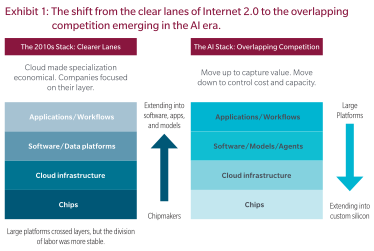
Move up to capture value
Chipmakers like NVIDIA are moving up the technology stack into systems, software, and models. At the same time, data platforms are moving toward applications, agents, and workflows. Meanwhile, infrastructure providers are seeking a more direct role in how customers use technology and make decisions.
The logic is straightforward. Companies lower in the stack do not want to remain interchangeable inputs beneath someone else’s customer relationship. Moving up can bring them closer to the workflow, the customer, and ultimately, the economic outcome.
In our terminology (Who Owns the Technology Harness), they are moving toward building the Harness, where models and data connect to workflows, permissions, and outcomes.
Move down to control cost
The pressure works in the opposite direction as well.
For large platforms, compute is becoming a major cost, a capacity constraint, and an important source of product performance. Amazon, Microsoft, Google, and Meta are therefore extending further down the stack into custom silicon.
Greater control can lower costs, secure supply, improve performance, and reduce dependence on a supplier capturing too much of the economics. These companies do not need to replace every outside provider for the strategy to matter. Even a credible internal alternative can improve bargaining power and change how value is divided across the stack.
Put simply, companies move up to capture value and down to control cost and capacity.
The competitive overlap
Each move may make sense individually. Collectively, however, they create overlapping competition, amplifying the way capitalism competes away excess returns.
Suppliers become competitors, customers become suppliers, and partners fall somewhere in between.
More firms are competing for the same profit pools, while expanding across the stack demands more capital, research spending, and operating expense. That is the double squeeze. Profit retained becomes less secure just as the capital required to earn it rises. AI demand and revenues can remain strong, but if incremental returns weaken and investors become less confident in the durability of those returns, valuation multiples are more likely to contract than expand.
The leaders may remain
A small number of large firms may continue to control much of the infrastructure and distribution, and thus account for much of the market capitalization. But concentration and competition are not opposites. A handful of companies can duplicate infrastructure, subsidize products, and bundle services, while investing aggressively against one another.
The leaders do not need to disappear for their economics to weaken. Market share can remain high while capital intensity rises, free cash flow falls, or returns on new investment decline.
That may be one way today’s index concentration eventually unwinds. Not because the current leaders suddenly vanish, but because their profits become less exceptional and investors become less willing to value them as though they were.
The leaders may remain, but their economics may not.
What changes for investors?
The investment question is not simply which companies participate in AI. Nearly every technology company will.
The harder question is, who keeps the economics after the rest of the stack responds?
Internet 2.0 broadly rewarded exposure to established profit pools. Internet 3.0 is blurring the lanes and making every layer more contestable. That is what the return of competition looks like, and why stock selection should matter more in the near term than it has in some time.
Individual securities mentioned are for illustrative purposes only and may not be relied upon as investment advice or as an indication of trading intent on behalf of any MFS product.
Keep in mind that all investments carry a certain amount of risk, including the possible loss of the principal amount invested.
The views expressed are those of the author(s) and are subject to change at any time. These views are for informational purposes only and should not be relied upon as a recommendation to purchase any security or as a solicitation or investment advice. No forecasts can be guaranteed. Past performance is no guarantee of future results.
AUTHOR
Robert M. Almeida
Portfolio Manager and Global Investment Strategist