
The Case for a New Profit Cycle
Japan may be moving from a low-growth, low-investment economy to one driven by investment, productivity, and pricing power. If so, that regime change should show up first in earnings and then, as returns on equity improve, potentially in valuations.
A Shift in Corporate Incentives
For much of the post-dot-com-bubble era, Japan has operated in a state of low-growth, low-investment equilibrium. Weak nominal growth and deflation limited pricing power, while holding cash often appeared more rational than committing capital. Governance reforms raised shareholder returns and improved balance-sheet efficiency but focused primarily on how profits were allocated. For long-term investors, however, the bigger opportunity may lie in how profits are generated.
Those conditions are shifting. Labor is scarce, industrial capacity has strategic value, energy systems and supply chains require investment, and artificial intelligence is increasing the demand for infrastructure and automation. Together, government policy, labor scarcity, and corporate spending point to a more investment-intensive regime.
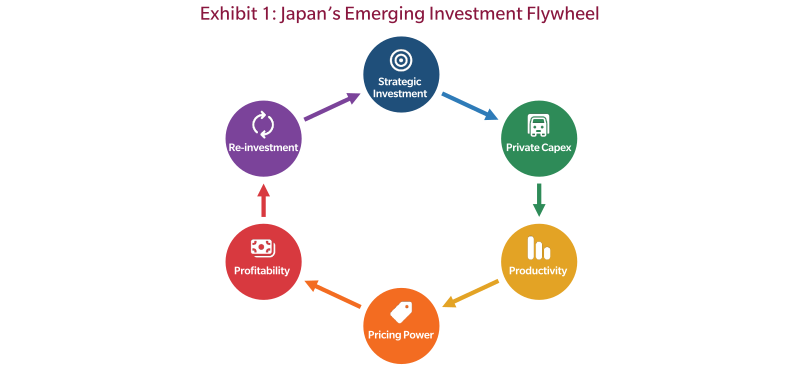
The cycle becomes self-reinforcing if public spending crowds in private investment, that will in turn raise productivity, and companies can retain part of the benefit through pricing power.
A Coordinated Push to Invest
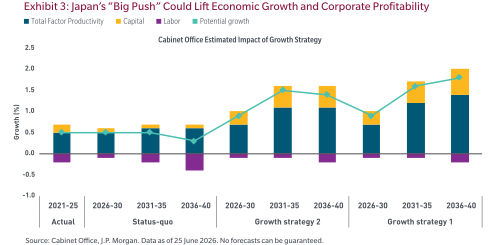
Industrial transitions gather momentum when complementary investments occur across sectors: factories require infrastructure, equipment, specialized materials, engineering, and skilled labor. Development economists call this a “big push,” and this kind of coordinated investment can move an economy to a higher level of productivity.
Japan's industrial strategy increasingly resembles this process. Their FY2026 Basic Policy targets 17 strategic sectors, including AI and semiconductors, defense, shipbuilding, critical minerals, and biotechnology, with around JPY370 trillion (USD2.4 trillion) of cumulative public-private investment expected by FY2040. This strategy builds on Japan’s bond-financed green transformation (GX) policy, an area where our perspective is informed in part by regular ESG engagements with the Government of Japan. With accommodative monetary policy also in place, the state is becoming a larger source of structural demand. Long-term commitments can give companies greater visibility over revenues and returns, encouraging capital spending. Durable nominal growth can also provide the government with some fiscal maneuverability, although Japan’s high public debt remains a consideration.
Industrial policy does not guarantee or automatically generate attractive returns. Rather, its aim is to crowd in private capital by improving visibility over future demand, making firms more willing to expand capacity, adopt technology, and commit to long-term opportunities. Policy is reinforced by a second powerful force: demographics.
Labour Scarcity as an Investment Catalyst
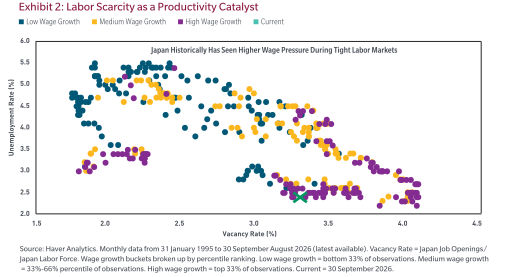
A shrinking, aging workforce remains a constraint on growth, but labor scarcity also changes corporate incentives. Demand for workers is rising, while the scope to increase participation among older workers and women is more limited. With unemployment low, skills mismatches widespread, and wages rising, companies cannot grow simply by hiring. Automation, digitization, software, and process redesign become increasingly attractive. Labor scarcity can therefore act as a productivity catalyst, encouraging investment even as it constrains growth.
Concentrated positions in the index and a significant universe of off-index issues are reasons we believe a flexible, active approach makes sense for this asset class. |
In our view, Japan is well placed to respond to these conditions: many of the technologies needed to address labor scarcity are ones in which Japanese companies already lead.
From State-Backed Demand to Profits
Investors own future earnings, so the critical question is whether state-backed demand, and the private investment it crowds in, can translate to stronger profitability.
In Japan, the link runs through both demand and productivity. The Kalecki-Levy profit equation, a rearrangement of the GDP expenditure identity, shows that aggregate corporate profits rise with net investment and fall with government saving.
Profits = Net Investment + Dividends − Household Savings − Government Savings − Foreign Savings
All else equal, public investment that crowds in private capital should therefore lift corporate profitability, while government procurement in areas such as defence provides a more direct channel. Productivity determines whether those profits endure: investment can lift productivity and strengthen margins. This link between industrial policy and equity returns is often overlooked. If the connection holds, Japan could move to a higher equilibrium of corporate profitability, with a broader earnings opportunity than many investors expect.
That aggregate effect is unlikely to be shared evenly, however. For individual companies, the investment case still depends on whether higher demand produces adequate returns on new capital and whether those returns can be sustained.
The Return of Pricing Power
Investment alone does not create profits; companies must convert that investment into commercial value. For three decades, deflationary expectations constrained price increases and made margin gains dependent on cost control. That is changing. Labor shortages and technology underinvestment have left firms operating at high capacity, with the economy above potential. The opportunity lies in companies that raise productivity through investment and retain part of the benefit through pricing.
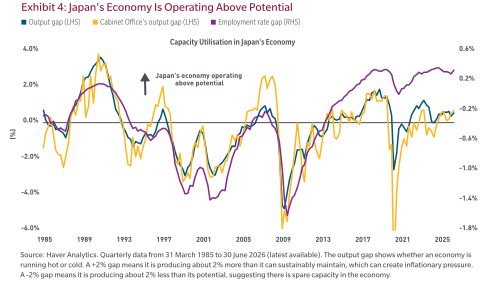
Labor scarcity is encouraging investment, which boosts productivity. |
Physical AI: Where Japan’s Strengths Meet New Demand
Physical AI illustrates how this broader investment cycle could translate into company-level opportunities. The global AI debate centers on models, cloud infrastructure, and computing capacity, but its economic impact will also depend on applications in the physical economy. This plays to Japan’s hardware strengths. Physical AI combines the reasoning power of agentic AI with the domain technology needed to act in the real world. It extends beyond humanoid robots into factory equipment, power grids, and railways.
Japan’s expertise in factory automation, sensing, power infrastructure, and high-reliability hardware places many companies on the domain-technology side of this partnership, which we feel should gain value as AI moves into more physical systems.
Company Spotlight: MinebeaMitsumi – the components behind the robot hand Japan’s machinery industry supplies precision motors, speed reducers, bearings, and touch and vision sensors used in robots. MinebeaMitsumi focuses on components for robot hands, a critical function for robots designed to perform human tasks. The company estimates its robot-related business could grow at around 65% annually through 2035, creating an opportunity to serve the expanding global market. Company examples are for illustrative purposes only and are not a recommendation to buy or sell any security. |
Physical AI is becoming a contest for industrial leadership as China’s humanoid robot development also accelerates. Japan is supporting its domestic manufacturers and component suppliers, targeting a global market share above 30% and a JPY20 trillion AI robotics business by 2040. Whether those targets are achievable remains uncertain. For investors, the test is monetization: suppliers are adding aftermarket services, control software, consulting, and installed-base revenues to product sales. These higher-margin, recurring models could improve the quality and durability of earnings, showing how investment could translate into more durable profits.
Company Spotlight: Hitachi – physical AI without the humanoid Hitachi is combining operational technology with AI to address Japan’s labor shortages. In its view, physical AI need not be humanoid: it can be embedded in elevators, transporters, power grids, switching equipment, and railways. These are areas where Japanese manufacturers may compete effectively, with a broad addressable market and scope for recurring revenues beyond the initial sale. Company examples are for illustrative purposes only and are not a recommendation to buy or sell any security. |
Why This Could Become a New Equity Cycle
Japan’s recent equity revival has been driven by higher shareholder returns and renewed investor interest. This opportunity goes further: a regime change should first appear in earnings. If state-backed demand and private investment lift productivity, companies could generate stronger real profits. Whether this creates shareholder value will depend on returns on new investment exceeding the cost of capital.
These forces could eventually support valuations. Persistent state-backed demand may reduce earnings volatility, while Japan's tight, low-churn labor market supports operating leverage and resilience. If this produces durable improvements in returns on equity, investors may place greater value on those earnings. Valuation gains, however, must be earned through durable profitability.
The beneficiaries may span industrial automation, advanced manufacturing, semiconductor equipment, energy infrastructure, specialist materials, control software, and system integration. But exposure alone is insufficient: companies must convert that increased exposure into durable earnings and durable returns on new investment. Outcomes will diverge, making stock selection critical.
Conclusion
For three decades, Japan’s equity story was shaped by an economy that rewarded caution over investment. We believe that is changing as capital formation, automation, and strategically directed demand create selective opportunities across the equity market.
In our view, investment will not guarantee or automatically produce attractive returns, and companies will still need to translate spending into productivity and profits. But the incentives across Japan’s economy increasingly favor committing capital over holding it. If this drives durable earnings growth and higher returns on capital, Japan’s next equity cycle could be built first on profits, then ultimately reinforced by valuations.
The views expressed are those of the author, and are subject to change at any time. These views should not be relied upon as investment advice, as securities recommendations, or as an indication of trading intent on behalf of any MFS investment product. Past performance is no guarantee of future results. No forecasts can be guaranteed.
AUTHORS
Carl Ang
Fixed Income
Research Analyst
Akira Fuse
Institutional Equity
Portfolio Manager
Ross Cartwright
Lead Strategist,
Strategy and Insights Group