Market Pulse
Leveraging expertise from the MFS Market Insights team to provide timely perspectives on economic and market dynamics that are top of mind for clients.
Market Insights Team
KEY TAKEAWAYS
|
-
Economy & Markets
Economy & Markets
Rate Cuts Can Be Hard to Predict
MFS PERSPECTIVE
- The large swings in rate-cut expectations ahead of the recent December FOMC may be a harbinger of what’s to come.
- A more volatile Fed policymaking environment likely lays ahead.
- Investors may want to diversify their sources of alpha by using both a skilled credit and rates manager.
Environment for Fixed Income to Remain Favorable in 2026
MFS PERSPECTIVE
- US fixed income thrived in 2025 amid elevated yield and Fed rate cuts.
- While lower yields may reduce return expectations in 2026 compared with 2025, looser financial conditions should support fundamentals, creating a favorable market environment.
- Though they are lower, yields remain attractive against a stable market backdrop.
Mid Caps Remain Well Positioned Moving Forward
MFS PERSPECTIVE
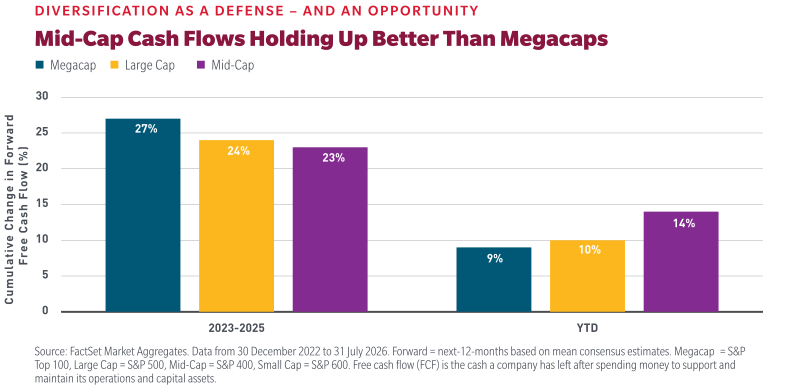
- Earnings growth forecasts suggest a favorable outlook for mid-cap companies.
- Easing US monetary policy and a strong fiscal impulse should provide a tailwind.
- A declining regulatory burden has the potential to increase margins.
Positive Credit Setup Benefits Risk Assets
MFS PERSPECTIVE
- A recovery from the 2023/24 lows and the lagged effects of ECB cuts signal strong EU credit expansion into 2026.
- As the effects of the cuts continue alongside fiscal support, prospects for growth are improving, providing a strong foundation for both equities and fixed income investments.
-
Asset Allocation
Asset Allocation
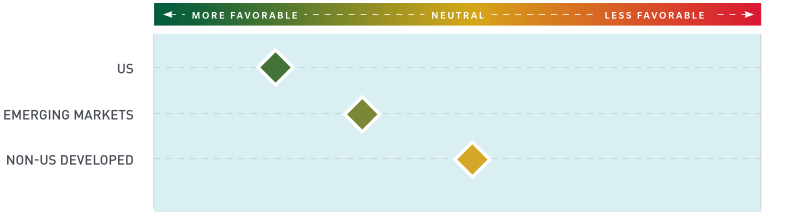
Relative to investor’s strategic asset allocation
We maintain our equity overweight, mainly reflecting a stronger macro and market backdrop, as well as the positive impact of policy stimulus, including pro-growth tax and regulatory policies. Meanwhile, fixed income remains attractive from a risk-adjusted return standpoint.
MFS PERSPECTIVE
1
2
3
4
The macro backdrop remains supportive of risky assets. So far, the impact of tariffs appears muted, even though some risks persist. The main source of potential concern is a weakening labor market.
US equities are buoyed by solid earnings, diminished tariff threats and renewed Fed easing. The valuation backdrop remains challenging, especially for US large caps, but there is a bullish case for mid caps as well as global equities.
While fixed income remains an attractive de-risking asset class, there are a few notable headwinds. Concerns over Fed independence remain a source of risk, while a challenging fiscal landscape has undermined the appeal of long-dated government bonds.
With spreads rich, spread compression is unlikely to be a major driver of returns. Cracks in the private credit universe have surfaced, but we don’t think that they pose a systemic risk for public markets. We favor riskier segments, given the robust macro backdrop and the valuation of cushion of total yields.
Approach and methodology: The Market Pulse provides an outlook over a 12 month investment horizon for major asset classes as well as considerations of the prevailing market conditions. Views are driven by both quantitative and qualitative inputs including, but are not limited to, macro-economic data, valuations, fundamentals and technical variables.
-
Equity
US Equity

• UNDERWEIGHT • NEUTRAL • OVERWEIGHT
- The environment remains constructive, supported by a potential reacceleration of economic growth in 2026.
- Easier monetary policy and fiscal stimulus should add to the supportive backdrop.
- With valuations stretched, strong corporate earnings will likely remain the main driver of returns.
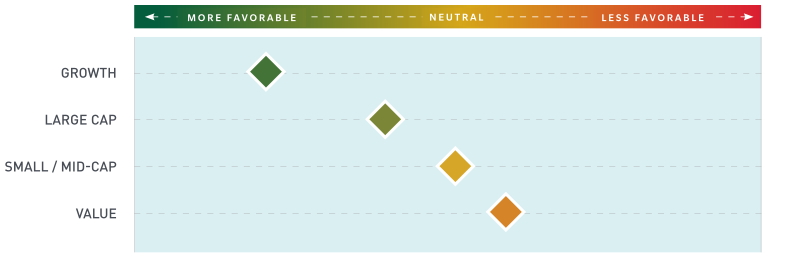
- Despite a recent rally in small caps, we continue to favor large and mid-cap stocks, as well as value over growth.
MFS CONSIDERATIONS LARGE CAP - Megacap tech leadership has been supported by strong earnings and AI investments, but elevated valuations and concentration remain risks.
- A broadening of earnings and economic activity provides the potential for a rotation into cyclical and value stocks.
SMALL/MID CAP - Declining interest rates should benefit SMID company margins, given their higher sensitivity to borrowing costs.
- The US consumer remains resilient, supporting economic growth and benefitting domestically focused SMID companies.
- Valuations remain discounted relative to large caps.
GROWTH - High-beta, low-quality stocks have outperformed post-Liberation Day.
- The concentration of returns in the Russell 1000 Growth Index has been even more pronounced in 2025.
- Relative earnings growth between megacap technology names and the rest of the index is expected to narrow further in 2026.
VALUE - Value stocks appear attractive on a relative basis compared with growth stocks given a deep valuation discount.
- Reaccelerating economic growth in 2026 could be a catalyst for outperformance of cyclical value.
International Equity
DEVELOPED INTERNATIONAL EQUITY
- The ECB’s rate cuts are starting to bear fruit, with sentiment improving across housing and construction.
- Japan’s new government released a major fiscal package, including consumerfocused tax cuts
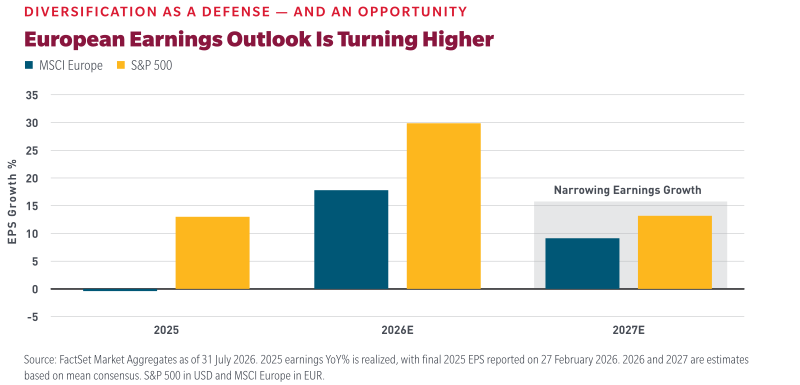
MFS CONSIDERATIONS - We remain constructive on Europe, which offers pockets of opportunity such as Germany’s fiscal package taking root and an anticipated recovery in earnings growth. Improving loan growth and potential capital markets reform is supportive of its large banking sector.
- The benefits of ongoing corporate governance reforms in Japan are beginning to be felt with increased capital returns to investors, improved returns on equity, and the continued unwind of cross shareholdings.
EMERGING MARKET EQUITY
- The impact of lower rates is filtering through economies, bolstering consumer demand.
- Healthier fiscal positions and resilient global growth are supportive for earnings.
MFS CONSIDERATIONS - Expect continued strong earnings growth from AI supply chain stalwarts such as Taiwan and South Korea.
- China continues to garner a greater market share as exports shift from developed to emerging economies.
- Amid shifting supply chains over national security concerns, demand for strategic and industrial metals/materials supports the region.
- Valuations remain compelling compared with most other regions.
BLANK
-
Fixed Income
Fixed Income
• UNDERWEIGHT • NEUTRAL • OVERWEIGHT
DURATION
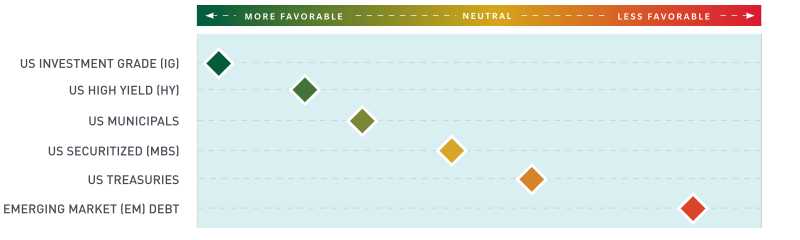
- We think the Fed rate-cutting cycle has room to run.
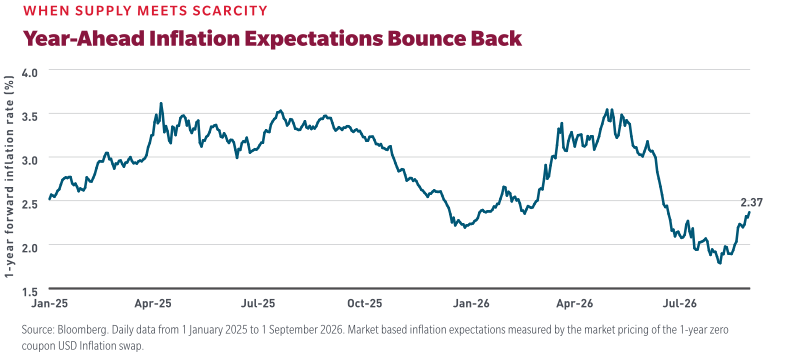
- While the latest dot plot flagged only one cut in 2026, the FOMC acknowledged downside risks to the labor market while signaling that tariff-induced inflation is likely to be transitory and may peak in early 2026.
MFS CONSIDERATIONS
- Duration can help bolster portfolios if labor growth weakens.
- While yields have declined, they remain above the average of the prior business cycle, which should drive investor demand.
MUNICIPALS
- Tax-adjusted yields are favorable, while fundamentals, including state finances, remain satisfactory.
- However, due to our positive risk outlook, we favor other segments of US fixed income.
MFS CONSIDERATIONS
- Given their low credit risk and favorable tax treatment, we think municipals could represent a great defensive asset for investors who want to focus on tax efficiency and downside protection.
- Our underweight reflects a more bullish call on riskier asset classes.
SECURITIZED (MBS)
- The agency MBS market remains supported by solid fundamentals and declining rate volatility.
- While MBS offer positive incremental yields compared with Treasuries, increased supply and refinancing activity could put upward pressure on spreads in the near term.
MFS CONSIDERATIONS
- Agency MBS may offer diversification and defensive benefits. While providing relatively more attractive spreads compared with other fixed income asset classes, a neutral stance is warranted as technicals may become challenged.
US INV-GRADE CORP
- A recently weaker macro backdrop, combined with historically tight spreads, places a premium on credit selection.
- While the asset class remains resilient, we favor an up-in-quality bias given higher macro uncertainty.
MFS CONSIDERATIONS
- A looser monetary policy environment should benefit corporate fundamentals and help improve the earnings outlook.
- Expected returns are likely to be supported by carry, but yields have declined recently, making this a less attractive entry point.
US HIGH YIELD
- Fundamentals remain solid, helped by historically low levels of leverage and strong earnings.
- Recent private credit bankruptcies appear idiosyncratic, contained, and unlikely to spill over into high yield.
MFS CONSIDERATIONS
- Compared to IG, HY appears to be more insulated from thematic trades such as the AI buildout.
- However, should the macro environment deteriorate, we think that there’s upside risk to spreads at current levels.
EMERGING MARKET DEBT
- Fund flows have been positive, supporting tight valuations.
- Yields, like fundamentals, have weakened but remain attractive relative to longer-term history.
- A weaker dollar environment helped emerging markets debt post double-digit returns in 2025.
MFS CONSIDERATIONS
- EMD is more exposed to global risks, making sovereign credit selection paramount.
- However, EMD has been resilient in the face of heightened geopolitical risks and trade uncertainty. There are still attractive opportunities within the asset class.
BLANK
The views expressed herein are those of the MFS Strategy and Insights Group within the MFS distribution unit and may differ from those of MFS portfolio managers and research analysts. These views are subject to change at any time and should not be construed as MFS’ investment advice, as portfolio positioning, as securities recommendations, or as an indication of trading intent on behalf of MFS. No forecasts can be guaranteed.
The Market Pulse leverages the firm’s intellectual capital to provide perspective on broad market dynamics that are top of mind for asset allocators. We celebrate the rich diversity of opinion within our investment team and are proud to have talented investors who may implement portfolio positions and express different or nuanced views to those contained here, which are aligned to their specific investment philosophy, risk budget and entrusted duty to allocate our client’s capital responsibly.
Source: Bloomberg Index Services Limited. BLOOMBERG® is a trademark and service mark of Bloomberg Finance L.P. and its affiliates (collectively "Bloomberg"). Bloomberg or Bloomberg's licensors own all proprietary rights in the Bloomberg Indices. Bloomberg neither approves or endorses this material, or guarantees the accuracy or completeness of any information herein, or makes any warranty, express or implied, as to the results to be obtained therefrom and, to the maximum extent allowed by law, neither shall have any liability or responsibility for injury or damages arising in connection therewith.
Index data source: MSCI. MSCI makes no express or implied warranties or representations and shall have no liability whatsoever with respect to any MSCI data contained herein. The MSCI data may not be further redistributed or used as a basis for other indices or any securities or financial products. This report is not approved, reviewed or produced by MSCI.
Frank Russell Company (“Russell”) is the source and owner of the Russell Index data contained or reflected in this material and all trademarks, service marks and copyrights related to the Russell Indexes. Russell® is a trademark of Frank Russell Company. Neither Russell nor its licensors accept any liability for any errors or omissions in the Russell Indexes and/or Russell ratings or underlying data and no party may rely on any Russell Indexes and/or Russell ratings and/or underlying data contained in this communication. No further distribution of Russell Data is permitted without Russell’s express written consent. Russell does not promote, sponsor or endorse the content of this communication.
“Standard & Poor’s®” and S&P “S&P®” are registered trademarks of Standard & Poor’s Financial Services LLC (“S&P”) and Dow Jones is a registered trademark of Dow Jones Trademark Holdings LLC (“Dow Jones”) and have been licensed for use by S&P Dow Jones Indices LLC and sublicensed for certain purposes by MFS. The S&P 500® is a product of S&P Dow Jones Indices LLC, and has been licensed for use by MFS. MFS’ Products are not sponsored, endorsed, sold or promoted by S&P Dow Jones Indices LLC, Dow Jones, S&P, or their respective affiliates, and neither S&P Dow Jones Indices LLC, Dow Jones, S&P, their respective affiliates make any representation regarding the advisability of investing in such products. BLOOMBERG® is a trademark and service mark of Bloomberg Finance L.P. and its affiliates (collectively “Bloomberg”). Bloomberg or Bloomberg’s licensors own all proprietary rights in the Bloomberg Indices. Bloomberg neither approves or endorses this material, or guarantees the accuracy or completeness of any information herein, or makes any warranty, express or implied, as to the results to be obtained therefrom and, to the maximum extent allowed by law, neither shall have any liability or responsibility for injury or damages arising in connection therewith The views expressed are subject to change at any time.
These views should not be relied upon as investment advice, as portfolio positioning, as securities, recommendations or as an indication of trading intent on behalf of the advisor. No forecasts can be guaranteed.
Unless otherwise indicated, logos and product and service names are trademarks of MFS® and its affiliates and may be registered in certain countries.
Economy & Markets
Rate Cuts Can Be Hard to Predict |
MFS PERSPECTIVE
|
Environment for Fixed Income to Remain Favorable in 2026 |
MFS PERSPECTIVE
|
Mid Caps Remain Well Positioned Moving Forward |
MFS PERSPECTIVE
|
Positive Credit Setup Benefits Risk Assets |
MFS PERSPECTIVE
|
Asset Allocation
Relative to investor’s strategic asset allocation
We maintain our equity overweight, mainly reflecting a stronger macro and market backdrop, as well as the positive impact of policy stimulus, including pro-growth tax and regulatory policies. Meanwhile, fixed income remains attractive from a risk-adjusted return standpoint.
MFS PERSPECTIVE
1 |
2 |
3 |
4 |
The macro backdrop remains supportive of risky assets. So far, the impact of tariffs appears muted, even though some risks persist. The main source of potential concern is a weakening labor market. |
US equities are buoyed by solid earnings, diminished tariff threats and renewed Fed easing. The valuation backdrop remains challenging, especially for US large caps, but there is a bullish case for mid caps as well as global equities. |
While fixed income remains an attractive de-risking asset class, there are a few notable headwinds. Concerns over Fed independence remain a source of risk, while a challenging fiscal landscape has undermined the appeal of long-dated government bonds. |
With spreads rich, spread compression is unlikely to be a major driver of returns. Cracks in the private credit universe have surfaced, but we don’t think that they pose a systemic risk for public markets. We favor riskier segments, given the robust macro backdrop and the valuation of cushion of total yields. |
Approach and methodology: The Market Pulse provides an outlook over a 12 month investment horizon for major asset classes as well as considerations of the prevailing market conditions. Views are driven by both quantitative and qualitative inputs including, but are not limited to, macro-economic data, valuations, fundamentals and technical variables.
US Equity

• UNDERWEIGHT • NEUTRAL • OVERWEIGHT
|
| MFS CONSIDERATIONS |
| LARGE CAP |
- Megacap tech leadership has been supported by strong earnings and AI investments, but elevated valuations and concentration remain risks.
- A broadening of earnings and economic activity provides the potential for a rotation into cyclical and value stocks.
| SMALL/MID CAP |
- Declining interest rates should benefit SMID company margins, given their higher sensitivity to borrowing costs.
- The US consumer remains resilient, supporting economic growth and benefitting domestically focused SMID companies.
- Valuations remain discounted relative to large caps.
| GROWTH |
- High-beta, low-quality stocks have outperformed post-Liberation Day.
- The concentration of returns in the Russell 1000 Growth Index has been even more pronounced in 2025.
- Relative earnings growth between megacap technology names and the rest of the index is expected to narrow further in 2026.
| VALUE |
- Value stocks appear attractive on a relative basis compared with growth stocks given a deep valuation discount.
- Reaccelerating economic growth in 2026 could be a catalyst for outperformance of cyclical value.
International Equity
| DEVELOPED INTERNATIONAL EQUITY |
- The ECB’s rate cuts are starting to bear fruit, with sentiment improving across housing and construction.
- Japan’s new government released a major fiscal package, including consumerfocused tax cuts
| MFS CONSIDERATIONS |
- We remain constructive on Europe, which offers pockets of opportunity such as Germany’s fiscal package taking root and an anticipated recovery in earnings growth. Improving loan growth and potential capital markets reform is supportive of its large banking sector.
- The benefits of ongoing corporate governance reforms in Japan are beginning to be felt with increased capital returns to investors, improved returns on equity, and the continued unwind of cross shareholdings.
| EMERGING MARKET EQUITY |
- The impact of lower rates is filtering through economies, bolstering consumer demand.
- Healthier fiscal positions and resilient global growth are supportive for earnings.
| MFS CONSIDERATIONS |
- Expect continued strong earnings growth from AI supply chain stalwarts such as Taiwan and South Korea.
- China continues to garner a greater market share as exports shift from developed to emerging economies.
- Amid shifting supply chains over national security concerns, demand for strategic and industrial metals/materials supports the region.
- Valuations remain compelling compared with most other regions.
BLANK
Fixed Income
• UNDERWEIGHT • NEUTRAL • OVERWEIGHT
| DURATION |
- We think the Fed rate-cutting cycle has room to run.
- While the latest dot plot flagged only one cut in 2026, the FOMC acknowledged downside risks to the labor market while signaling that tariff-induced inflation is likely to be transitory and may peak in early 2026.
| MFS CONSIDERATIONS |
- Duration can help bolster portfolios if labor growth weakens.
- While yields have declined, they remain above the average of the prior business cycle, which should drive investor demand.
| MUNICIPALS |
- Tax-adjusted yields are favorable, while fundamentals, including state finances, remain satisfactory.
- However, due to our positive risk outlook, we favor other segments of US fixed income.
| MFS CONSIDERATIONS |
- Given their low credit risk and favorable tax treatment, we think municipals could represent a great defensive asset for investors who want to focus on tax efficiency and downside protection.
- Our underweight reflects a more bullish call on riskier asset classes.
| SECURITIZED (MBS) |
- The agency MBS market remains supported by solid fundamentals and declining rate volatility.
- While MBS offer positive incremental yields compared with Treasuries, increased supply and refinancing activity could put upward pressure on spreads in the near term.
| MFS CONSIDERATIONS |
- Agency MBS may offer diversification and defensive benefits. While providing relatively more attractive spreads compared with other fixed income asset classes, a neutral stance is warranted as technicals may become challenged.
| US INV-GRADE CORP |
- A recently weaker macro backdrop, combined with historically tight spreads, places a premium on credit selection.
- While the asset class remains resilient, we favor an up-in-quality bias given higher macro uncertainty.
| MFS CONSIDERATIONS |
- A looser monetary policy environment should benefit corporate fundamentals and help improve the earnings outlook.
- Expected returns are likely to be supported by carry, but yields have declined recently, making this a less attractive entry point.
| US HIGH YIELD |
- Fundamentals remain solid, helped by historically low levels of leverage and strong earnings.
- Recent private credit bankruptcies appear idiosyncratic, contained, and unlikely to spill over into high yield.
| MFS CONSIDERATIONS |
- Compared to IG, HY appears to be more insulated from thematic trades such as the AI buildout.
- However, should the macro environment deteriorate, we think that there’s upside risk to spreads at current levels.
| EMERGING MARKET DEBT |
- Fund flows have been positive, supporting tight valuations.
- Yields, like fundamentals, have weakened but remain attractive relative to longer-term history.
- A weaker dollar environment helped emerging markets debt post double-digit returns in 2025.
| MFS CONSIDERATIONS |
- EMD is more exposed to global risks, making sovereign credit selection paramount.
- However, EMD has been resilient in the face of heightened geopolitical risks and trade uncertainty. There are still attractive opportunities within the asset class.
BLANK
The views expressed herein are those of the MFS Strategy and Insights Group within the MFS distribution unit and may differ from those of MFS portfolio managers and research analysts. These views are subject to change at any time and should not be construed as MFS’ investment advice, as portfolio positioning, as securities recommendations, or as an indication of trading intent on behalf of MFS. No forecasts can be guaranteed.
The Market Pulse leverages the firm’s intellectual capital to provide perspective on broad market dynamics that are top of mind for asset allocators. We celebrate the rich diversity of opinion within our investment team and are proud to have talented investors who may implement portfolio positions and express different or nuanced views to those contained here, which are aligned to their specific investment philosophy, risk budget and entrusted duty to allocate our client’s capital responsibly.
Source: Bloomberg Index Services Limited. BLOOMBERG® is a trademark and service mark of Bloomberg Finance L.P. and its affiliates (collectively "Bloomberg"). Bloomberg or Bloomberg's licensors own all proprietary rights in the Bloomberg Indices. Bloomberg neither approves or endorses this material, or guarantees the accuracy or completeness of any information herein, or makes any warranty, express or implied, as to the results to be obtained therefrom and, to the maximum extent allowed by law, neither shall have any liability or responsibility for injury or damages arising in connection therewith.
Index data source: MSCI. MSCI makes no express or implied warranties or representations and shall have no liability whatsoever with respect to any MSCI data contained herein. The MSCI data may not be further redistributed or used as a basis for other indices or any securities or financial products. This report is not approved, reviewed or produced by MSCI.
Frank Russell Company (“Russell”) is the source and owner of the Russell Index data contained or reflected in this material and all trademarks, service marks and copyrights related to the Russell Indexes. Russell® is a trademark of Frank Russell Company. Neither Russell nor its licensors accept any liability for any errors or omissions in the Russell Indexes and/or Russell ratings or underlying data and no party may rely on any Russell Indexes and/or Russell ratings and/or underlying data contained in this communication. No further distribution of Russell Data is permitted without Russell’s express written consent. Russell does not promote, sponsor or endorse the content of this communication.
“Standard & Poor’s®” and S&P “S&P®” are registered trademarks of Standard & Poor’s Financial Services LLC (“S&P”) and Dow Jones is a registered trademark of Dow Jones Trademark Holdings LLC (“Dow Jones”) and have been licensed for use by S&P Dow Jones Indices LLC and sublicensed for certain purposes by MFS. The S&P 500® is a product of S&P Dow Jones Indices LLC, and has been licensed for use by MFS. MFS’ Products are not sponsored, endorsed, sold or promoted by S&P Dow Jones Indices LLC, Dow Jones, S&P, or their respective affiliates, and neither S&P Dow Jones Indices LLC, Dow Jones, S&P, their respective affiliates make any representation regarding the advisability of investing in such products. BLOOMBERG® is a trademark and service mark of Bloomberg Finance L.P. and its affiliates (collectively “Bloomberg”). Bloomberg or Bloomberg’s licensors own all proprietary rights in the Bloomberg Indices. Bloomberg neither approves or endorses this material, or guarantees the accuracy or completeness of any information herein, or makes any warranty, express or implied, as to the results to be obtained therefrom and, to the maximum extent allowed by law, neither shall have any liability or responsibility for injury or damages arising in connection therewith The views expressed are subject to change at any time.
These views should not be relied upon as investment advice, as portfolio positioning, as securities, recommendations or as an indication of trading intent on behalf of the advisor. No forecasts can be guaranteed.
Unless otherwise indicated, logos and product and service names are trademarks of MFS® and its affiliates and may be registered in certain countries.