
Interest in incorporating private market investments into defined contribution (DC) plans — and particularly target date funds (TDFs) — has accelerated in recent years. Proponents argue that assets such as private equity, private credit, and private real estate can improve portfolio diversification, potentially enhance returns, and reduce volatility due to their lower correlation with public markets.
We believe their features and potential benefits are often overstated, particularly when evaluated over long investment horizons and within the practical constraints of DC plans.
At MFS®, our TDFs utilize liquid, public alternative exposures to provide diversification benefits while maintaining daily liquidity, transparent pricing, and efficient portfolio rebalancing. We believe this approach supports participant outcomes and aims to deliver many of the intended portfolio benefits of private markets while avoiding the additional complexity, cost, and liquidity constraints that can be particularly challenging in a DC environment.
Regulation Does Not Necessarily Lead to Adoption
Recent policy changes have not provided an all clear to the adoption of private investments in DC vehicles such as TDFs. Regulatory safe harbors do not eliminate fiduciary risk. Plan sponsors remain exposed to potential litigation, and recent changes in the legal landscape have reduced judicial deference to regulatory agencies. As a result, including private assets in TDFs may actually increase the burden of fiduciary justification. The direct or indirect inclusion of private assets in DC plans remains voluntary, and plan sponsors must evaluate whether such allocations are appropriate given fiduciary responsibilities, participant needs, and operational considerations. For these reasons, we don’t view widespread adoption as likely at this point.
Our recent survey work supports this view. According to the MFS 2026 DC Plan Sponsor Survey, only 4% of plan sponsors say they are likely to incorporate private assets within their plans in the next 12–24 months. Furthermore, of those that anticipate including private assets, the majority (62%) would prefer to incorporate them via the core menu; only 24% would integrate them as a subcomponent within the QDIA choice.1
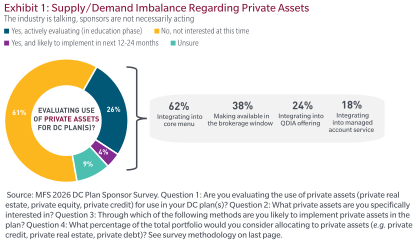
At MFS, we are concerned that the industry may be trying to solve a problem that doesn’t exist, as our survey finds that only 13% of employees are asking for private assets to be included in their retirement plans. More troublesome, with many institutional investors at capacity on private asset allocations, we are concerned that TDF investors could end up serving as liquidity providers to private investment managers seeking new funding sources for their investment products. Ultimately, incentives may be misaligned.
Retirement investors continue to prioritize simplicity, transparency, and liquidity — hallmarks of traditional public market solutions.
Key Considerations When Evaluating Private Assets
When evaluating whether private assets should play a role in a TDF, many dimensions need to be considered.
1. Cost
Private investments typically involve significantly higher fee structures than their public market equivalents. This fee stack, which might include management fees, performance fees, and additional operational costs, can meaningfully dilute gross returns, creating a higher hurdle just to break even.
Furthermore, capital committed to private funds is not always fully invested, especially in the context of TDFs. If held in cash, uncalled capital can create performance drag and provide less exposure to the asset class than intended; if equitized, on the other hand, it may increase the volatility profile and dilute the differentiation provided by the private asset.
The DC market is extremely fee sensitive, and the inclusion of higher-cost private investments runs counter to this dynamic.
2. Liquidity
Liquidity is another central consideration in TDF portfolio construction. Private investments generally involve multi-year lockups, limiting an asset manager’s ability to rebalance or meet participant cash flows.
Recently, there have been several examples of liquidity strain and credit deterioration in private credit, including rising default rates, borrower restructurings, and redemption gates imposed by several high-profile managers as investors sought liquidity. During periods of market stress, this kind of gated access could force TDF managers to source liquidity from public market allocations. In extreme cases, this could lead to extended holdings periods, reduced portfolio flexibility, and skew asset allocation into suboptimal territory as public securities are sold to meet cash needs.
To address liquidity issues, managers sometimes hold a liquidity buffer within a private portfolio. Though this technique may help create liquidity, the tradeoff is dilution of the private allocation. As a result, the effective exposure to private markets can be meaningfully lower than advertised, with cash and other liquid holdings needed to actually make the private allocation operationally viable. Ironically, gaining access to illiquid private investments often requires maintaining a meaningful allocation to highly liquid assets, creating a drag on the portfolio’s actual private market exposure.
Beyond the scope of the investment manager, liquidity is also a consideration for plan sponsors. If a plan sponsor decides to replace a TDF manager that holds illiquid private assets, the funds may be subject to lockups, redemption gates, or lengthy exit timelines, making the transition of assets difficult or costly. As a result, sponsors could face delayed implementation, secondary market discounts, or the need to maintain legacy investments until liquidity becomes available. Additionally, fiduciary risk may come into play given the ERISA requirement for fiduciaries to prudently monitor investments on an ongoing basis. Should a plan sponsor conclude that private assets are no longer appropriate—because of performance, valuation concerns, fees, or changing market conditions—illiquidity may impede timely implementation of that decision. The inability to readily exit an investment may create tension between fiduciary obligations and the practical constraints of the investment vehicle.
3. Volatility and Valuation
Private assets are typically valued on a periodic basis, often quarterly rather than daily. Valuation marks may also differ substantially across otherwise similar assets, further complicating the true worth of an investment.
From an accounting perspective, infrequent pricing can smooth return patterns and create the appearance of lower volatility relative to public markets. However, this phenomenon — sometimes described as “volatility smoothing” — understates the true economic risk of private investments. Adjusting for the effects of smoothed pricing, private assets exhibit higher volatility, greater market beta, and stronger correlations with public equities than initially observed.
As a result, the perceived diversification benefits of private assets may be less significant than commonly assumed. This reflects unreported volatility, not lower underlying risk.
4. Transparency
Transparency is a key consideration for DC investors. Public market securities offer daily pricing and high levels of disclosure, enabling clear performance monitoring and risk assessment.
Private assets, by contrast, lack daily valuations and often provide limited transparency regarding underlying holdings and portfolio performance. This can make it more difficult for plan sponsors and participants to evaluate outcomes or understand portfolio behavior.
Recent headlines highlighting challenges within private credit have brought this issue into sharper focus, with portfolios heavily concentrated in lower-quality software business showing signs of stress.
5. Return Profile
While private assets may generate strong returns over certain periods, long-term comparisons suggest their performance often converges with public market equivalents once fees, leverage, and liquidity constraints are taken into account.
For example:
- Private equity has historically exhibited returns similar to public small-cap equities.
- Private credit has often behaved similarly to high-yield bonds.
- Private real estate shares similar characteristics with publicly traded REITs.
These overlaps suggest that many of the economic exposures associated with private assets can be accessed through liquid public markets, often with greater transparency, less operational or structural complexity, and lower cost.
6. Allocation Size
Another practical consideration is allocation size. Given cost, illiquidity, and operational considerations, TDF allocations to private assets may ultimately be relatively small. This raises a fundamental question: if the allocation is small enough to maintain liquidity and risk control, is it large enough to meaningfully impact portfolio outcomes?
Conversely, increasing the allocation to a level where it could materially impact returns may increase cost as well as introduce liquidity and risk management challenges. Given the fee sensitivity and fiduciary scrutiny common in DC plans, these trade-offs may be of particular importance.
7. Manager Access and Capacity
Having exposure to private assets may be the central topic, but how a TDF manager achieves that access should not be overlooked. Returns for private market portfolios are generally highly dispersed across managers, and top-performing managers often have both limited capacity and long-standing institutional investor relationships. A 2025 study by MSCI found meaningful dispersion amongst evergreen structures across private assets. Even when omitting the widest outliers and focusing on the 95th and 5th percentile of fund returns, the dispersion observed was 18.1%, 13.3% and 8.1% in private equity, private real estate and private credit, respectively.2
All of these factors can make access to private markets challenging for large-scale vehicles such as TDFs. As a result, TDFs may face a higher probability of allocating to median or below-median managers, where the potential for excess returns may be more limited.
Conclusion
TDFs are designed to be simple, diversified, default solutions for a broad population of investors with varying levels of financial sophistication. Adding private assets introduces additional complexity that may not meaningfully improve participant outcomes. Research on retirement plans consistently shows that simplicity and transparency improve participant engagement and understanding.
While private assets may have a role in certain portfolios, their commonly cited benefits — particularly enhanced diversification and superior risk-adjusted returns — may be less than advertised, especially when evaluated in the context of DC plan constraints.
In TDF portfolios, disciplined rebalancing, liquidity management, cost efficiency, simplicity, and transparency are all critical. Illiquid private assets can complicate these attributes and introduce structural challenges that may outweigh their potential advantages.
We believe that public markets and liquid alternative strategies provide sufficient tools to construct diversified, resilient portfolios capable of delivering competitive long-term results. Maintaining transparency, flexibility, and implementation efficiency remains critical, and these attributes may be best achieved through liquid, public investment solutions.
Endnotes
1 MFS 2026 US DC Plan Sponsor Survey. For survey methodology, please click here.
2 The Ascendance and Implications of Evergreen Funds in Private Markets https://www.msci.com/research-and-insights/blog-post/the-ascendance-and-implications-of-evergreen-funds-in-private-markets.
AUTHORS
Derek Beane, CFA
Institutional Portfolio Manager
Trisha Guchait, CFA
Quantitative Research Analyst