
Key Insights
We expect alpha to play a larger role in fixed income returns going forward. While beta should remain supportive in 2026, it is no longer exceptional. In this environment, security-selection alpha appears particularly attractive, offering both style diversification and stronger potential for excess returns relative to other alpha sources.
We expect alpha to play a much bigger role in fixed income returns this year
In our view, fixed income expected returns are lining up to be quite decent in 2026 but are no longer remarkable, primarily because the “Goldilocks” macro regime is over. Indeed, the current macro and market environment is less supportive of fixed income, in large part due to a more complicated duration landscape and a challenging spread valuation backdrop. In many parts of the world, central banks are no longer easing; even in the US, the bar is fairly high for the Fed to deliver more cuts than are currently priced in by the rates market. In the absence of aggressive policy easing, duration is therefore unlikely to be a major contributor to total returns. In addition, credit spreads are tight in many markets. As a result, we believe that there is limited space for further spread compression, though we are not necessarily calling for a spread correction in the period ahead. In fact, our baseline scenario calls for stable spreads, helped by a robust macro backdrop and solid credit fundamentals, though we do not expect this alone to drive total returns. This leaves us with income as a main driver of global fixed income returns, supported by total yields that remain attractive by historical standards (Exhibit 1). Looking at the Bloomberg Global Aggregate Index (Global Agg), its yield is currently around 3.45%, producing a 10-year z-score* of 1.05 in our valuation analysis — a level that is quite attractive relative to history.
* A Z-score measures how many standard deviations a data point is above or below the mean of a distribution.
Exhibit 1: Income may be a Main Driver of Fixed Income Beta in 2026

Source: MFS, for illustration only
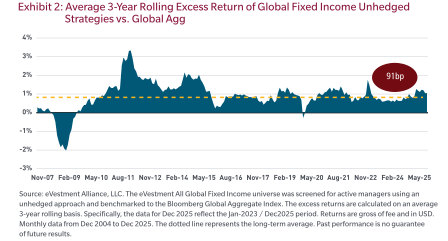
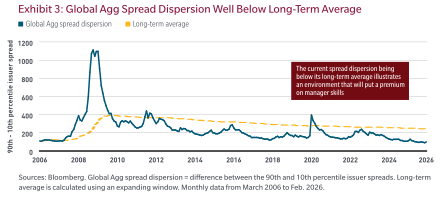
As fixed income beta returns diminish, alpha may play a bigger role in generating returns. In recent months, we’ve seen the alpha generated by active asset managers rise above the Global Agg’s long-term average of 91 basis points (Exhibit 2). The current market environment of complexity and macro volatility, along with a focus on diversification and risk management, is creating opportunities for active asset managers to potentially generate higher excess returns. In turn, this alpha is likely to represent a larger share of total returns. Fundamental mispricing, greater differentiation, and the emergence of winners and losers: together, these factors create a more favorable market environment for active managers. The spread dispersion within the Global Agg is the tightest it has been in many years, which means that there is a greater premium on the quality of the active manager, especially when it comes to security selection (Exhibit 3).
Strategically, security-selection alpha appears to offer attractive characteristics
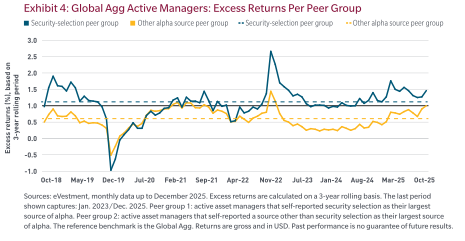
For a start, selecting a global active manager that primarily relies on security selection may offer some style diversification. Based on eVestment data, we have identified two distinct global fixed income peer groups: the first is active managers that cite security selection as their largest source of alpha (peer group 1); the second is the rest, i.e., those whose self-reported largest source of alpha is not security selection (peer group 2). What’s striking is that peer group 1 represents a minority in the community of active Global Agg mandates. Indeed, in our data sample, peer group 1 is only 17 managers, compared with 45 managers in peer group 2; this suggests that security selection may offer some style diversification. In fact, the most popular self-reported source of alpha across all respondents is asset allocation.
Empirical evidence shows that security selection may help generate higher excess returns. Looking at the past seven years — the longest time window for which data are available — excess returns generated by peer group 1 have been higher, averaging 1.08% annually against 0.60% for peer group 2 (Exhibit 4). In our view, this 48 basis point annual average outperformance is significant. In addition, it’s worth noting that peer group 1 excess returns beat peer group 2 excess returns 86% of the time, suggesting robust outperformance consistency. Finally, when factoring in the volatility of alpha, it is worth pointing out that peer group 1 has generated 0.76% of expected returns per unit of risk over the whole period, as opposed to 0.44% for peer group 2. In other words, this suggests that security selection may help generate more attractive risk-adjusted returns.
Investment implications: Security selection may offer an attractive source of alpha diversification in global, multi-sector strategies
Given the dislocations in global markets, fundamental differentiation is likely to be a key market driver in the period ahead. In particular, there are going to be winners and losers as a result of the AI-driven technological disruption. Against this backdrop and looking forward, we believe that security selection is well positioned to be a key contributor to excess returns, and, by extension, to fixed income total returns. In addition, we believe that security selection may offer style diversification in global, multi-sector strategies, because active managers that identify security selection as their primary source of alpha appear to be in the minority. More importantly, security selection may help generate higher excess returns, especially in relation to other sources of alpha.
The views expressed herein are those of the MFS Strategy and Insights Group within the MFS distribution unit and may differ from those of MFS portfolio managers and research analysts. These views are subject to change at any time and should not be construed as the Advisor’s investment advice, as securities recommendations, or as an indication of trading intent on behalf of MFS.
No forecasts can be guaranteed.
Diversification does not guarantee a profit or protect against a loss. Past performance is no guarantee of future results.
AUTHORS
Benoit Anne
Senior Managing Director
Strategy and Insights Group