
Macro/Micro: A Construct for Robust Risk Budgeting
AUTHORS
Josh Marston
Head of North American
Multi-Sector Portfolio Management
Fixed Income Portfolio Manager
Rob Hall
Fixed Income Institutional Portfolio Manager
In Brief
- We believe that the effective integration of top-down macro and bottom-up micro perspectives on the economy is critical to building a market thesis to guide the deployment of capital.
- A macro perspective provides a framework to understand the broader workings of global capital markets as they are impacted by policy, global events, and demographics. Macro data is backward-looking and subject to revision, however, making it difficult to recognize and predict the impact of structural changes in the economy or turning points in the growth cycle.
- A micro, or company-level, perspective provides real-time information that can be useful in the early identification of turning points in the market and as a means of gauging the impacts of structural changes in the economy as they occur.
- Dissonance between top-down and bottom-up views may signal cyclical or structural inflection points in the economy, as well as associated actionable investment opportunities.
- We have built a repeatable framework for leveraging both top-down macro and bottom-up micro insights from across our research platform to support the development of a more comprehensive and nuanced market thesis to guide the risk budgeting process.
Introduction
We believe that fundamental views on the state of the economy that derive from the integration of bottom-up and top-down inputs are better attuned to real-time cyclical and structural changes than fundamental views based solely on macro data explained through the application of an economist’s toolkit. The key advantage of interpreting and systematically compiling analysts’ findings from their interactions with company management teams is the focus on real-time and forward-looking guidance, which may provide a useful complement to the backward-looking data releases that tend to dominate the market’s perceptions of economic reality. At critical junctures in the economy, the synthesis of top-down and bottom-up perspectives can support a differentiated macro view that can arm a portfolio manager with the confidence needed to take a contrarian stance on risk-taking.
Fundamental Views Are a Key Contributor to Risk Budgeting
For an active manager like MFS, the establishment and calibration of a risk budget that guides the aggregate level of active portfolio risk is the critical starting point of the investment process. Portfolio risk budgets are predicated on our expectations for the interplay between three key drivers of the bond markets: fundamentals, supply/demand technicals, and valuation. We seek to build a market thesis that considers forward-looking views on fundamentals in conjunction with technical scenarios and evaluates outcomes in terms of the potential excess returns implied by starting valuations. Weighing possible outcomes helps us target a desired aggregate level of credit and interest rate risk for a portfolio, which we then iteratively refine into specific asset allocation and positioning decisions. This whitepaper focuses on our process for assessing the fundamental outlook by integrating a top-down macro framework with a bottom-up company-level perspective:
- Top-down: We examine real growth, inflation, monetary and fiscal policy, secular trends, and tail risks in an effort to understand the macro and market backdrop and how it may evolve over time.
- Bottom-up: Primarily through real-time and forward-looking feedback from company management teams, we assess current and forward-looking trends in the labor market, capital expenditures, revenue growth, and profit margins. An aggregated view on these four dimensions of corporate health across industries can provide signals on the state of the economy and its likely path forward.
Comparing Top-Down and Bottom-up Viewpoints on Fundamentals
Top-down data constitutes a significant component of investors’ traditional toolkit for interpreting the economic cycle. Much of this data is recurring and can be observed over the course of multiple cycles, allowing investors to identify patterns and signals that may presage future developments, such as a recession. The underlying assumption in this kind of analysis is that the past is prologue — and it often is.
The “hard data” that describes what has happened in the past often does so by incorporating seasonal adjustments that assume a continuation of past patterns, and it is accordingly frequently subject to meaningful revision. The hard data is complemented by “soft data,” or survey data, which is opinion-based and can potentially be heavily influenced by prevailing market sentiment. While survey data often correlates well with actual economic activity over the long-term, it can show significant short-term deviations.
A key limitation of top-down data is that its dated, inherently backward-looking focus means that it can miss key inflection points in an economic cycle. The last two decades are replete with examples of economies not following traditional patterns, in part because of the introduction of various unprecedented elements to the macro mix, including policy initiatives like quantitative easing and tightening and extraordinarily generous fiscal stimulus, and in part because of structural shifts in labor and the consumer that have altered the economy’s reaction function to policy initiatives.
Bottom-up signals provide a critical complementary strength: the time factor. Corporate managements’ messaging is focused on current conditions and forward-looking expectations and therefore addresses the key limitation of much of the top-down data. As such, the bottom-up perspective can be especially helpful as a means of validating when an economy is improving ahead of the data or how the economy is reacting to structural shifts. Micro signals that appear inconsistent with the top-down narrative challenge conventional macro interpretations and encourage deeper investigation. However, just as top-down views reflect inherent biases, so too do bottom-up views. What company management teams express in public can be influenced by a variety of motivations that can skew the narrative (e.g., “talking one’s book,” politics, etc.), and recognizing these biases is critical in appropriately interpreting the message.
Conceptualizing a Macro/Micro Forum
We formally established our Macro/Micro Forum in 2017 as a framework to help facilitate the integration of topdown and bottom-up views on macro fundamentals as an input to the risk budgeting process. In doing so, we were seeking to accomplish several objectives aimed at making better-informed risk budgeting decisions:
- Establish a more systematic and structured process to capture the observations of our credit analysts across industries and companies;
- Synthesize a view on the fundamentals through the integration of macro and micro viewpoints; and
- Improve our ability to test our macro and market theses in an evolving economic backdrop.
This was conceived as a variation on the “battle of the bands” idea: our firm’s key interpreters of the top-down message (the Chief Economist and the Chief Investment Strategist) are on a quarterly basis pitted against the North American high-grade and high-yield credit analysts, who offer evidence that either supports or challenges the top-down message on the economy.
Macro/Micro Mechanics
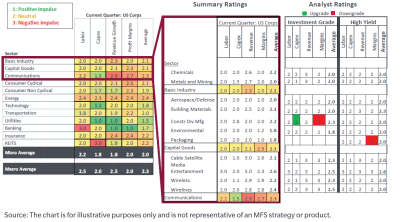
Prior to the formal quarterly Macro/Micro Forum meeting, all participants are asked to rate their covered industries and sectors across four key themes: labor, capital expenditures, revenue growth, and profit margins. All participants note whether each dimension is experiencing positive or negative momentum or remains unchanged at what could be considered a “normalized” (i.e., average or through-cycle) level. A rating of “1” is indicative of above-trend behavior, a “2” of normalized behavior, and a “3” of below-trend behavior.
Industry-level scores from investment-grade and high-yield analysts are aggregated by applying a weighting to each based on the market capitalization of the industry within investment-grade and high-yield indices. Sector-level scores represent market-cap weighted averages of component industry-level scores. Finally, the aggregated scores reflect market-cap weighted contributions across sectors.
Our macro representatives employ a similar scoring system when contributing their views, which allows the two sets of scores to be readily compared.
The graphic below illustrates the scoring process, highlighting upgrades and downgrades from the analysts:
The dialogue during the Macro/Micro Forum begins with the top-down team summarizing their interpretation of trends in labor, capex, revenue growth, and profit margins. What follows is an around-the-room discussion in which the analysts present their industry-level findings with respect to the same four themes.
Throughout this process, the moderator asks directed questions of the analysts to test market theses in real time; these may be tied to both longer-term cyclical shifts, as well as to potentially shorter-lived structural changes underway in the economy that may not be evident in the macro data and consequently potentially missed by a traditional macro framework.
Case Study: Integrating Bottom-up and Top-down Views Can Drive a Differentiated View of the Fundamentals
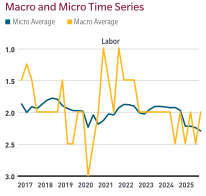
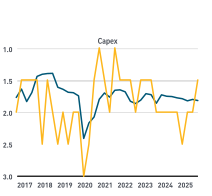
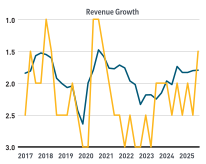
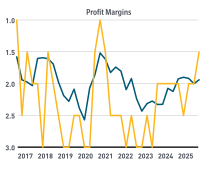
The graphic below represents a time series of the scoring of macro and micro views and illustrates the idea that although macro- and micro-derived impressions of labor, capex, revenue growth, and profit margins generally travel in the same direction, they can and do periodically diverge from each other.
Case Study: 2022 and 2023
In the following case study, the integration of bottom-up and top-down views on the fundamentals supported a level of risk-taking in portfolios that would not have been warranted if relying solely on the macro data. Importantly, in this example, a differentiated view on the fundamentals led to non-consensus conclusions to add risk.
2022 witnessed a continuation of the strong post-pandemic rebound in economic activity that began in 2021. Inflation surprised to the upside, hitting a 40-year high and prompting aggressive tightening by the Federal Reserve. With widespread market fears that the Fed would tighten too much, too fast and drive the economy into recession, rates sold off sharply. As the year progressed, macroeconomic data continued to deteriorate, driving a growing market consensus for recession by the end of the year. This negative sentiment continued into 2023, peaking early in the year with a regional banking crisis, which began with a run on Silicon Valley Bank and the collapse of struggling Credit Suisse. Rate volatility skyrocketed and spreads widened sharply as recessionary fears proliferated.
Amid this tumultuous period, when a cascade of traditional recessionary indicators was “flashing red,” our expectations were consistently focused on more benign outcomes. While we foresaw a slowing of growth, we felt it would be mild enough to remain supportive of credit. This contrarian view was supported by what we were observing at the company level. Specifically, we were seeing signs of a resilient, healthy consumer who was for several reasons both willing and able to support growth by spending. First, our analysts’ conversations with companies suggested that a degree of “labor hoarding” could be supporting the consumer. Companies were reluctant to trim labor in response to short-term slowing in business conditions after having experienced labor shortages post-pandemic, keeping labor income more durable than expected. Moreover, both homeowners and corporations had the benefit of locking in inexpensive financing prior to the start of the Fed’s hiking cycle, which we felt would mitigate the impact of higher rates for some time. The availability of cheap mortgage refinancing during the pandemic and related “lock-in” effects helped change housing market dynamics, leaving the housing sector more resistant to higher rates. Consumer finance companies reported readiness to lend, giving consumers increased spending power. Additional feedback from company management teams suggested confidence about growth and their ability to pass higher costs through to consumers to protect margins, as reflected in higher micro versus macro ratings for top-line revenue growth and profit margins. In this way, the bottom-up evidence suggested an economy that had been structurally altered in ways that made it unusually resistant to recession, changing its reaction function to higher rates such that the policy transmission mechanism was left less efficacious than in the past.
Our more positive view on the economy — based on what we were observing from our micro-level analysis, together with a credit market offering spreads consistent with a near certainty of recession — created an investable opportunity. In addition, with our view that the Fed was nearing the end of its hiking cycle, and with signs that interest rates were stabilizing at levels that offered the highest all-in bond yields in a decade, we felt that the technical backdrop for fixed income was poised to shift from decidedly negative to more positive. With that thesis in mind, we started selectively adding to both high-grade and high-yield corporate exposure in the second half of 2022 and then again, to a more meaningful extent, in early 2023 amid the market jitters precipitated by the banking crisis. Not surprisingly, adds to the portfolio included consumer finance companies and other financials the market had “painted with the same brush.”
By the end of 2023 and into early 2024, credit spreads had compressed significantly from levels consistent with recession to multi-decade lows last seen prior to the Global Financial Crisis, resulting in significant capital appreciation and alpha generation.
When a divergence between the micro and macro messages occurs, the micro message does not always lead the macro data. In the Global Financial Crisis, for example, the meltdown in housing was well entrenched and aggressively working its way through the financial system before companies broadly recognized the impact the crisis was likely to have on their business prospects. Similarly, in the early days of the COVID pandemic, it was monetary and fiscal policy that provided the most important guidance for investing, not the view from the bottom up. These examples underscore the importance of bringing both top-down and bottom-up perspectives to bear.
Conclusion
We established the Macro/Micro Forum as a component of our risk budgeting process with the goal of creating a repeatable, systematic approach to collecting bottom-up signals that, together with top-down analyses, could help us anticipate turning points in the economy. Most often, both sides of the debate are in general agreement, with subtle and nuanced degrees of difference. In such cases, the result is a higher level of conviction.
At times of change in the economy, however, divergence between the viewpoints can alert us to said changes, influencing how we think about the deployment of risk. As noted in the 2022-2023 case study, bottom-up inputs helped us conclude that the economy was in better health than what was implied by recessionary credit spreads. These fundamental insights, along with a view on improving market technicals and attractive valuations, allowed us to make more informed investment decisions by stepping into undervalued risk.
The views expressed are those of the author(s) and are subject to change at any time. These views are for informational purposes only and should not be relied upon as a recommendation to purchase any security or as a solicitation or investment advice. No forecasts can be guaranteed. Past performance is no guarantee of future results.
Diversification does not guarantee a profi t or protect against a loss. Past performance is no guarantee of future results.