
Signal in Sync: Designing Quantitative Models to Align with Fundamental Timeframes
AUTHORS
Jeffrey Morrison, CFA
Quantitative Institutional
Portfolio Manager
Patrick Beksha, CFA
Senior Strategist,
Investment Product Specialist
In Brief
- Our quantitative models are specifically designed to align with the longer time horizon of fundamental research.
- We believe the unique alpha opportunities within our Blended Research® process do not come from the quantitative model or our fundamental analysts independently, but rather from investing through the ‘intersection’ of these opportunities.
- This approach differs from a common systematic approach which often holds a larger number of stocks to gain factor exposures and then trades those names frequently, driving up turnover.
Discretionary fundamental portfolios and quantitative equity portfolios generally exhibit distinct portfolio characteristics as a result of their stock selection process. Fundamental managers typically have a smaller number of holdings and hold those stocks for longer time periods to allow a fundamental thesis to play out over time. In contrast, quantitative managers often hold a larger number of stocks to gain factor exposures and then trade those names more frequently as new data and price movements drive turnover within the portfolio.
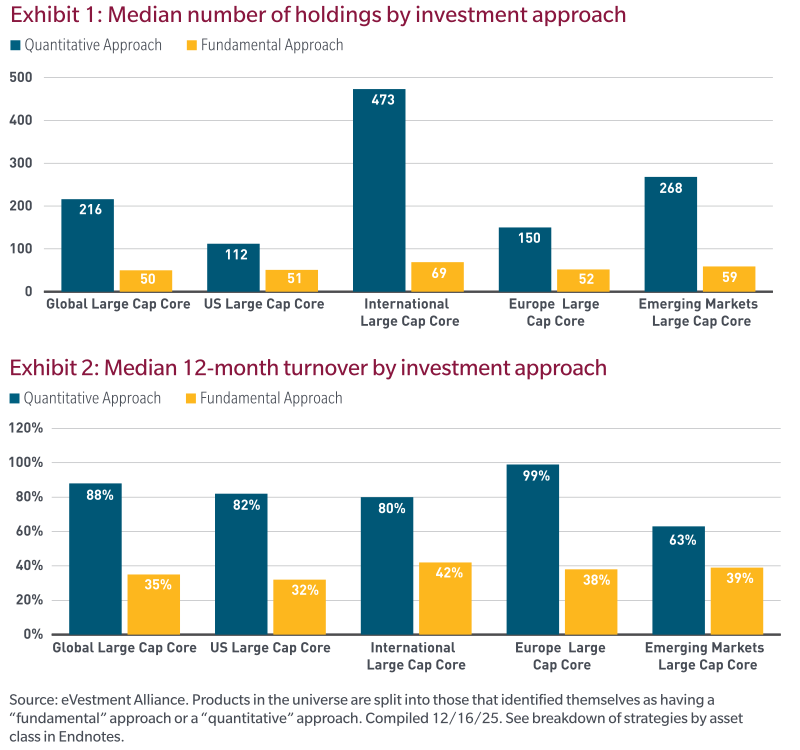
We see these characteristics in fundamental and quantitative managers across different equity universes shown in Exhibits 1 and 2 below. The median fundamental manager across Large Cap Core Equities consistently holds fewer stocks and exhibits a lower turnover than quantitative peers. For example, within the Global Equity universe, the median number of holdings for a fundamental manager was just 50 stocks, with a median annual turnover of 35%. Conversely, the median quantitative Global Equity manager holds over 200 stocks and has a median turnover of 88%. These characteristics become even more pronounced at the extremes. For instance, within the Global Equity universe, 40% of quantitative strategies have portfolio turnover rates exceeding 100%.
At the core of our Blended Research® process is an alpha signal that combines fundamental and quantitative insights. However, integrating these approaches requires addressing the inherent mismatch in their investment time horizons. Fundamental signals often rely on a longer-term thesis, while many quantitative models are designed for short-term trading.
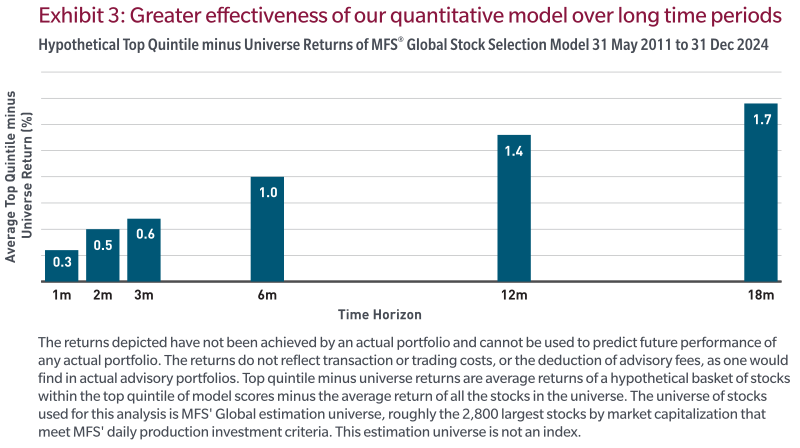
To bridge this gap, we believe it is important to ensure our quantitative signal is measured and achieved over a similar time period as fundamental analysis. Our quantitative research is focused on estimating returns over longer-term horizons, which naturally increases the emphasis on factors with lower turnover and more persistent signal. By focusing on factors with slower decay — such as Value, Quality, and Sentiment — and smoothing price momentum through trend factors, our models achieve lower turnover and maintain efficacy over forward return horizons of at least one year.
Exhibit 3 illustrates this quantitative time horizon, showing greater effectiveness of our quantitative model over long time periods. This approach also contrasts with many quantitative models that would be more focused on short term trading signals.
We believe the strength of our Blended Research® portfolios lies in the ‘intersection’ of fundamental and quantitative insights. By combining the deep, qualitative understanding of fundamental analysts with the systematic, data-driven approach of quantitative models, we believe we can capture unique alpha opportunities that are different than either approach individually.
Summary
Fundamental and quantitative research use distinct approaches, each with unique strengths, limitations, and style characteristics. For our Blended Research portfolios, we believe the unique alpha opportunities do not come from the quantitative model or our fundamental analysts independently, but rather from investing in the ‘intersection’ of these opportunities. For this reason, we deliberately design our models with a longer-term horizon to capture and sustain that overlap, rather than relying on either approach in isolation.
Endnotes
Exhibits 1 and 2: Number of strategies reporting turnover and number of holdings differs. Numbers of strategies reporting holdings are: Global Large Cap Core (211 fundamental, 85 quantitative); US Large Cap Core: (211 fundamental, 83 quantitative); ACWI ex US Large Cap Core: (53 fundamental, 13 quantitative); Pan-Europe Large Cap Core: (31 fundamental, 17 quantitative); Emerging Markets Large Cap Core: (22 fundamental, 25 quantitative). Numbers of strategies reporting turnover are: Global Large Cap Core: (172 fundamental, 73 quantitative); US Large Cap Core: (182 fundamental, 64 quantitative); ACWI ex US Large Cap Core: (46 fundamental, 13 quantitative); Pan-Europe Large Cap Core: (29 fundamental, 14 quantitative); Emerging Markets Large Cap Core: (22 fundamental, 25 quantitative).
Exhibit 3: Top quintile baskets are roughly the top 560 stocks ranked by global stock selection model scores, equal weighted. Each month end, the top quintile and universe baskets are formed using model scores as of that point in time, average returns for the subsequent return horizons are computed for each basket, and the difference (top quintile minus universe) is taken. For example, to calculate the top quintile minus universe returns for 31 December 2015, top quintile and universe hypothetical baskets are formed using scores as of that date. The average returns for the top quintile and universe baskets are then computed at horizons between 1 and 18 months. The top quintile minus universe returns are then the differences in the returns for these two baskets. This is repeated each month for the observation period and averaged to calculate the returns shown in this chart. Results may vary depending on the date this hypothetical calculation is run. Each time the calculation is repeated, the returns for all past periods are recomputed using the most recent security data in FactSet as applied to the then-current hypothetical baskets.
The model and the stocks included in the hypothetical baskets change over time because of a variety of factors including changes in the composition of the MFS Global estimation universe, changes in relevant data (e.g., due to third-party data updates), corporate actions, etc. Any changes made to the model are not retroactively applied to the older model scores. Investments selected using quantitative models may not produce the intended results because of, among other things, the factors used in the models, the weight placed on each factor in the models, changing sources of market return, and technical issues in the design, development, implementation, and maintenance of the models (e.g., incomplete or inaccurate data, programming or other software issues, and technology failures).
The views expressed in this report are those of MFS and are subject to change at any time. These views should not be relied upon as investment advice, as securities, recommendations or as an indication of trading intent on behalf of the advisor. Past performance is no guarantee of future results. No forecasts can be guaranteed.
Diversification does not guarantee a profit or protect against a loss. Past performance is no guarantee of future results.