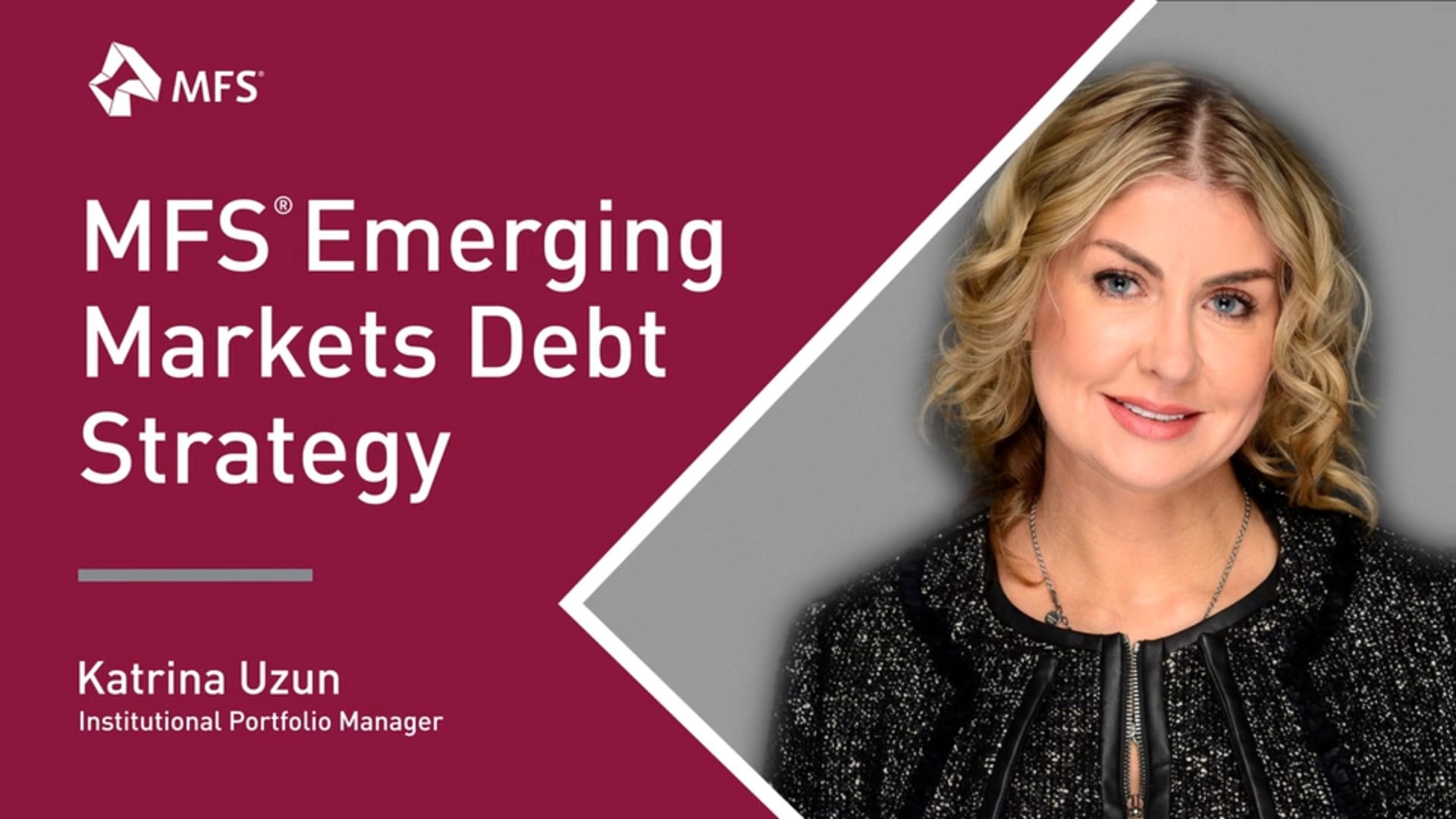
MFS® Emerging Markets Debt Strategy - Quarterly Portfolio Update
Neeraj Arora, CFA, Portfolio Manager, shares the team's thoughts on emerging markets and provides a quarterly update on the Emerging Markets Debt Strategy.
Katrina Uzun: Hello, everyone, and welcome back. Today I'm joined by Neeraj Arora, an emerging markets debt portfolio manager, to discuss what has been a remarkable year in emerging markets debt. Neeraj, thank you for being here.
Neeraj Arora: Pleasure to be here, Katrina.
Katrina Uzun: So, let's start with the big picture. 2025 was a very strong year of performance. EM credit spreads tightened about 70 basis points last year, from 325 basis points at the start of the year to 253 basis points by the end of December. And yields moved down to 6.8%.
As a result, hard currency generated 14.3% return for the year. But as always, headlines do not always tell you the full story. So how would you characterize the year performance?
Neeraj Arora: You're right. While the overall performance of the asset class was very strong, but it was really concentrated in the riskier segments of the asset class. So the lower-rated segments of the asset class — the single B, triple C credits — posted outsized gains. And even the defaulted credits like Venezuela returned almost 100%. Lebanon returned 80% last year. Those outsized moves really drove the index performance.
And it was not necessarily because of improving fundamentals in all these credit. It was really a function of the market and the backdrop of the environment of chasing, grabbing yield, the grabby yield environment that drove these outsized returns.
It's also important to keep in mind that these returns came against a backdrop of really heightened volatility in the market. We had increased tensions on global US trade policy, where we ended up almost in a global trade war. The world was at the precipice of a global recession.
And not to mention, we had active wars in EM and in the world. You had the ongoing Russia-Ukraine war, the Israel-Gaza war, Israel-Iran, and with the US getting involved in Iran, and then you had two nuclear-armed neighbors, India and Pakistan, also in a mini-war in the summer. So, any of these risks, the macro risk and the geopolitical risks, could have materialized in a negative way for investors.
Kartina Uzun: And you mentioned Venezuela, and as you can imagine, we've had quite a few client questions on Venezuela in this past quarter. So what is your outlook there? Is it time to add exposure to Venezuela? And what is the broader readthrough on Latin America?
Neeraj Arora: Sure. So, Venezuela has rallied sharply to start the year. Already in January, Venezuela is up 25% in the month of January, on really expectations of a meaningful regime change in Venezuela. We had added, in our portfolios, we had added Venezuela back in the fall, in October. We had moved from an underweight position to a neutral position, in expectations of regime change as we saw the US military build up naval assets in the Caribbean.
However, today, given the strong move at the end of last year and in January, we wouldn't advocate establishing new positions in Venezuela at these levels. And that's because the debt restructuring in Venezuela is going to be pretty complex, very long-drawn-out, and which should likely limit the upside from these levels.
To your question about impact on the rest of the region, it should be quite limited because the financial and trade linkages with the rest of Latin America are quite small in the Venezuela linkages. What's more notable to us is the geopolitical aspects of this, which is the renewed US engagement in the region, in Latin America, and US support for governments that are more aligned with the US administration's policies.
We saw this most notably in Argentina last fall when the US Treasury supported Argentina ahead of their midterm elections with a swap line. Now, this is a theme that we are monitoring closely in Latin America, where there are some larger economies this year that go to elections, in Peru and Brazil, Colombia, where you could have a change, a shift to the right in those elections, and where those policies and those countries could be more aligned with the Trump administration's policies. So that's something to watch in '26.
Katrina Uzun: Understood. Let's zoom out for a second to the global macro environment. How would you describe the macro backdrop for emerging market debt investors?
Neeraj Arora: Well, overall, the macro environment is very constructive. Global and EM growth has been resilient. Inflation has moderated within target in most countries. The central bank policy paths have become more predictable.
The Fed is likely to cut rates. Commodity prices, excluding oil, are strong, which is an important tailwind for emerging markets. And the dollar is likely to stay on a weaker depreciation path. And these are all tailwinds for emerging markets.
Katrina Uzun: Well, and you mentioned the dollar. That's another question our clients keep asking us about, "What is the outlook for the dollar?" So what would you say? What do you expect for the dollar this year?
Last year, the dollar weakened about 10%, and that gave a significant boost for not only the local currency debt market, but the hard currency debt market as well. Do you expect that to continue?
Neeraj Arora: Yes. We believe the dollar has entered a weaker phase of the structural dollar cycle for several reasons. First, the dollar remains substantially overvalued on a trade-weighted basis. Second, the US is running these really large fiscal and current account deficits which should push the dollar weaker. Third, if US recession risks rise, or even US slowdown risks rise, that would mean that the Fed would have to cut rates more, which would again erode the support for the dollar.
Another reason would be, risk for the dollar, the Federal Open Market Committee, the composition of the committee turns towards a more dovish composition in the spring or later in the year, then that's another headwind for the dollar. And finally, just the emerging institutional weaknesses in the US and the need for diversification hedging by foreign investors, that's another headwind for the dollar.
In terms of the magnitude, we don't expect a similar magnitude, 10% weakness, that we saw last year, but the direction of travel is for a weaker dollar. And again, a weaker dollar or stable to a weaker dollar is a tailwind for emerging market assets.
Katrina Uzun: Great. Thanks, Neeraj. So let's talk about emerging market debt specifically, then. How do you see fundamentals in emerging markets evolving?
Neeraj Arora: Sure. Emerging market fundamentals are in good shape. EM growth has held up well and proved to be resilient, partly thanks to strong exports last year. We do expect a modest slowdown in EM growth this year, but that'll be cushioned with some EM central bank easing that has already happened, and we expect some more easing from EM central banks.
Inflation in EM has fallen back to targets in most cases. Real policy rates are high. The fiscal balances in emerging markets of the countries that we track, the primary fiscal deficits in most countries, are expecting the forecast to adjust further in '26.
And then finally the external sector in emerging markets is quite strong. When we look at the external sector, we look at the measure of current account deficit plus foreign direct investment, which is called the basic balance, and which is a measure of external financing required for sovereign.
That in aggregate is in surplus. And not only that, this year, I mean this past year, and our expectation for the commodity prices have held up really well, and especially metal prices, so that's given a boost to a lot of commodity exporters in emerging markets.
And in addition, for emerging Asian economies, they've really benefited from this AI investment boom in terms of the exports that Asian economies are exporting to the rest of the world, the tech exports.
So that, again, all of this has resulted in emerging market central banks being able to accumulate foreign currency reserves and further strengthening their already strong external position.
Katrina Uzun: So that all sounds very positive, and that brings us naturally to valuations and then portfolio positioning. After this very strong year last year, are valuations attractive, and how do you express that through portfolio positioning?
Neeraj Arora: Oh, that's the key challenge. Valuations across credit markets are looking quite full, so EM is not an exception to that. And while EM bond spreads, relative to their own history, screen a bit on the risk side, but when you compare them to other fixed income asset classes like US investment grade or US high yield, they screen fair to a little bit on the cheaper side.
So from a portfolio perspective, we're not necessarily adding risk, but instead we're focused on maintaining carry in the portfolio, and being selective and focusing on differentiation, because our main goal is to generate alpha and not chase beta, and we do that through differentiating among credits.
Katrina Uzun: Thank you. Maybe you can give us a bit more color on positioning in the portfolio at the moment?
Neeraj Arora: Sure. In both the hard currency and local currency strategies, we continue to emphasize carry, and we're being very selective about where we take on additional risk, especially on the hard currency side because spreads are so tight. And country selection remains key to our focus in the strategy, and we focused on the fundamentals, policy credibility, and the valuations all have to line up.
So some examples of, for example, in the investment grade space, we have overweights in Mexico and Romania where we think the valuations are still attractive. And there's some policy changes, for example in the case of Romania that, fundamental changes, that improve the credibility units of the sovereign.
We've also found opportunities in investment grade corporates and investment grade sovereigns. So in countries like Chile and in India, we have invested in corporates where we found good carry-to-vol opportunities. And in the BB space, we maintain our overweights in countries like Paraguay, Costa Rica, and these are countries that are resilient to macroeconomic shocks and eventually would be upgraded to investment grade.
And then finally, in the low-rated segment of the asset class, in the B space, CCC space, we are overweight Argentina, where we're quite encouraged by the administration's policies, fiscal policies, the resolve of its consolidation, and their resolve to implement structural reforms in the coming years. So, Argentina's sovereign could reprice and rerate higher. So that's an example of being invested and being overweight, a low-rated sovereign in the asset class.
And then I should mention local rates and FX. And we have, again, the focus there is carry. So, we've been emphasizing high carry currencies at the Brazilian real, the Nigerian naira, Egyptian pound and the Turkish lira.
Katrina Uzun: Thank you, Neeraj. So, maybe let's spend a minute on technicals. That has been a big story last year. How do you see technicals evolving?
Neeraj Arora: You're right, technicals were very strong last year. After three years of outflows in the asset class, fund flows into EM turned positive last year for both the hard currency and local currency, and the flows were split between the two. Issuance was heavy at times, but that was well absorbed by both dedicated investors, crossover investors, and really a new emerging class of investors in the domestic market.
So for example, domestic pension funds and banks buying hard currency-denominated bonds in EM. And in all three classes of investors, we saw significant inflows in the asset class from that. So that was pretty well absorbed. All the issuance and amortizations have been on the lower side, so net supply was quite limited.
And then positioning, while long in the asset class doesn't seem overly stretched, and that should keep any spread widening more contained. I would say one headwind to this positive technical would be the bit for crossover investors slows, and that could happen if you get increased issuance from US investment grade, the hyperscalers related to the AI boom. If they started showing large amounts, then that could result in some slowdown in crossover investment into emerging markets.
Katrina Uzun: So, fundamentals are solid, valuations are reasonable, and technicals are supportive. What are the key risks that you're watching that could challenge that outlook?
Neeraj Arora: A few risks stand out. One is in the US growth outlook, if you get weaker-than-expected AI-related earnings in the US, and that results in an equity market correction, that could result in a slowdown in US growth. If you get further softening in the US labor market, that is another downside risk to US growth. On the global side, a slow-down in China, a sharper-than-expected slowdown in China would be negative for risk assets.
Coming back to the US, as you know, the US fiscal trajectory is on a, I would say one could argue, on an unsustainable path. And if that results in a repricing of US treasuries, that would be a negative risk event for the market. In the US, again, it would be if there's a credit event in the private credit market, just because the lack of transparency in that market, that would be a risk curve.
And then as always, finally, geopolitics. There are a number of geopolitical flashpoints that could flare up, Iran-Israel could flare up. China-Taiwan could be a flashpoint, maybe not necessarily for '26, but that's one that we're monitoring. And of course there's an ongoing war in Russia and Ukraine, which could take a more negative turn.
Those are the downside risks. I would also highlight some of the upside risks that are possible. One is, again, on the geopolitics, you could get a resolution of the Russia-Ukraine war, or at least a ceasefire, and that would be positive for risk assets, and emerging market risk assets in particular.
Or in China, you could get more targeted fiscal measures, particularly focused on the consumption side, on households; that could boost Chinese growth and consequently global growth, and that would be a big positive for global growth and emerging market assets.
Katrina Uzun: Thank you, Neeraj. And a difficult question, I know, but what is your expectation for return for this year for emerging markets?
Neeraj Arora: For the asset class, we would expect mid- to single-digit total return for the asset class. Obviously, you can't repeat the 14% return from last year. And it'll mostly be driven by the yield of the index, the carry, and so maybe some spread tightening, still in the high yield segment that you could get some spread tightening.
And together, if you can find attractive opportunities in, say, emerging market corporates, add that to the portfolio, and then selective EM local rates and FX in the portfolio, currencies in the portfolio, then that could deliver mid- to high-single-digit returns in 2026.
Katrina Uzun: Fantastic insights, Neeraj. Thank you.
Neeraj Arora: Well, thank you for having me.
Katrina Uzun: Fantastic insights, Neeraj. Thank you.
To summarize, 2025 was a very strong performance for emerging markets debt, but the gains were concentrated on the high-yielding portions of the market. And while valuations remain on the fuller side, solid fundamentals and supportive technicals should provide ample opportunities for emerging markets debt in the active space.
And while macro and geopolitical risks remain elevated, carry and diversification will provide very attractive opportunities across the asset class. With that, thank you very much for joining us today.
##PRODUCTS##
The views expressed are those of the speaker and are subject to change at any time. These views are for informational purposes only and should not be relied upon as a recommendation to purchase any security or as a solicitation or investment advice from the Advisor. No forecasts can be guaranteed. Past performance is no guarantee of future results.
Important Risk Considerations:
The strategy may not achieve its objective and/or you could lose money on your investment.
Bond: Investments in debt instruments may decline in value as the result of, or perception of, declines in the credit quality of the issuer, borrower, counterparty, or other entity responsible for payment, underlying collateral, or changes in economic, political, issuer-specific, or other conditions. Certain types of debt instruments can be more sensitive to these factors and therefore more volatile. In addition, debt instruments entail interest rate risk (as interest rates rise, prices usually fall). Therefore, the portfolio's value may decline during rising rates. Portfolios that consist of debt instruments with longer durations are generally more sensitive to a rise in interest rates than those with shorter durations. At times, and particularly during periods of market turmoil, all or a large portion of segments of the market may not have an active trading market. As a result, it may be difficult to value these investments and it may not be possible to sell a particular investment or type of investment at any particular time or at an acceptable price. The price of an instrument trading at a negative interest rate responds to interest rate changes like other debt instruments; however, an instrument purchased at a negative interest rate is expected to produce a negative return if held to maturity.
Emerging Markets: Emerging markets can have less market structure, depth, and regulatory, custodial or operational oversight and greater political, social, geopolitical and economic instability than developed markets.
International: Investments in foreign markets can involve greater risk and volatility than U.S. investments because of adverse market, currency, economic, industry, political, regulatory, geopolitical, or other conditions.
Derivatives: Investments in derivatives can be used to take both long and short positions, be highly volatile, involve leverage (which can magnify losses), and involve risks in addition to the risks of the underlying indicator(s) on which the derivative is based, such as counterparty and liquidity risk.
High Yield: Investments in below investment grade quality debt instruments can be more volatile and have greater risk of default, or already be in default, than higher-quality debt instruments.
Please see the applicable prospectus for further information on these and other risk considerations.
The portfolio is actively managed, and current holdings may be different.
Distributed by: U.S. - MFS Investment Management; Latin America - MFS International Ltd.; Canada - MFS Investment Management Canada Limited. Please note that in Europe and Asia Pacific, this document is intended for distribution to investment professionals and institutional clients only. U.K./EMEA – MFS International (U.K.) Limited (“MIL UK”), a private limited company registered in England and Wales with the company number 03062718, and authorized and regulated in the conduct of investment business by the U.K. Financial Conduct Authority. MIL UK, an indirect subsidiary of MFS, has its registered office at One Carter Lane, London, EC4V 5ER UK/MFS Investment Management (Lux) S.à r.l. (MFS Lux) – MFS Lux is a company is organized under the laws of the Grand Duchy of Luxembourg and an indirect subsidiary of MFS – both provides products and investment services to institutional investors in EMEA. This material shall not be circulated or distributed to any person other than to professional investors (as permitted by local regulations) and should not be relied upon or distributed to persons where such reliance or distribution would be contrary to local regulation; Singapore – MFS International Singapore Pte. Ltd. (CRN 201228809M); Australia/New Zealand – MFS International Australia Pty Ltd (“MFS Australia”) (ABN 68 607 579 537) holds an Australian financial services licence number 485343. MFS Australia is regulated by the Australian Securities and Investments Commission.; Hong Kong – MFS International (Hong Kong) Limited (“MIL HK”), a private limited company licensed and regulated by the Hong Kong Securities and Futures Commission (the “SFC”). MIL HK is approved to engage in dealing in securities and asset management regulated activities and may provide certain investment services to “professional investors” as defined in the Securities and Futures Ordinance (“SFO”).; For Professional Investors in China – MFS Financial Management Consulting (Shanghai) Co., Ltd. 2801-12, 28th Floor, 100 Century Avenue, Shanghai World Financial Center, Shanghai Pilot Free Trade Zone, 200120, China, a Chinese limited liability company regulated to provide financial management consulting services.; Japan – MFS Investment Management K.K., is registered as a Financial Instruments Business Operator, Kanto Local Finance Bureau (FIBO) No.312, a member of the Investment Trust Association, Japan and the Japan Investment Advisers Association. As fees to be borne by investors vary depending upon circumstances such as products, services, investment period and market conditions, the total amount nor the calculation methods cannot be disclosed in advance. All investments involve risks, including market fluctuation and investors may lose the principal amount invested. Investors should obtain and read the prospectus and/or document set forth in Article 37-3 of Financial Instruments and Exchange Act carefully before making the investments.
Unless otherwise indicated, logos and product and service names are trademarks of MFS® and its affiliates and may be registered in certain countries.
FOR INVESTMENT PROFESSIONAL USE ONLY. Not intended for retail investors.
MFS Fund Distributors, Inc., Member SIPC, Boston, MA
51885.15