
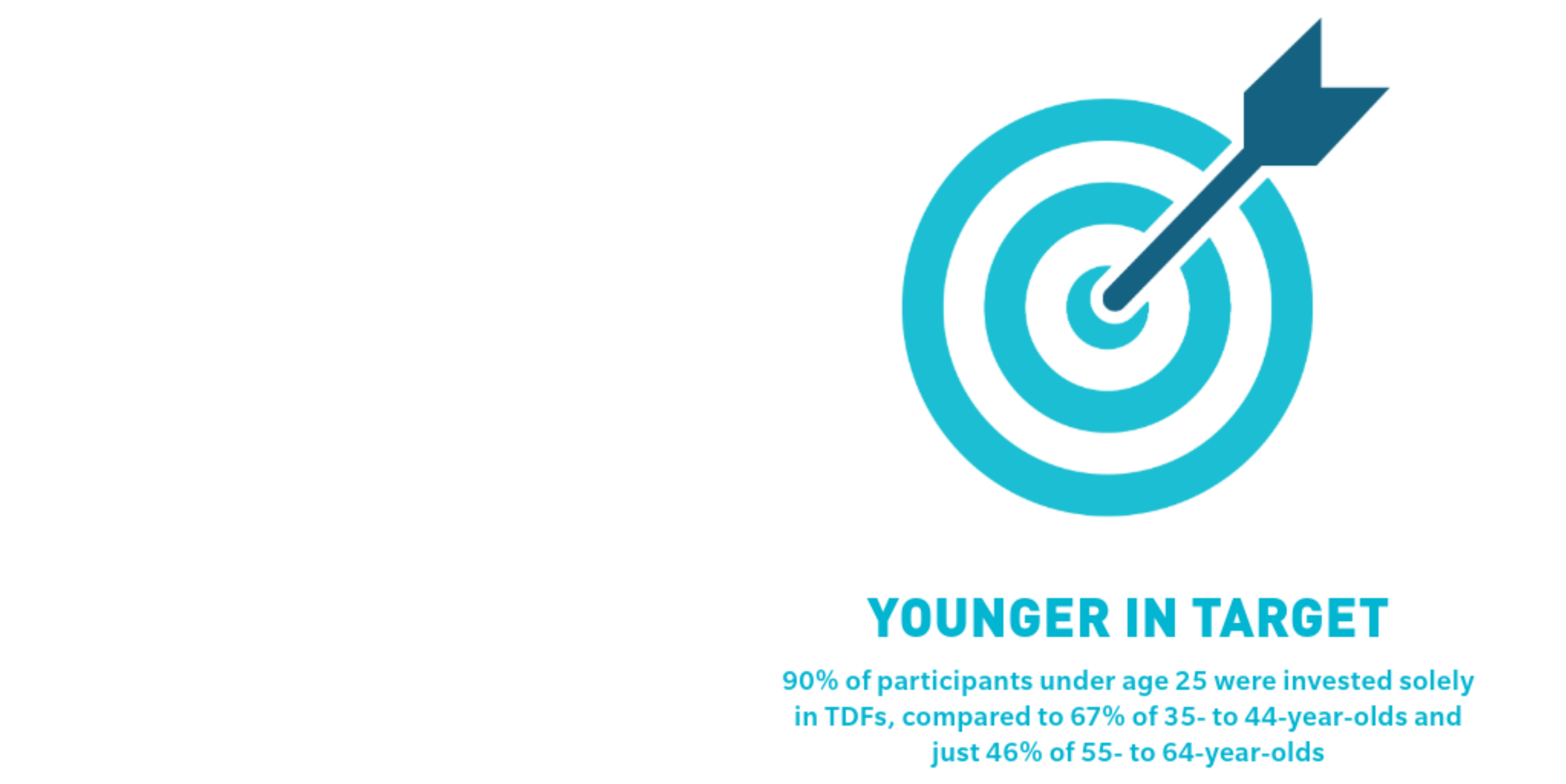
In 2025, 85% of retirement plan participants had at least some of their balance in a target date fund, up from 83% in 2022. Adoption skews widely by age, however: 90% of participants under age 25 were invested solely in TDFs, compared to 67% of 35-to-44-year-olds and just 46% of 55–to-64-year-olds. (Source: Vanguard)
|
1. 401(K) HIGHS. The average 401(k) balance in Fidelity 401(k)s was $155,800 in Q2, a 10.5% increase versus Q1. The number of 401(k) millionaires hit a record high of 769,000, a 19% increase. The average total savings rate was unchanged at a record 14.4%, with a record employee savings rate of 9.6. (Source: Fidelity)
2. PEP IN PEPS. Pooled employer plans (PEPs), created under the SECURE Act of 2019 and available to employers since 2021, let unrelated businesses pool together under a single 401(k) plan. Recordkeepers are bullish on their prospects, as 64% expect PEPs to boost their business in 2026,accounting for 20%-40% of business growth. (Source: Cerulli Associates)
3. GOP SHIFT ON SOCIAL SECURITY.A growing number of Republicans, including Sen. Moreno (R-OH) and Reps. Cole (R-OK) and Smucker (R-PA), have said they would consider raising Social Security payroll taxes. Eliminating the $184,500 payroll tax cap without increasing benefits would close 67% of the program’s 75-year solvency gap; with a benefit increase, that drops to 48%. Only about 6% of workers earn above the cap each year. (Source: CNBC)
4. FLAT COLA. Social Security’s annual Cost-of-Living Adjustment (COLA) has not kept up with actual inflation, as benefits have lost 13.7% of their buying power over the last 10 years. Items that have seen the greatest increase in price since 2016 include golf balls (301%) and coffee (186%), but housing and cars have had the largest dollar impact. (Source: The Senior Citizens League)
5. EARLY (UNPLANNED) RETIREMENTS. Among middle-class (i.e., annual income between $50K and $200K) Americans who are still working, 33% expect to either retire after the age of 70 or not at all. Among middle-class Americans who have already retired, 48% retired sooner than originally planned, with 53% citing employment-related reasons. (Source: Transamerica)
6.SOLO RETIREMENT. Most US retirement planning frameworks have been written with couples in mind, but Americans are increasingly approaching or entering retirement as singles. 28% of Americans 65 and older live alone compared to 10% in 1950. About a third of Americans between 45 and 62 are single, and 12% of adults over the age of 50 have no spouse and no children. (Source: Forbes)
7. A MODERATE WINDFALL. Moderate-income earners (i.e., $50K–$100K) pay only 9.1% of federal income taxes but capture 30.1% of retirement tax benefits from 401(k) plans, or more than 3x their tax share. High earners ($200K+) pay 71.4% of the taxes but get just 16.7% of the benefits, less than a quarter of the total. (Source: American Retirement Association)
8. SHORT-STAFFED. The American Federation of Government Employees union has called on Congress to add $3 billion in funding and 20,000 workers to the Social Security Administration to support its digital-first agenda and streamline operations through technology. During President Trump’s second term, the SSA’s staffing level has fallen by 14%, or 7,945 workers, to a 63-year low of 49,439. (Source: MarketWatch)
9. AGING INTO FLORIDA. In a study of US cities where residents 65 and older number at least 7,500 and account for over 20% of the population, Florida reigned supreme, accounting for 11 of the 30 fastest-growing retirement cities. The largest city on the list was Port St. Lucie, FL with 232,491 residents, while Englewood, FL had the highest density of 65+ residents, who account for 60.1% of the population. (Source: MoneyLion)
QUESTION: When employees were asked what benefits would make them more likely to stay with their employer over the next two years, where did increased retirement savings match/contributions rank relative to other factors (e.g., four-day work week, working remotely, and flexible workday hours)?
Keep in mind that all investments, including mutual funds, carry a certain amount of risk including the possible loss of the principal amount invested.
These views should not be relied upon as investment advice, as securities recommendations, or as an indication of trading intent on behalf of any other MFS investment product. No forecasts can be guaranteed. Past performance is no guarantee of future results.
MFS® does not provide legal, tax or accounting advice. Clients of MFS should obtain their own independent tax and legal advice based on their particular circumstances. This has been provided for informational purposes only, and reflects the current opinion of the author, which is subject to change without notice, as are statements of financial market trends, which are based on current market conditions. Past performance is no guarantee of future results. Integrated Retirement is not affiliated with MFS Investment Management® or any of its subsidiaries.
Distributed by: U.S. - MFS Fund Distributors, Inc., Member SIPC, Boston, MA.
Please note that in Canada this document is intended for distribution to institutional clients only. Note to readers in Canada: Issued in Canada by MFS Investment Management Canada Limited.
Note to readers in Canada: Issued in Canada by MFS Investment Management Canada Limited.