
The AI Revolution and the Future of Growth Investing
AUTHOR
Brad Mak
MFS Growth Portfolio Manager
In a recent podcast, seasoned growth investor Brad Mak shared his perspective on the rapidly evolving landscape of growth investing, emphasizing the transformative impact of artificial intelligence (AI), the opportunities it presents across industries, and a roadmap for navigating the current wave of technological and industrial disruption.
The AI Transformation: A New Era of Disruption
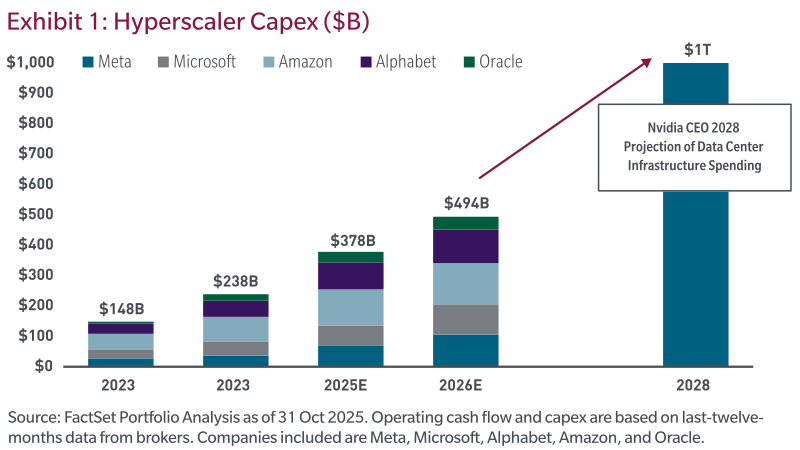
Mak highlighted the distinct nature of the current AI-driven market environment compared to past technological revolutions, such as the internet boom of the late 1990s or the rise of smartphones and cloud computing in the 2000s. Unlike those periods, where new disruptors emerged to challenge incumbents, today’s AI transformation is being led by megacap technology companies. These scaled incumbents are making unprecedented investments in AI infrastructure, with hyperscalers expected to spend nearly $400 billion on capital expenditures (CapEx) in 2025, representing around 60% growth this year and another 30%–40% of growth projected in 2026. Mak believes we are currently in year three of a five-to-seven-year AI CapEx buildout phase.
AI’s Ripple Effect: Growth Beyond Technology
While AI is often associated with the technology sector, Mak noted that its impact is extending into traditionally low-growth industries such as energy and capital goods. For instance, the energy sector, which has historically grown at a modest 1–2% annually, is now forecasted to grow 3-4% due to increased demand from AI and electrification. Similarly, capital goods companies are benefiting from longer cycles tied to datacenter buildouts and the development of physical AI applications, such as robotics, electric vehicles, and autonomous systems. These shifts are creating new opportunities for growth investors to explore beyond the traditional technology sector.
The Rapid Growth of AI Revenues
Mak highlighted the explosive growth of AI-related revenues, citing OpenAI as a prime example. The company, which generated around $1 billion in revenue in 2023, is projected to reach $12–15 billion in 2025. Similarly, the next-largest AI company, Anthropic, is expected to generate somewhere between $7–10 billion in 2025. Then there is a long tail of other private companies expected to generate around $3-5 billion. This rapid growth is a testament to the transformative potential of AI and its ability to create entirely new markets and revenue streams.
Real-World AI Adoption: Transforming Industries and Labor Markets
Mak emphasized that AI adoption is transitioning from experimentation to real-world usage across a variety of industries. In healthcare, AI tools are automating medical documentation and assisting with diagnoses, significantly improving productivity for physicians. In the legal sector, AI is streamlining workflows and replacing or augmenting the work of entry-level legal associates. In financial services, tools are enhancing research processes and reducing the need for junior analysts. These advancements don’t necessarily mean labor displacement, however — AI is also making existing workforces more efficient, reshaping the labor market rather than causing widespread layoffs.
On the consumer side, Mak pointed to the growing popularity of AI-powered applications like ChatGPT, Google’s Gemini, and Perplexity. These tools are currently generating revenue through premium subscriptions but may be poised to revolutionize industries like e-commerce and advertising. For example, agentic search tools are beginning to integrate product recommendations, advertising, and even direct purchasing within apps, creating new growth opportunities in e-commerce and search industries.
Addressing Valuation Concerns and Managing Risks
Mak addressed concerns about a potential AI “bubble,” noting that current valuations for leading AI companies remain far below historical peaks seen during past tech booms. Instead, he suggested that the key question to focus on is the duration of the AI CapEx cycle and whether the anticipated growth of AI-driven revenues will justify the investment. While systemic risks such as demand-side slowdowns, supply-demand mismatches, and circular financing structures exist, Mak emphasized that debt financing currently accounts for only 15% of datacenter CapEx, suggesting that systemic risk remains limited.
Mak also discussed the importance of conducting “pre-mortems” to evaluate potential risks and prepare for various scenarios. His team is closely monitoring factors such as demand-side slowdowns, overcapacity, and other systemic shocks that could disrupt the AI ecosystem. By staying vigilant and leveraging MFS’ global research platform, Mak and his team believe they are well-equipped to navigate these risks and adapt to the rapidly changing market environment.
Looking Ahead: The Adoption Phase and Beyond
As the AI transformation progresses, Mak is optimistic about the adoption phase, which he believes will be driven by enterprise and consumer use cases delivering measurable returns on investment. He emphasized the importance of identifying companies that can benefit from bottlenecks in the AI build-out, such as labor shortages and supply chain constraints, which are extending the duration of the cycle and creating opportunities for growth. Mak also highlighted the value of collaboration across sectors and regions, leveraging insights from a global research platform to identify risks and opportunities as the AI transformation continues to evolve.
Beyond AI: Other Areas of Secular Growth
While AI is a dominant theme in growth investing, Mak also highlighted that there remain many areas of secular growth that excite him. In health care, advancements in medical devices, life sciences tools, and pharmaceuticals are driving innovation and creating new opportunities. The commercial aerospace and defense sectors are also experiencing robust growth. Even traditionally slow-growth industries like tobacco and beverages are undergoing transformation, with the rise of smokeless tobacco products and the expansion of the energy drink market into health and wellness.
Conclusion: A Long-Term View on AI and Growth Investing
In summary, Brad Mak’s insights underscore the vast potential of AI to drive growth across industries while highlighting the importance of identifying opportunities in other sectors undergoing innovation and transformation. For growth investors, the key lies in navigating these disruptions and positioning portfolios to benefit from both the AI revolution and broader secular trends. Mak remains confident in AI’s long-term potential to transform the global economy, but he emphasizes the importance of vigilance in managing risk and adapting to the rapid pace of change. Mak believes that by focusing on companies that can capitalize on the AI build-out and adoption cycles, growth investors can position themselves to benefit from this transformative technology while ensuring their portfolios are resilient in a fast-evolving market.
The views expressed are those of the speaker and are subject to change at any time. These views are for informational purposes only and should not be relied upon as a recommendation to purchase any security or as a solicitation or investment advice from the Advisor. No forecasts can be guaranteed. Past performance is no guarantee of future results.