
In brief
- Today’s index concentration reflects concentrated profits and investors’ belief in their duration — not passive flows
- Competition eventually lowers returns and diffuses profit leadership
- AI may accelerate this process by lowering barriers to entry and enabling new competition
Indices Are Scoreboards of Profits
I often hear that today’s index concentration is a consequence of market-cap-weighted index construction and the growth of passive investing. That confuses the mechanism that records concentration with the economics that create it.
Index concentration begins in the real economy. A small number of companies capture a disproportionate share of corporate profits and free cash flow. Investors then assign premium valuations to those profits because they expect superior growth and returns on capital to persist. Only then does a market-cap- weighted index become concentrated.
Put simply, market-cap concentration reflects two things: profit concentration and the valuation investors place on the expected duration of those profits.
As Exhibit 1 shows, the combined market-cap share of the S&P 500’s 10 largest constituents has generally moved with those same companies’ share of index profits.
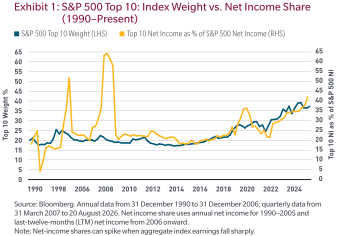
The late 1990s is instructive. Concentration rose sharply when passive investing was far less prevalent than today. The common ingredients between then and now are concentrated profits and confidence in their durability, not a particular investment vehicle.
Market-cap concentration can also diverge from profit concentration as investors change the duration and multiple they assign to earnings. In the late 1990s, market-cap concentration briefly ran ahead of profit share; today the two are more closely aligned. The question is how durable those profits are.
Passive flows may reinforce existing weights, but they do not create demand, pricing power, margins, or returns on invested capital. An index does not determine which companies win customers or earn superior economics. It records the result. If profits are the game, the index is the scoreboard.
How Index Concentration Breaks
A business’s exceptional returns attract capital and new entrants. Capital builds supply, giving customers more alternatives, pressuring pricing and forcing incumbents to spend more to defend their positions. Eventually, the return on the next dollar invested falls, even if returns on existing assets remain high for a time.
That is the capital cycle, as we have written about extensively in recent years. Railways and telecommunications transformed the economy, but the investment and competition they attracted eventually created excess capacity and diluted returns. Technology was real and enduring, but what proved less durable was the assumption that extraordinary profits would remain concentrated indefinitely.
The largest companies do not need to disappear or stop growing to break concentration. They only need to capture less incremental profit, spend more to defend their position (as we are witnessing today), earn lower returns on new investment (also happening today) or receive a lower valuation (already happening too) as investors shorten the expected duration of their competitive advantages.
Concentration does not end because it is high. It ends when the competitive landscape changes.
AI Accelerates the Cycle
AI is accelerating that change. Investors have focused on what AI can do for today’s leaders but may be underestimating how it allows tomorrow’s competitors to gain ground.
AI is lowering the minimum scale required to start and operate a business. Capabilities that once required a large organization and fixed headcounts, from research and coding to marketing, customer service, and administration, can increasingly be rented or automated. AI does not guarantee that a new business will succeed, but it reduces the cost of trying. And we are witnessing a surge of attempts today.
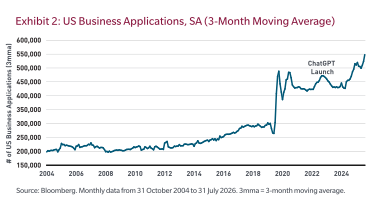
The rise in applications to start new US businesses is therefore worth watching. While an application is not a functioning company, and the timing does not prove that AI caused the increase, the trend is consistent with falling barriers to starting a firm and challenging established profit pools.
Indices Own the Donor First
It’s important to note that many firms attacking the profit pools of today’s incumbents remain private. The benchmark can therefore own the profit donor at a large weight years before it owns the profit taker.
There may never be one obvious taker. Many smaller competitors can collectively fragment an incumbent’s market, pressure prices, and transfer some of the surplus to customers. Economic value can rise while the share captured by today’s index leaders falls.
Not every moat will weaken. As we have emphasized in multiple Strategist Corners this year, proprietary data, trusted workflows, regulated systems, distribution, and customer relationships may become more valuable as AI proliferates. The opportunity lies in distinguishing companies whose advantages strengthen from those whose returns prove less durable than investors assume.
The key question is not which companies will adopt AI. Nearly all will, and the successful ones will have the right mix of human and token capital. It is which companies’ growth, margin, and return assumptions remain reasonable in a world of higher costs and greater competition.
Many active portfolios therefore hold less than benchmark weights in the largest companies. This is not necessarily an aversion to size but a reflection of an unwillingness to assume that extraordinary profitability will persist indefinitely. That discipline can be a performance drag while profits and index weights continue to concentrate, but it can be rewarded when the capital cycle turns, returns decline, and market leadership changes. A cap-weighted index adapts only after prices move while active managers can position before the scoreboard changes. They do not need to identify every future profit taker. Avoiding future profit donors may be just as important.
Conclusion
Passive flows may amplify today’s concentration, but they did not create the profit pools beneath it and cannot preserve them when competition changes the economics. And just like in the past, competition, not index mechanics, will determine how today’s concentration ends. Passive investing simply records the outcome.
The S&P 500 Index measures the broad US stock market. It is not possible to invest directly in an index.
“Standard & Poor’s®” and S&P “S&P®” are registered trademarks of Standard & Poor’s Financial Services LLC (“S&P”) and Dow Jones is a registered trademark of Dow Jones Trademark Holdings LLC (“Dow Jones”) and have been licensed for use by S&P Dow Jones Indices LLC and sublicensed for certain purposes by MFS. The S&P 500® is a product of S&P Dow Jones Indices LLC, and has been licensed for use by MFS. MFS’s Products are not sponsored, endorsed, sold or promoted by S&P Dow Jones Indices LLC, Dow Jones, S&P, or their respective affiliates, and neither S&P Dow Jones Indices LLC, Dow Jones, S&P, their respective affiliates make any representation regarding the advisability of investing in such products.
The information included above as well as individual companies and/or securities mentioned should not be construed as investment advice, a recommendation to buy or sell or an indication of trading intent on behalf of any MFS product.
Keep in mind that all investments carry a certain amount of risk, including the possible loss of the principal amount invested.
The views expressed are those of the author(s) and are subject to change at any time. These views are for informational purposes only and should not be relied upon as a recommendation to purchase any security or as a solicitation or investment advice. No forecasts can be guaranteed. Past performance is no guarantee of future results.
AUTHOR
Robert M. Almeida
Portfolio Manager and Global Investment Strategist